
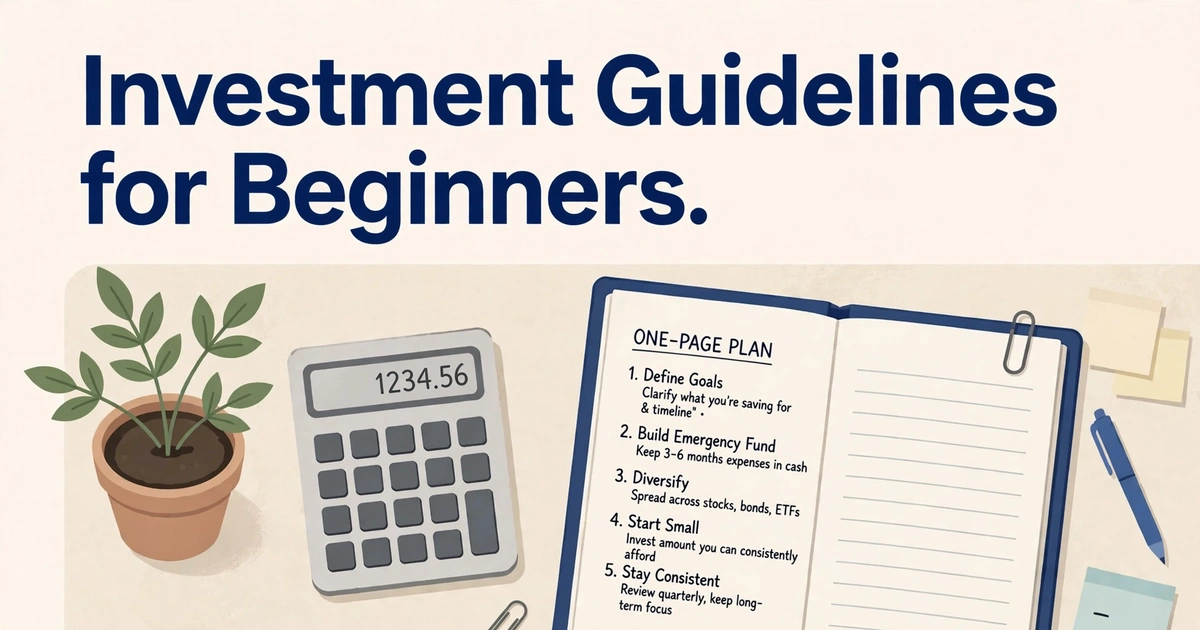
Investment Guidelines for Beginners: A Complete Guide
Say you’ve just received a $3,000 year-end bonus, and a coworker insists you put all of it into one hot stock. Before you act on that, it helps to have a few investment guidelines for beginners that hold up no matter which asset you eventually choose. Investing means putting money into assets such as funds, stocks, or bonds in the hope they grow over years, with no promise that they will. This guide covers the order of operations, the math on fees and drops, and the habits that do the most damage. It draws on widely taught investing concepts, not personal results.
Five Guidelines to Settle Before Your First Purchase
- Cover emergency expenses and high-interest debt before you invest.
- Tie every investment to a date when you’ll need the money.
- Spread your money across many holdings, not one.
- Count fees and taxes, because they compound against you.
- Decide in advance how you’ll react when your balance falls.
Saving, Investing, and Speculating Are Three Different Jobs
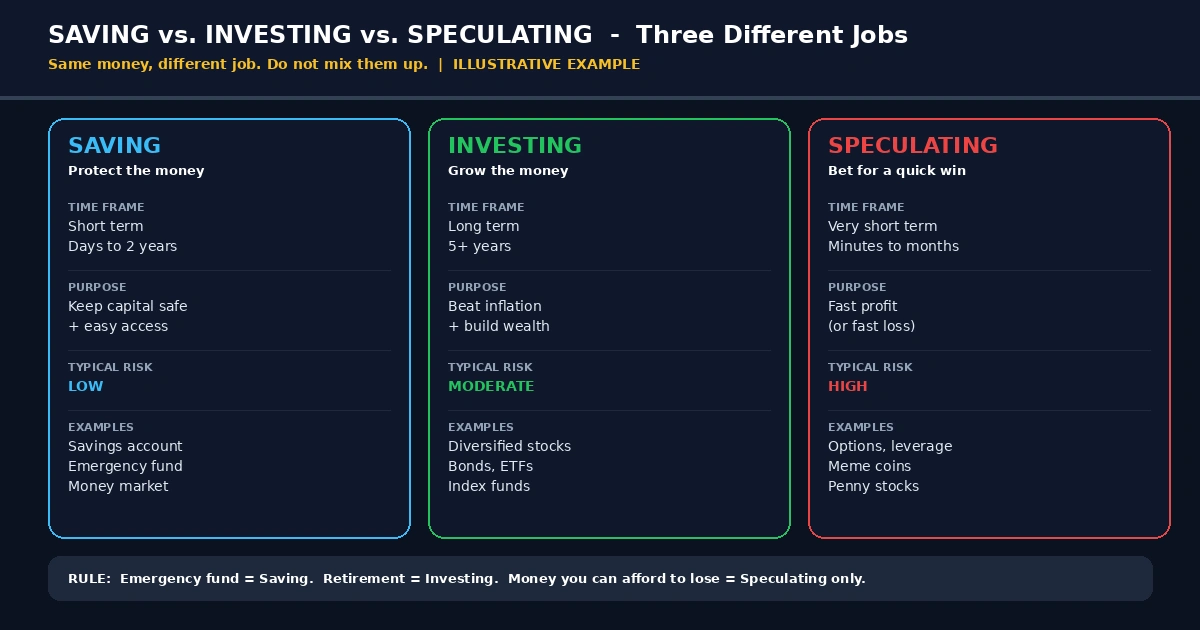
Saving protects money you’ll need soon. Investing aims to grow money over a longer period and accepts that values will swing along the way. Speculating is a short-term bet on price direction, often with borrowed money.
Mixing these up is where many beginners get hurt. Rent money placed in a volatile asset is a speculation, even if you call it an investment. If you want the fundamentals first, read about what investing means and how it differs from trading.
One more distinction matters on this platform. Leveraged forex or CFD trading is short-term speculation, and losses can arrive much faster than in an unleveraged, diversified portfolio. This guide is about the slower side of the ledger.
Build the Cushion Before You Buy Anything
Money you might need within a few months doesn’t belong in the market. A forced sale during a downturn turns a temporary dip into a permanent loss.
Many financial educators suggest holding several months of essential expenses in cash before investing. The right amount depends on your job stability, dependents, and costs, so treat any number as a starting point, not a rule.
High-interest debt deserves the same attention. If a credit card charges more than you could reasonably expect an investment to earn, paying it down is a guaranteed saving, while investment returns are uncertain.
Match the Money to the Date You’ll Need It
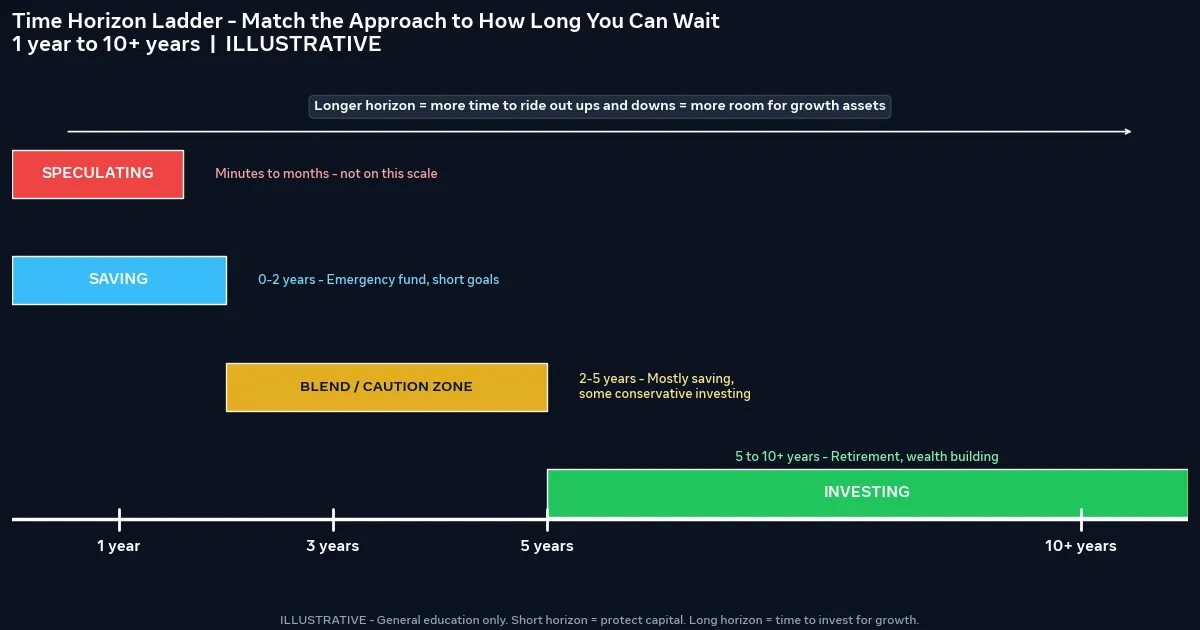
Time horizon is the length of time before you need the money. It shapes how much price swing you can absorb.
| When you’ll need it | What many people consider | Main concern |
|---|---|---|
| Within 1–2 years | Cash or cash-like holdings | Inflation slowly eating value |
| 3–7 years | A mix of lower- and higher-volatility holdings | A downturn landing near your deadline |
| 10+ years | Broadly diversified growth-oriented holdings | Selling in a panic during a long decline |
This table describes common thinking, not a recommendation for your situation. The longer your horizon, the more time you have to recover from declines, though recovery is never guaranteed. For more on this, see long-term investing explained.
One Holding Is a Bet, Not a Portfolio
Diversification means spreading money across many assets so that one failure doesn’t sink the whole plan. If your entire $3,000 sits in a single company and that company stumbles, there is nothing to cushion the fall.
Many beginners use broad funds, which bundle hundreds or thousands of securities into one purchase. Before you buy one, check three things:
- What it holds
- Its annual cost
- Whether you understand how it behaves in a falling market
Diversification can help reduce the damage from any single failure. It cannot prevent losses when the whole market falls.
Also watch for hidden concentration. Owning five funds that all hold the same large companies isn’t much spreading at all. The same goes for holding your employer’s stock in your retirement account while your paycheck depends on that employer too.
A Hypothetical 1% Fee Over Twenty Years
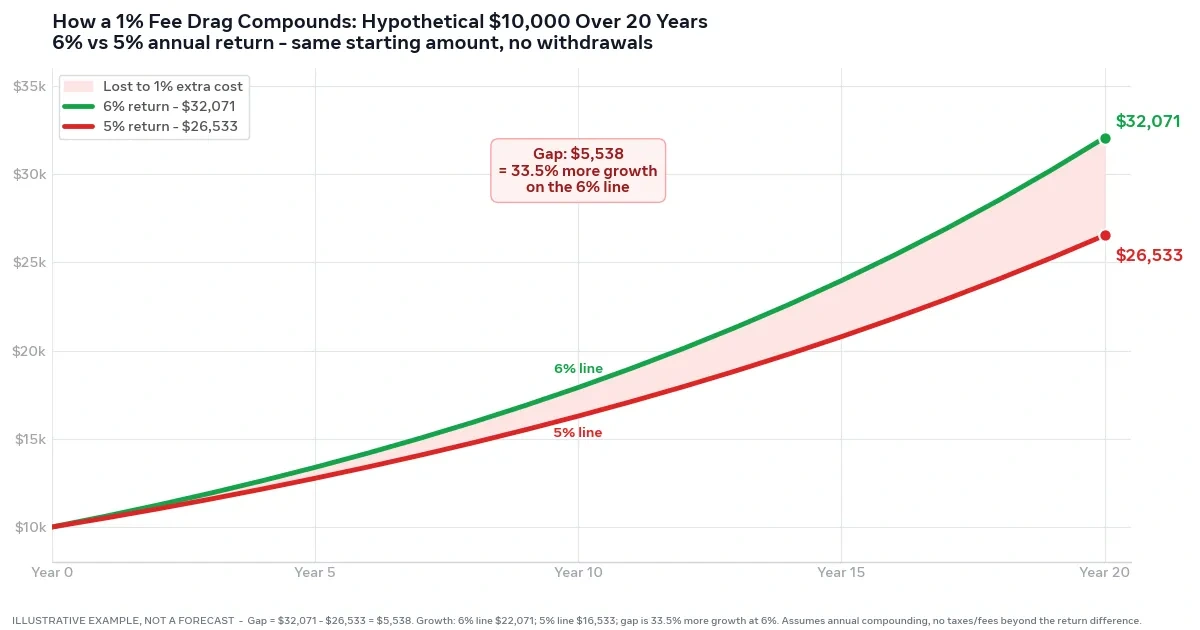
Fees look tiny on paper, which is why they get ignored. Here’s what the gap can look like.
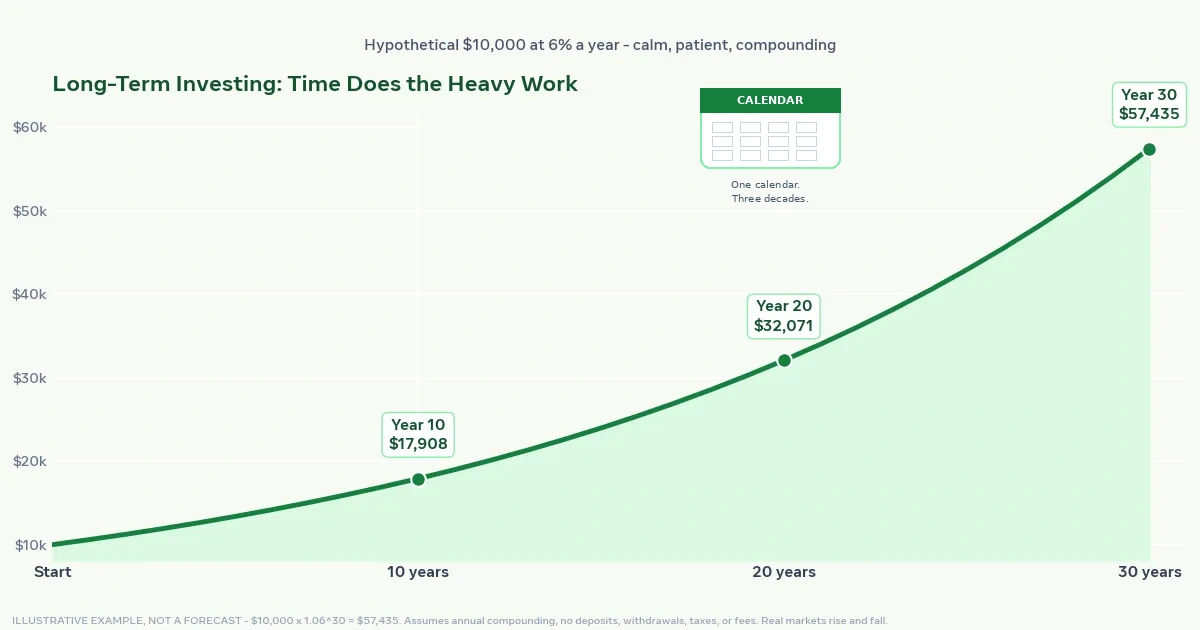
Imagine a $10,000 lump sum that grows at 6% a year for 20 years with no extra contributions. It reaches about $32,071. Now charge a 1% annual cost, so the net growth is 5%. The same $10,000 reaches about $26,533. The difference is roughly $5,538, or more than half your original amount, lost to cost alone.
This is a hypothetical example for illustration only. Real returns vary every year, and fees vary by provider, so check the cost of any fund or account before you buy. Taxes work the same way: how and when gains are taxed depends on your country and account type, so look up your local rules.
Buying in Slices: A Three-Month Hypothetical
Contributing a fixed amount on a schedule is often called dollar-cost averaging. It removes the pressure of picking the perfect day to buy.
Suppose you invest $300 a month into a fund whose price is $50 in month one, $40 in month two, and $60 in month three. You buy 6 shares, then 7.5 shares, then 5 shares, for a total of 18.5 shares on $900 invested. Your average cost is about $48.65 per share, slightly below the simple average price of $50 because more shares were bought when the price was lower.
This is a hypothetical example for illustration only. The method has a real drawback: if prices rise steadily, money waiting to be invested misses some of the gains. Neither approach wins in every period. Regular contributions mainly help with discipline and reduce regret about timing.
What a 30% Drop Feels Like at Your Balance
Risk tolerance is how much decline you can live through without abandoning your plan. It’s easy to claim a high tolerance when markets are rising.
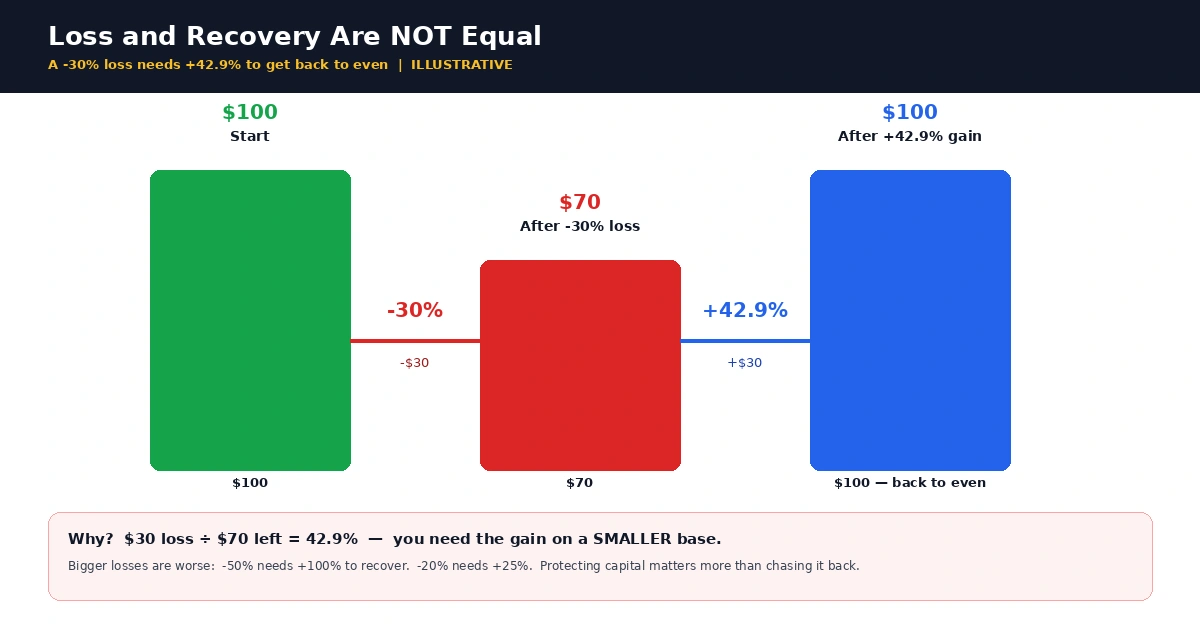
Picture a hypothetical $5,000 portfolio that falls 30%. It’s now worth $3,500. To get back to $5,000, it must gain about 42.9%, because the recovery starts from a smaller base. A 30% loss isn’t repaired by a 30% gain. This is a hypothetical example for illustration only.
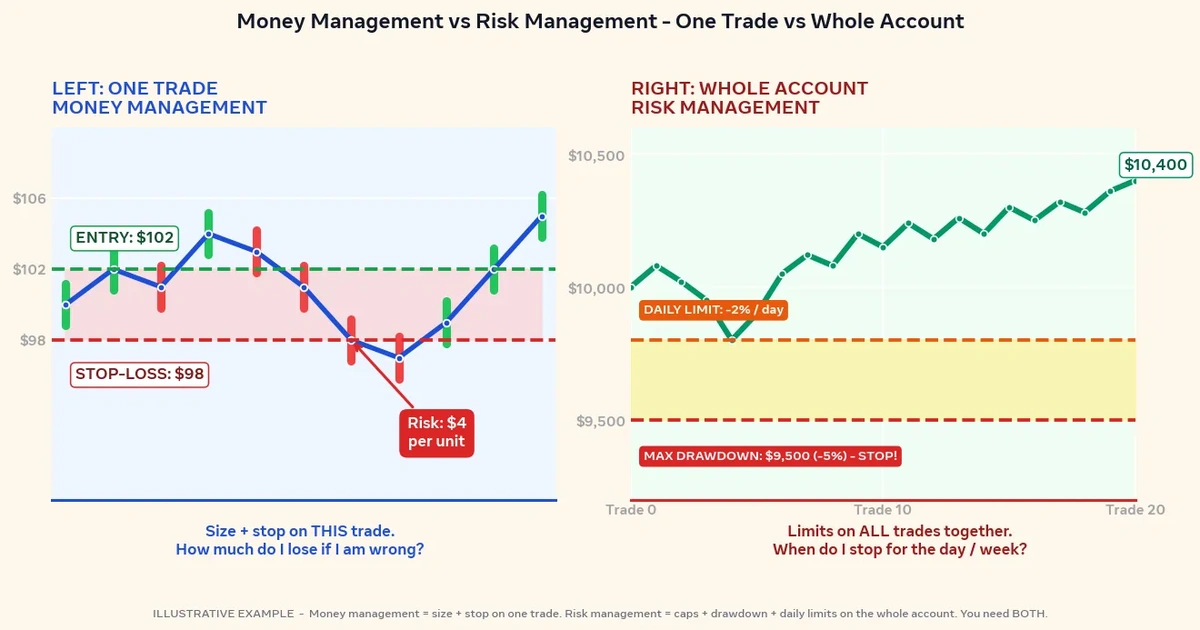
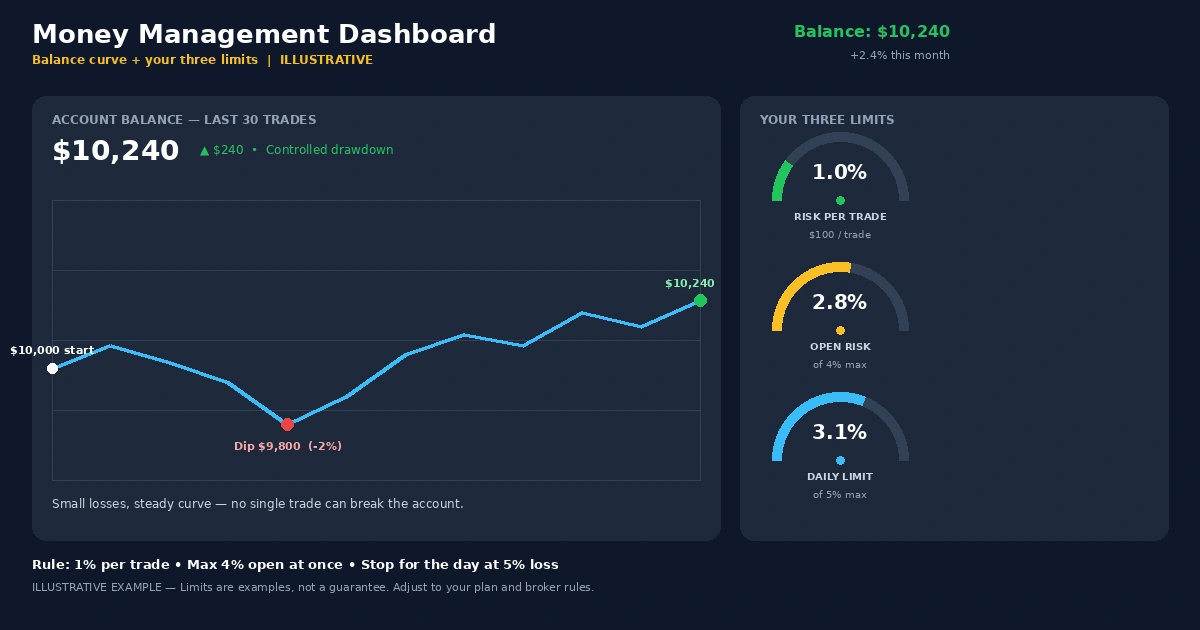
Ask yourself in advance: would you sell at $3,500, hold, or add more? Write the answer down. If the honest answer is “sell in a panic,” your portfolio may be taking more risk than you can handle. Sizing positions and limiting exposure are the same ideas covered in forex risk management, and they apply here too.
Habits That Hurt a New Portfolio
- Investing the emergency fund. A car repair or job loss can force you to sell at a bad moment.
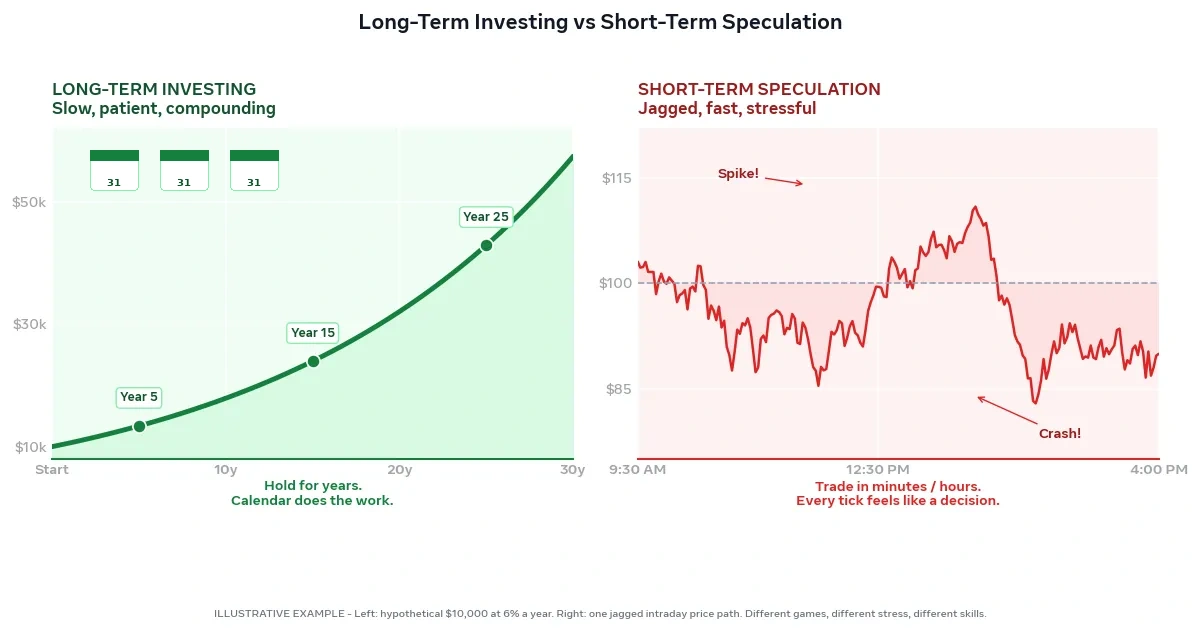
- Chasing last year’s winner. Strong recent performance doesn’t predict future results, and the hottest asset is often the most crowded one. The gap between long-term investing and short-term speculation, covered in this comparison, is where this habit lives.
- Checking balances daily. Constant monitoring turns normal swings into emotional events and encourages impulsive selling.
- Borrowing to invest. Margin and leverage magnify gains and losses alike, and you can lose more than you expected.
- Ignoring costs. Small annual fees, trading charges, and account fees compound against you.
- Following tips from strangers. If you can’t explain why you own something in two sentences, you don’t understand it well enough yet.
How a Beginner Portfolio Can Still Lose Money
Even a careful plan has real risks:
- Market risk: Broad declines can hit nearly every holding at once, and some periods take years to recover from.
- Timing risk: A downturn near the date you need the money can force you to sell at a loss.
- Inflation risk: Money held too conservatively can lose buying power over time.
- Concentration risk: Too much in one company, sector, or country raises the damage from a single failure.
- Leverage risk: Borrowed money can magnify losses, and in some cases you can lose your entire deposit.
- Scam risk: Promises of high, steady returns with little risk are a classic warning sign. Verify any firm with your local regulator before you send money.
- Behavior risk: Panic selling and impulsive buying often cost more than any single bad pick.
There is no guarantee in any of this, and results vary by person, market, and period.
Starting-Out Questions About Investing, Answered
How much money do I need to start investing?
There’s no universal minimum. Many providers allow small starting amounts, though minimums and fees vary by provider. What matters more than the starting size is that the money is truly spare and that you’ve covered emergency needs first. Beginning small lets you learn how price swings feel before larger amounts are at stake.
Should I pay off debt or invest first?
It depends on the interest rate and your situation. High-interest debt often costs more than you can reasonably expect to earn, so many educators suggest tackling it first. Low-interest debt is a closer call. A licensed financial professional can help weigh your specific numbers.
Is investing safer than forex trading?
Neither is safe. They carry different risks. Diversified, unleveraged investing over many years usually moves more slowly. Leveraged forex and CFD trading can lose money quickly, sometimes more than a deposit’s worth in extreme cases. Match the approach to your goal, time horizon, and tolerance for loss.
How often should I check my investments?
Reviewing on a schedule, such as quarterly or twice a year, is a common approach. Checking constantly tends to increase stress and impulsive decisions. Your review should ask whether your goal, time horizon, or finances have changed, not whether prices moved this week.
What does a diversified portfolio look like?
It holds many assets that don’t all move together, such as different companies, sectors, regions, or asset types. Broad funds are one common way to get there. Diversified doesn’t mean protected: all holdings can fall at the same time in a severe downturn.
Start With the Plan, Then the Purchase
Beginners rarely lose money because they picked the wrong fund. They lose it because they had no plan for when to sell, how much to put in, or what to do when prices fell. Before you invest anything, write one page covering your goal, your target date, the amount you’ll contribute, and what you’ll do if your balance drops 30%. Keep it where you’ll see it. That page will do more for you than any hot tip.
Disclaimer
This article is for educational purposes only and is not financial advice. Forex and CFD trading involves a high level of risk, and you can lose some or all of your capital. Leverage can magnify both gains and losses. Never trade with money you can’t afford to lose.
This is educational content, not personalized investment advice. Your financial situation, goals, and local regulations are different, so consider speaking with a licensed financial professional before making decisions.
Any percentages or figures shown are historical averages or hypothetical examples, not guarantees. Past performance does not predict future results.
Join now
Comments (0)
Be the first to comment.