
Money Management vs Risk Management: What Is the Difference?
Plenty of traders place a stop-loss on every trade and still watch their balance shrink month after month. The stop isn’t failing. It’s answering a smaller question than the one the account is asking. That gap is the heart of money management vs risk management: one protects each trade, the other protects everything those trades add up to. The two terms get used as synonyms, so many traders build one layer and assume they have both. This article separates them, shows where they overlap, and shows what a missing layer looks like in numbers.
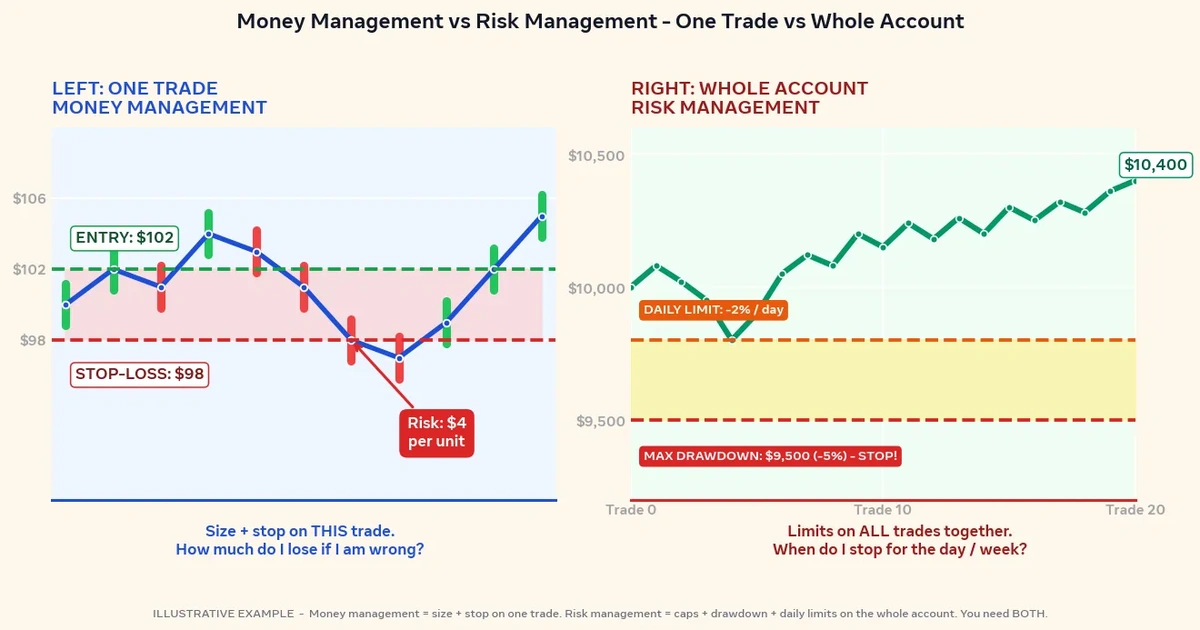
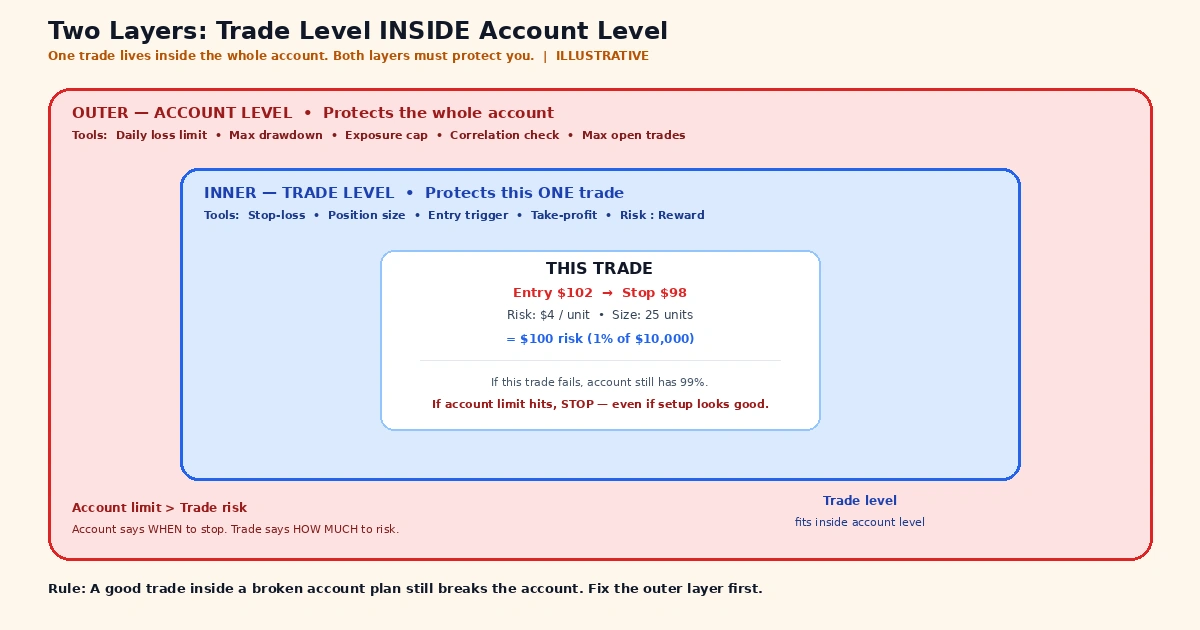
One Protects the Trade, the Other Protects the Account
- Risk management limits what a single trade can cost: stop-loss placement, position size, and leverage choices.
- Money management governs the account as a whole: how much you fund, total open risk, loss limits, scaling rules, and withdrawals.
- Position sizing sits in the overlap. Both layers use it, but they ask different questions of it.
- Tight stops with no account-level rules can still allow a deep drawdown. The two layers work as a pair.
Risk Management Lives Inside the Trade
Risk management answers one question before every entry: what does this trade cost if I’m wrong? You answer it with three tools.
A stop-loss is an order that closes a trade at a preset price to cap the loss. Position sizing is choosing the trade size so that hitting the stop costs a planned amount. Leverage lets you control a larger position than your deposit alone would allow, which magnifies gains and losses alike.
Here’s a hypothetical case. A $4,000 USD account risks 1% ($40) on a GBP/USD trade with a 20-pip stop. A pip is the standard unit of price movement (0.0001 on most pairs), and on a USD account one pip is worth about $10 per standard lot. So the size is 40 ÷ (20 × 10) = 0.20 lots. That’s the whole job of this layer: know where you’re wrong, and size so that being wrong is affordable. This is a hypothetical example for illustration only.
Stops aren’t perfect. Fast markets and gaps can fill them at worse prices than planned. For the full toolkit, see this forex risk management guide.
Money Management Sets the Rules for the Next Hundred Trades
Money management zooms out. It doesn’t ask what one trade costs. It asks what the account can absorb over weeks and months, and what you’ll do when it takes a hit.
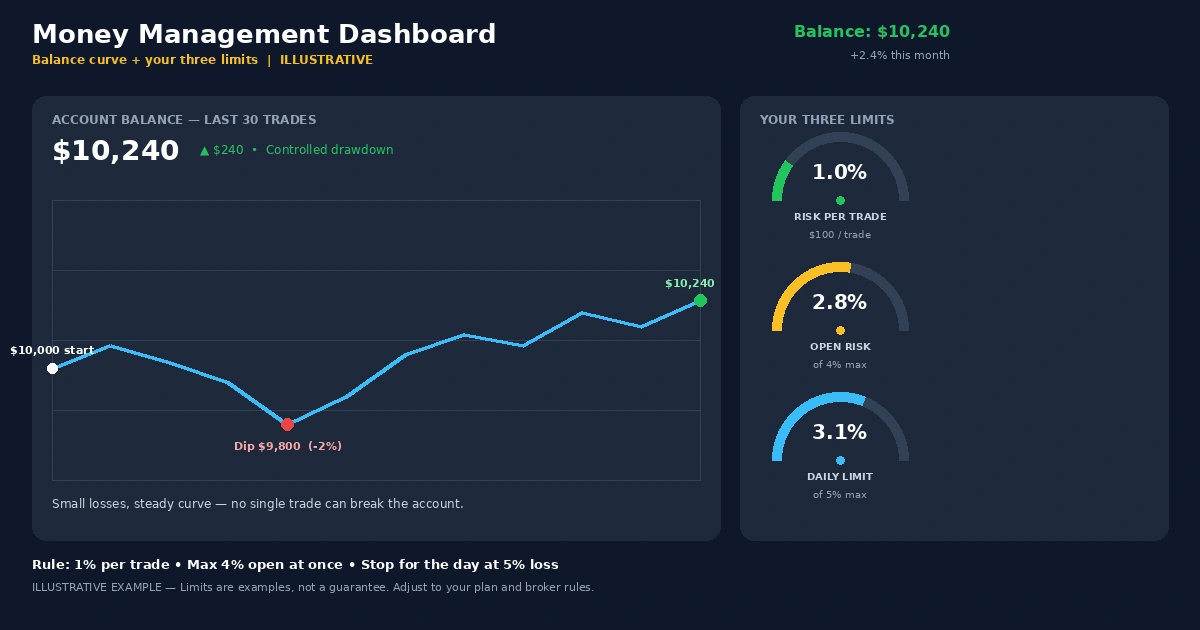
The decisions here include how much of your money is trading capital, the percentage you risk per trade, the most you’ll have at stake across all open trades, daily and weekly loss limits, the drawdown (the drop from your account’s peak to a later low) that triggers a pause or a smaller size, and how and when profits leave the account.
None of these decisions belongs to a specific trade. They apply whether the setup looks perfect or mediocre, and that’s their purpose: they’re made once, calmly, so you aren’t inventing them mid-streak. The full account-level framework is in this money management in trading guide.
Scope, Tools, and Time Horizon in One Table
| Aspect | Risk management | Money management |
|---|---|---|
| Core question | What can this trade cost? | What can the account absorb? |
| Scope | One trade or position | All trades, plus the capital behind them |
| Typical tools | Stop-loss, trade size, leverage limit | Risk percentage, open-risk cap, loss limits, withdrawal rule |
| Time horizon | Entry to exit | Weeks, months, and the account’s lifespan |
| Example rule | “Stop sits beyond the last swing low” | “Stop trading for the day after a 2% loss” |
| Weak spot | Many small capped losses can still pile up | Rules mean little if single trades are oversized |
Where the Two Overlap, and Why the Line Blurs
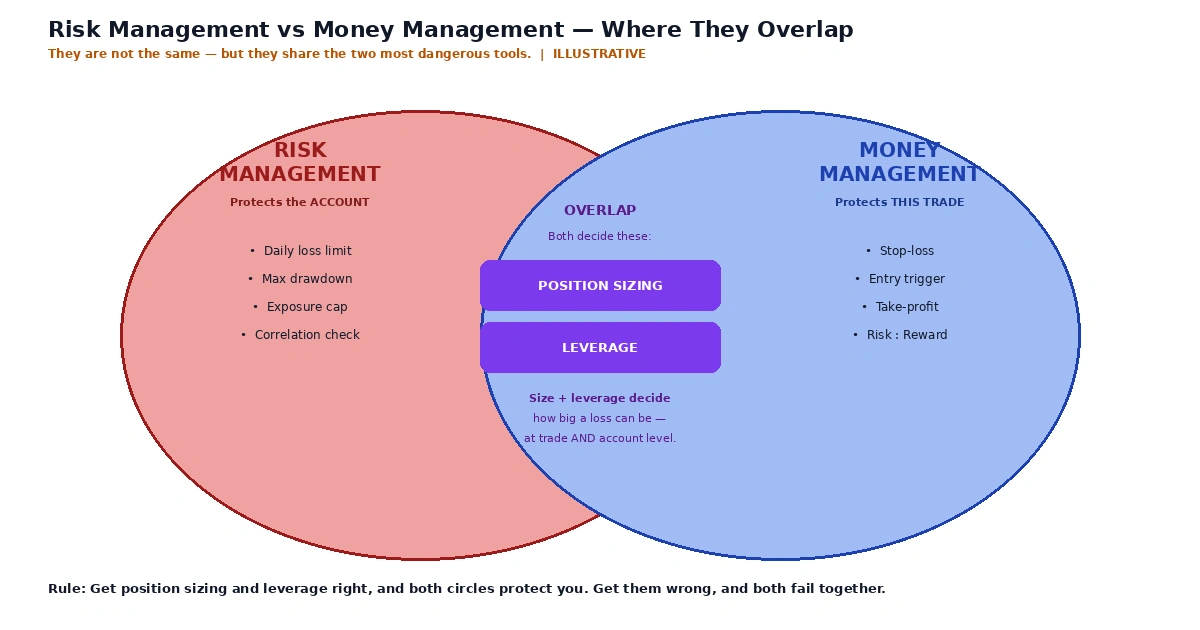
The confusion is understandable, because several tools live on the border.
Position sizing is the clearest case. The percentage you risk, say 1% of the account, is a money management decision. Turning that percentage into a lot size for a specific stop distance is risk management at work. One layer supplies the number, the other applies it.
Leverage works similarly. Choosing a maximum leverage level for the account is an account-level rule. Checking whether a particular trade’s margin requirement fits is a trade-level check. Pip value, which varies by pair and account currency, also feeds both, so it’s worth reading how account currency affects pip value and profit calculation before you size anything.
A useful test: if the rule would change when you switch from one trade to another, it’s probably risk management. If it holds across every trade, it’s probably money management.
Five Stops, Three Bad Days, Two Different Accounts
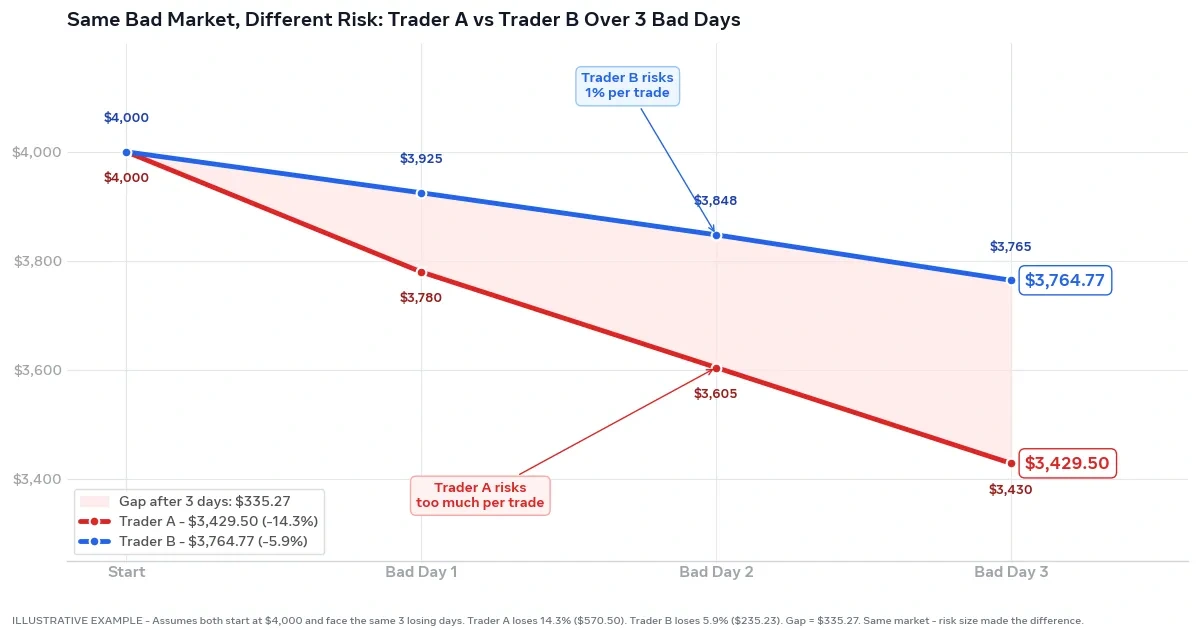
Consider two hypothetical traders, each with a $4,000 account, each risking 1% per trade with proper stops. Both open five long positions in USD-quoted pairs, such as GBP/USD, EUR/USD, and AUD/USD. All five lean on the same idea, a weaker US dollar.
- Trader A has strong trade-level risk management and no account-level rules. If a broad dollar rally hits all five stops, that’s a 5% loss in one day. Over three such days: 4,000 × 0.95³ = $3,429.50, a drawdown of about 14.3%.
- Trader B uses the same stops but also caps total open risk at 2% and stops trading for the day after a 2% loss. Three equally bad days cost at most 4,000 × 0.98³ = $3,764.77, about 5.9%.
Neither trader’s stops failed. The difference came entirely from the account layer. These numbers are a stress scenario, not a forecast, and past performance doesn’t predict future results. This is a hypothetical example for illustration only.
Diagnosing Which Half Is Missing
Most traders are stronger on one layer than the other. A few signs point to where the gap is.
A thin trade-level layer looks like this:
- You can’t state your dollar risk before entering.
- Position size stays the same regardless of stop distance.
- Stops get moved or removed after entry.
A thin account-level layer looks like this:
- You can’t say how much total risk is open right now.
- No daily or weekly loss limit exists, so bad days run long.
- Size rises or falls with your mood after streaks.
- There’s no written plan for what a 10% drawdown triggers.
If both lists feel familiar, start with the first one. Without per-trade limits, account-level rules have nothing solid to stand on.
How Beginners and Experienced Traders Split the Work Differently
Newer traders usually arrive with a single tool, the stop-loss, and treat it as the plan. That’s a reasonable start, but it covers only the first layer. A new trader can lose through size, through stacking positions, or through trading angrily after losses, none of which a stop addresses.
More experienced traders tend to spend their effort on the account layer. They track total open risk, watch correlation between positions, review results in a journal, and adjust the rules on a schedule instead of in the moment. They don’t drop the trade-level discipline. They just stop treating it as sufficient.
Experience doesn’t make the rules unnecessary. It makes the temptation to bend them more convincing.
A Sensible Build Order for a New Account
If you’re starting from nothing, building in sequence is easier than trying to write everything at once. This is a general education framework, not personal advice.
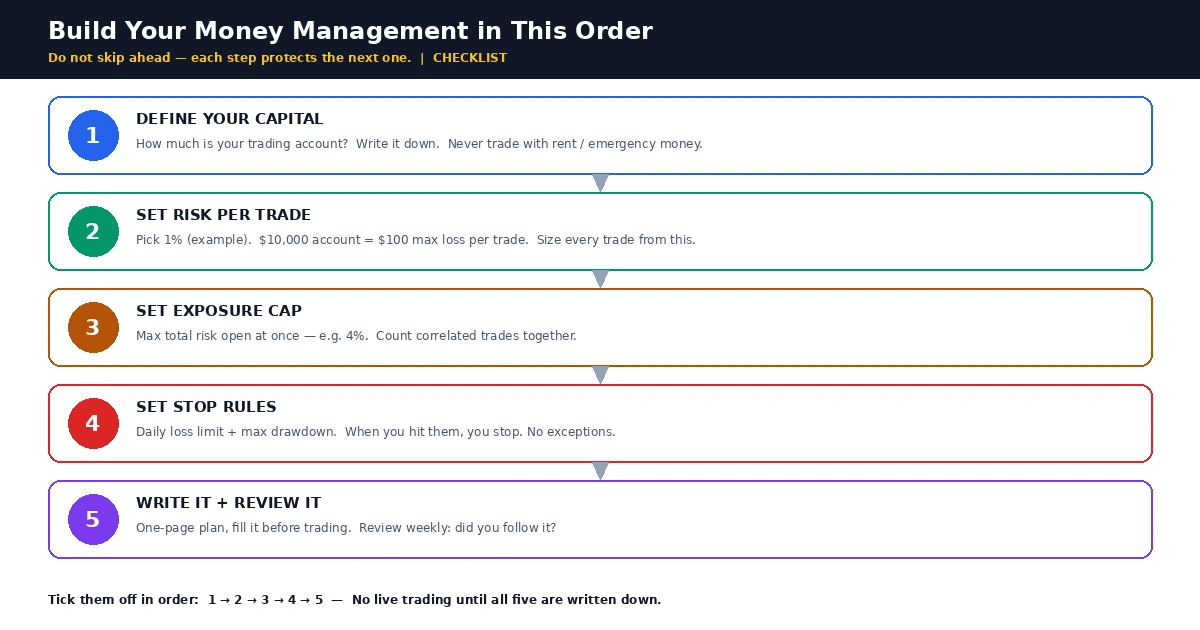
- Fix a per-trade risk percentage and learn to size from your stop distance.
- Add a cap on total open risk, so several trades can’t quietly stack up.
- Set a daily loss limit and a weekly one, so bad stretches have an end point.
- Write a drawdown rule covering when you reduce size or pause.
- Decide on withdrawals and a regular review date.
Test the whole set on a demo account first. Demo trading can’t reproduce real emotional pressure, but it can show whether your rules are workable.
Mix-Ups That Leave a Gap in the Defense
- Treating the stop-loss as the whole plan. It limits one trade. It says nothing about how many trades you take or what happens after a loss.
- Using the terms interchangeably. When both layers share one name, traders tend to build only one and never notice.
- Borrowing someone else’s percentage without context. A risk level that suits one trader’s strategy, account size, and temperament may not suit yours.
- Assuming diversification covers the account layer. Holding several pairs helps only if they don’t move together, and many USD pairs do.
- Relying on the broker’s margin stop-out. That’s a last-resort mechanism, and its rules vary by provider. Your own limits should trigger long before it does.
- Skipping the emotional side. Rules fail when stress overrides them. How emotions affect trading decisions covers the patterns that push traders past their own limits.
Gaps, Slippage, and Other Ways Both Layers Can Fail
Having both layers helps limit losses, but it doesn’t remove risk. Be clear about what remains.
- Price gaps. Price can jump past a stop, for example over a weekend or on a news release, and your loss can exceed the planned amount.
- Slippage. In fast markets, stop orders can fill away from your price.
- Leverage and margin. On a highly leveraged account, margin requirements can force positions closed before your stop is reached. Stop-out levels and negative balance policies vary by broker and region.
- Correlation surprises. Pairs that normally move independently can suddenly move together. Your open-risk cap assumes more independence than you may have.
- Rules you override. A limit you ignore in the moment protects nothing.
- Over-engineering. A plan so complicated that you can’t follow it under pressure is weaker than a short one you actually keep.
Rules built on past conditions can’t anticipate every future one, and some traders lose all of their deposit.
Sorting Out the Terms Traders Keep Mixing Up
Is position sizing money management or risk management?
It sits in the overlap. Sizing a trade from your stop distance limits the loss on that trade, which is risk management. The percentage you choose to risk comes from account-level rules, which is money management. Most traders treat sizing as the bridge between the two layers.
Which matters more for beginners?
Neither works alone. Many beginners start with per-trade risk, because one oversized loss can end an account before account rules matter. As trades accumulate, account-level rules such as loss limits and exposure caps keep a normal losing streak from becoming a crisis. Treat them as two layers of one plan.
Can I have good risk management and still lose my account?
Yes. If each trade is capped but you open many correlated trades, ignore daily limits, or keep trading after losses, capped losses can add up quickly. Account-level rules help limit that stacking. Neither layer guarantees results, and no combination of rules removes the chance of loss.
Do these ideas apply to long-term investing?
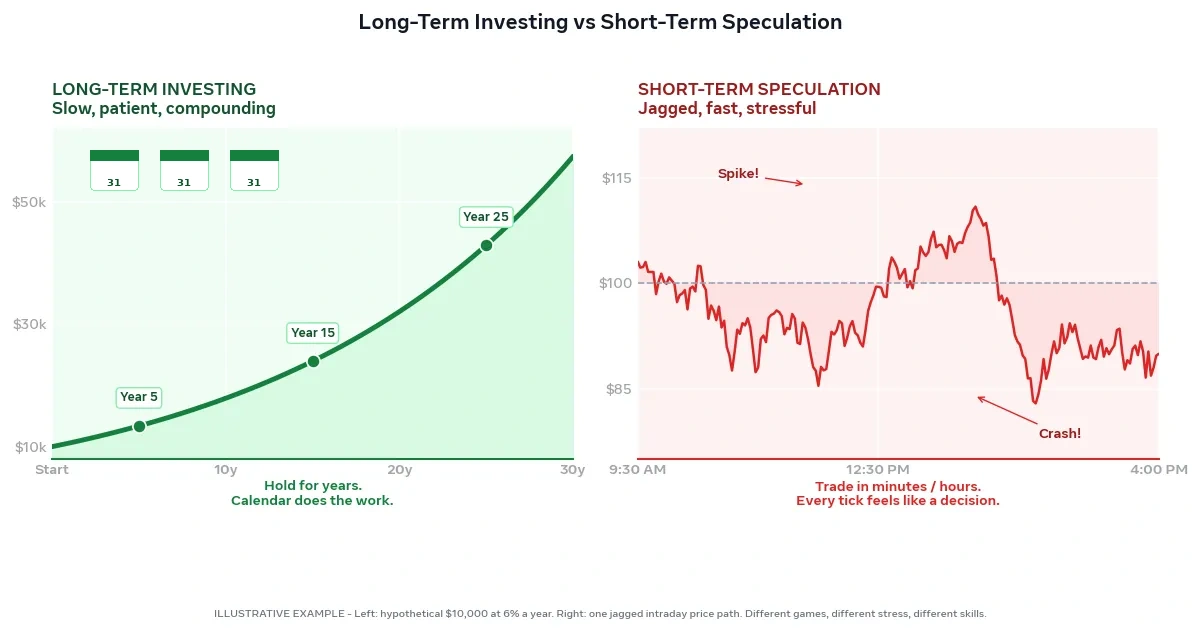
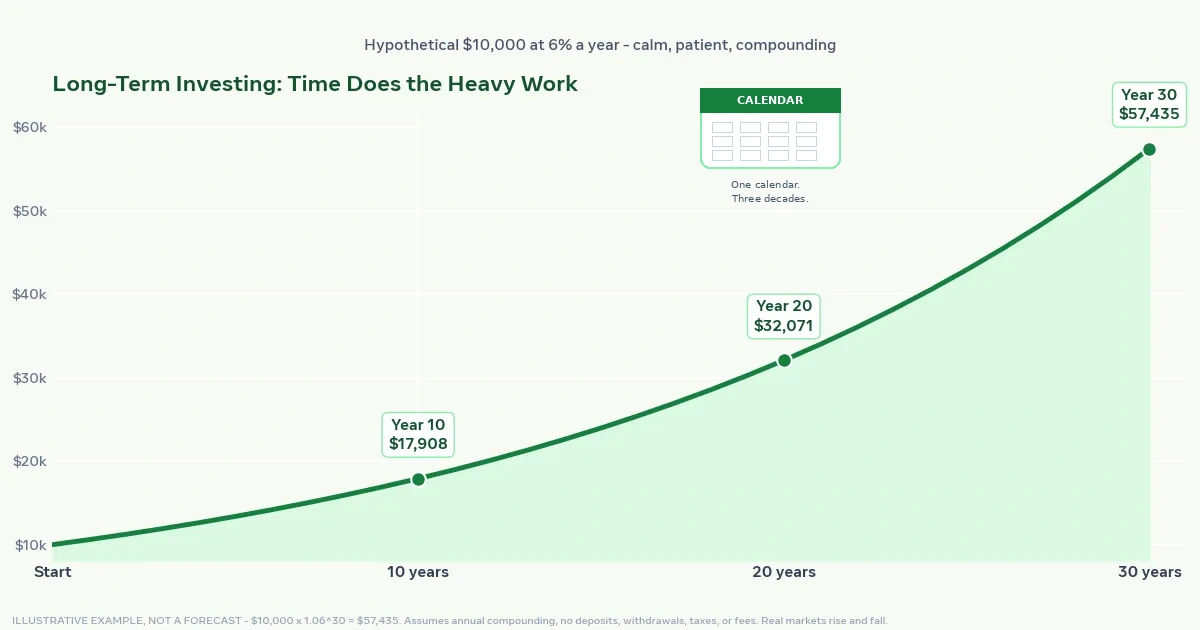
The concepts carry over, though the tools differ. Long-term investors manage position-level risk through diversification and position limits, and manage the account through allocation, contribution, and withdrawal rules. Leveraged forex and CFD trading adds margin, which makes account-level limits more pressing.
Does a broker’s stop-out replace my own limits?
No. A margin stop-out is a last-resort mechanism that protects the broker, and its levels and policies vary by provider. Relying on it means your losses are decided by someone else’s rules. Set your own limits well before that point.
Trade-Level Safety and Account-Level Survival
A stop-loss protects a trade, but only account-level rules protect the account from the trades piling up. Treat the two as halves of one plan. This week, write your current rules on paper in two columns, one for single trades and one for the whole account, and see which column is shorter. Then read why risk management matters more than strategy to see how the shorter column tends to decide results over time.
Disclaimer
This article is for educational purposes only and is not financial advice. Forex and CFD trading involves a high level of risk, and you can lose some or all of your capital. Leverage can magnify both gains and losses. Never trade with money you can’t afford to lose.
This is educational content, not personalized investment advice. Your financial situation, goals, and local regulations are different, so consider speaking with a licensed financial professional before making decisions.
Any percentages or figures shown are historical averages or hypothetical examples, not guarantees. Past performance does not predict future results.
Join now
Comments (0)
Be the first to comment.