
How Emotions Affect Trading Decisions
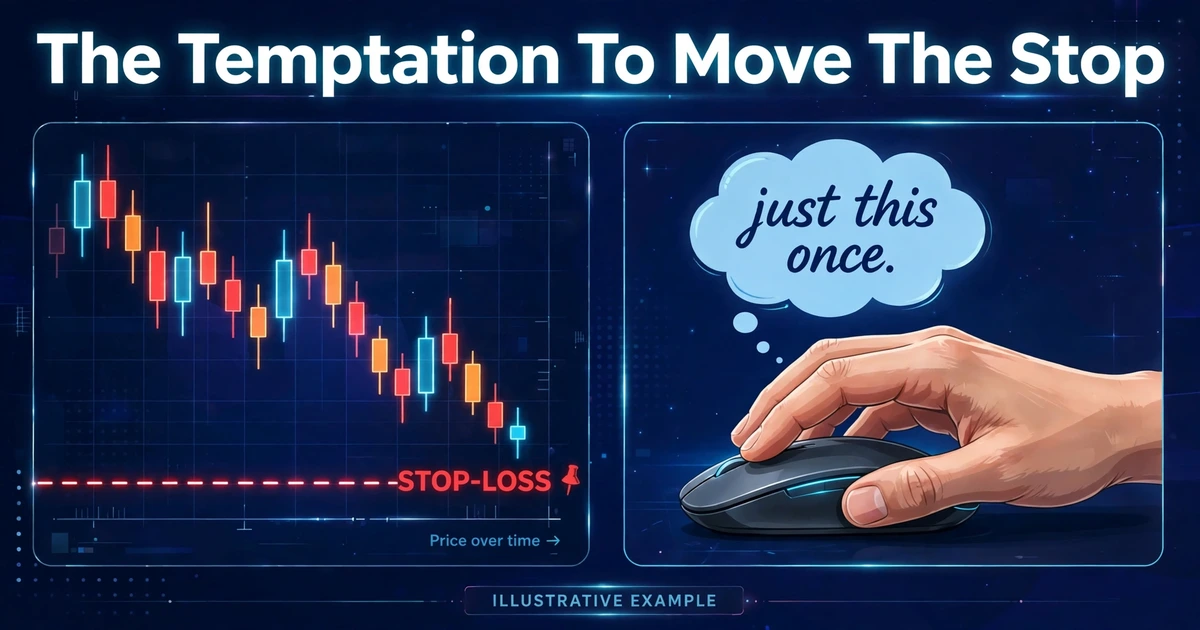
Price touches the level where your stop-loss should trigger, and for about thirty seconds your hand hovers over the mouse. Nothing about the chart has changed. What changed is that the loss is now real money, and a quiet argument starts in your head about whether to let it happen. That moment is the whole subject of how emotions affect trading decisions: feelings rarely replace your analysis, they bend it, one small choice at a time. This guide shows where the bending happens, what it can cost in a worked example, and how to protect a plan without trying to feel nothing.
Feelings Change What You See, Size, and Hold
- Emotions don’t usually make you ignore a plan outright. They shift which information you notice, how much you risk, and how long you hold.
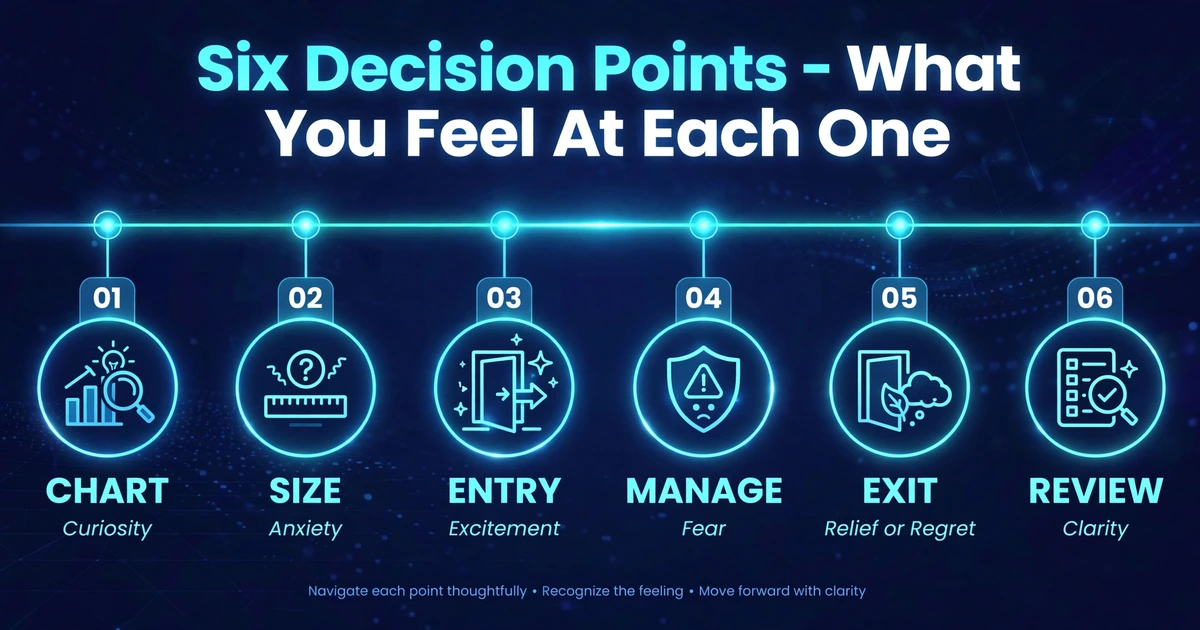
- The influence shows up at six points: reading the chart, choosing size, entering, managing the open trade, exiting, and reviewing.
- You can’t delete emotion, but you can make rules and pre-set orders carry the decision.
- Handling emotions well reduces avoidable errors. It doesn’t create an edge or guarantee profit.
The Body Reacts Before the Plan Gets a Vote
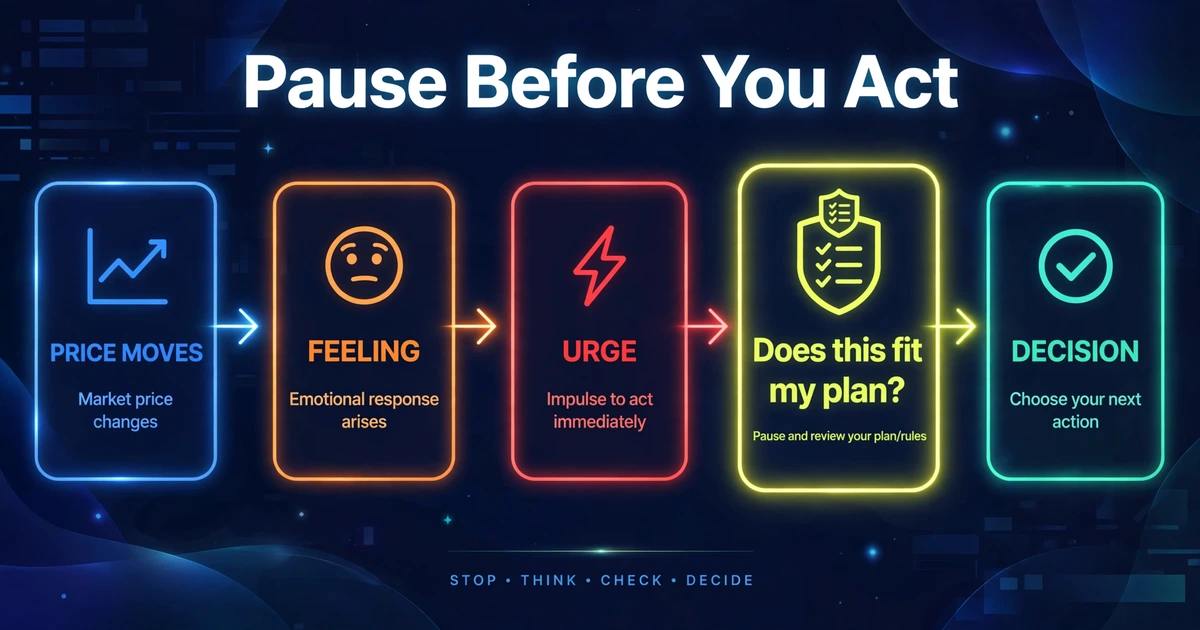
Trading puts an unusual object in front of you: a number that moves in real time and is tied to your money. People tend to respond to threat and reward quickly, often before deliberate thinking catches up. Traders commonly describe the result as a physical stress response: a faster pulse, narrowed attention, a sense of urgency.
The exact biology varies from person to person, and you don’t need it to use the lesson. When your balance is moving, the part of you that follows rules competes with the part that wants relief from discomfort.
That’s why the same plan can feel different at 8 a.m. with a clear head and at 2 p.m. after a loss. The wider relationship between mindset and strategy is laid out in trading psychology explained if you want that background first.
Six Decision Points Where Feelings Slip In
Reading the Chart: Seeing What You Hope to See
Hope and fear decide which candles get noticed. If you want a long position, a rising trendline looks supportive. After a stop-out, the identical chart can look like a trap. Price charts are ambiguous enough that emotion has plenty of room to pick the story.
Choosing Size: When Mood Quietly Moves Your Risk
After a few wins, size tends to creep up because things feel easy. After losses, it may shrink to almost nothing or balloon in an attempt to recover. Both changes reflect your state, not the market. Leverage (borrowed buying power that lets a small deposit control a larger position) amplifies whichever mistake you make.
Pulling the Trigger: Impatience and Fear of Missing Out
Impatience enters before confirmation. Fear of missing out (FOMO), the urge to join a move because it has already happened, enters late at a worse price. In both cases the entry is driven by discomfort with waiting, not by a rule.
Managing the Open Trade: The Fear and Hope Seesaw
Fear shortens winners: you close early to make sure the gain stays real. Hope lengthens losers: you drag a stop further away because the trade “should” come back. Staring at the floating profit and loss every minute feeds both reactions.
Closing the Trade: Relief, Regret, and Pride
An exit can be a rule, or it can be relief from tension. After you close, regret can push you back in at a worse price when the move continues. Pride can refuse a small loss that the plan said to take.
Reviewing the Result: Hindsight Rewrites the Story
Once the outcome is known, it feels obvious. “I knew it would reverse” or “I should have held” turns a random result into a false lesson. A review shaped by hindsight teaches the wrong habits.
One Trade, Two Versions: A Hypothetical Pair
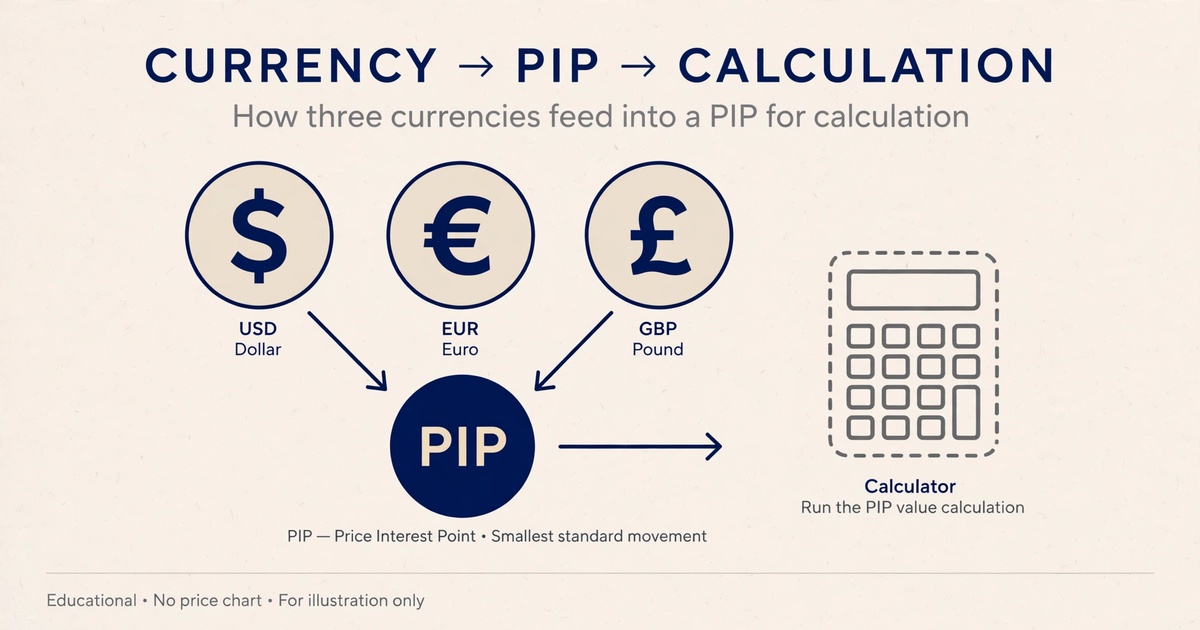
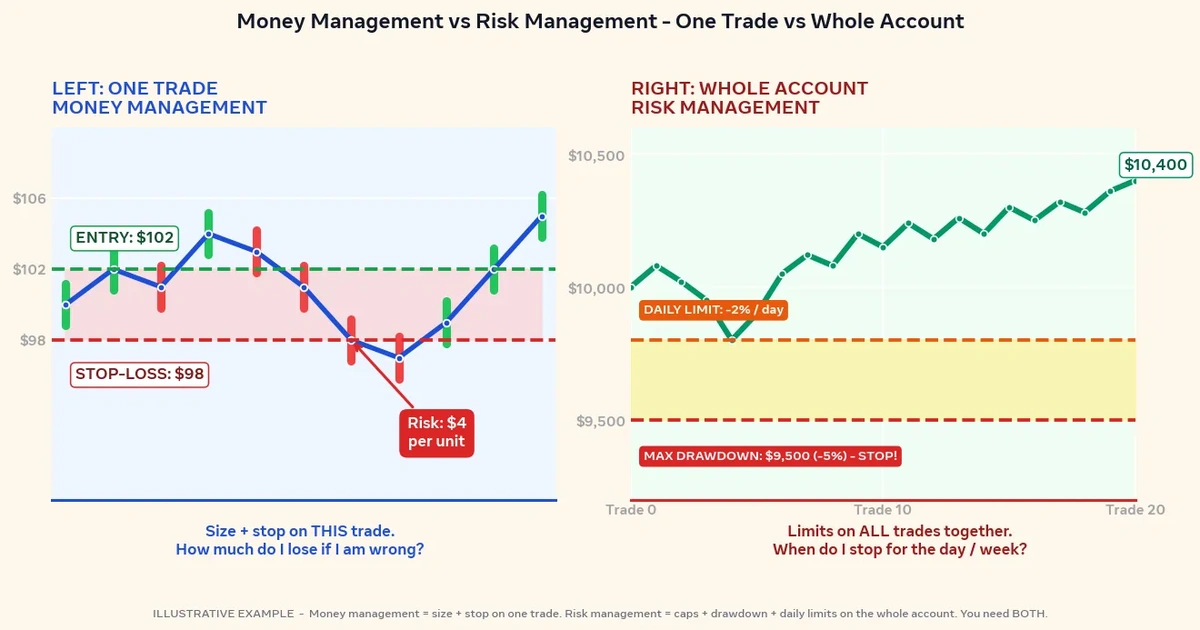
Assume a trader with a $3,000 account who risks 1% ($30) per trade. For illustration, use GBP/USD, where one pip is the smallest standard price move. On a USD-denominated account, a 10,000-unit position (one mini lot) is worth about $1 per pip. Pip value depends on the pair and your account currency, so calculate it for your own setup.
The plan: a 30-pip stop, a 60-pip target, and 10,000 units. That means $30 at risk and $60 in potential reward. This is a hypothetical example for illustration only, and spread and commission are ignored for clarity.
Two trades happen in one week. The first reaches its target. The second hits its stop.
Following the plan: +$60 and −$30, a net of +$30.
Letting feelings in: The first trade reaches +18 pips and the trader, uneasy after a rough week, closes it by hand for +$18. On the second trade, price moves against the position, so the trader drags the stop from 30 pips out to 50 “to give it room.” It’s hit anyway: −$50, which is about 1.7% of the account instead of the planned 1%. Net: −$32.
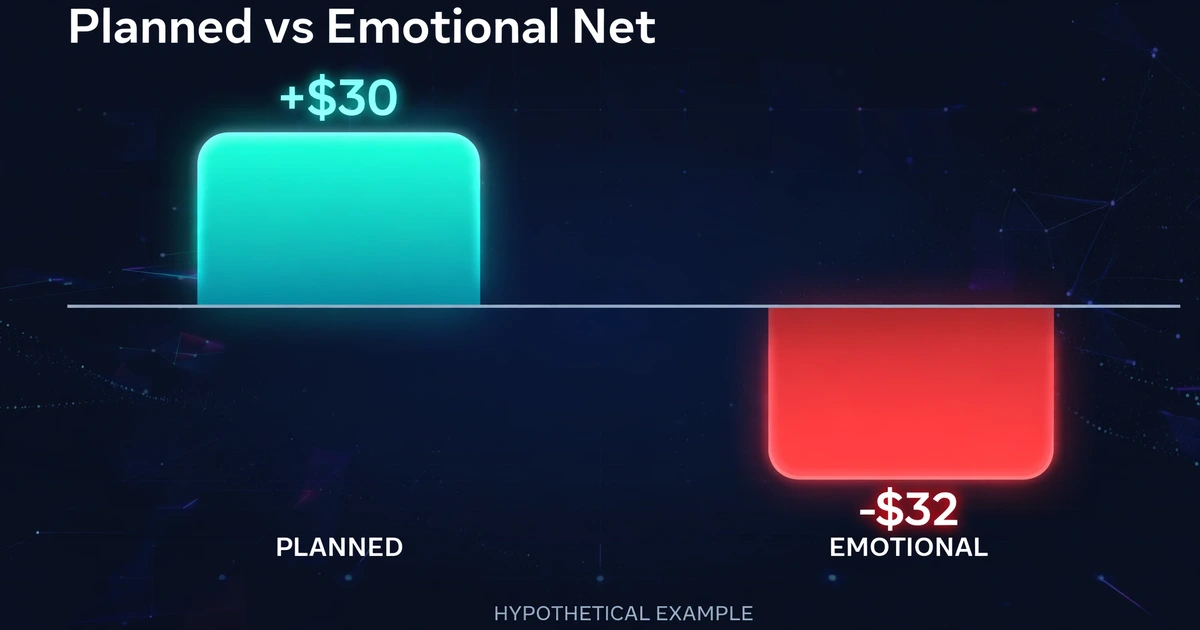
The market behaved identically in both versions. The gap between +$30 and −$32 is $62, and every dollar of it came from two emotional edits to a plan. Closing early isn’t always wrong, but doing it because of nerves rather than a rule is the pattern that repeats.
Telling an Urge From a Signal
A signal comes from your written criteria. An urge comes from discomfort. They can feel similar in the moment, but urges tend to leave tells:
- Urgency. “It’s now or never” thinking, when your plan has no time pressure.
- Bargaining language. “Just this once” or “I’ll tighten it later.”
- New reasons for an old trade. Justifications that weren’t in your plan when you entered.
- Wanting to change size. Especially right after a loss or a win.
- Compulsive checking. Refreshing the profit and loss figure far more than your plan calls for.
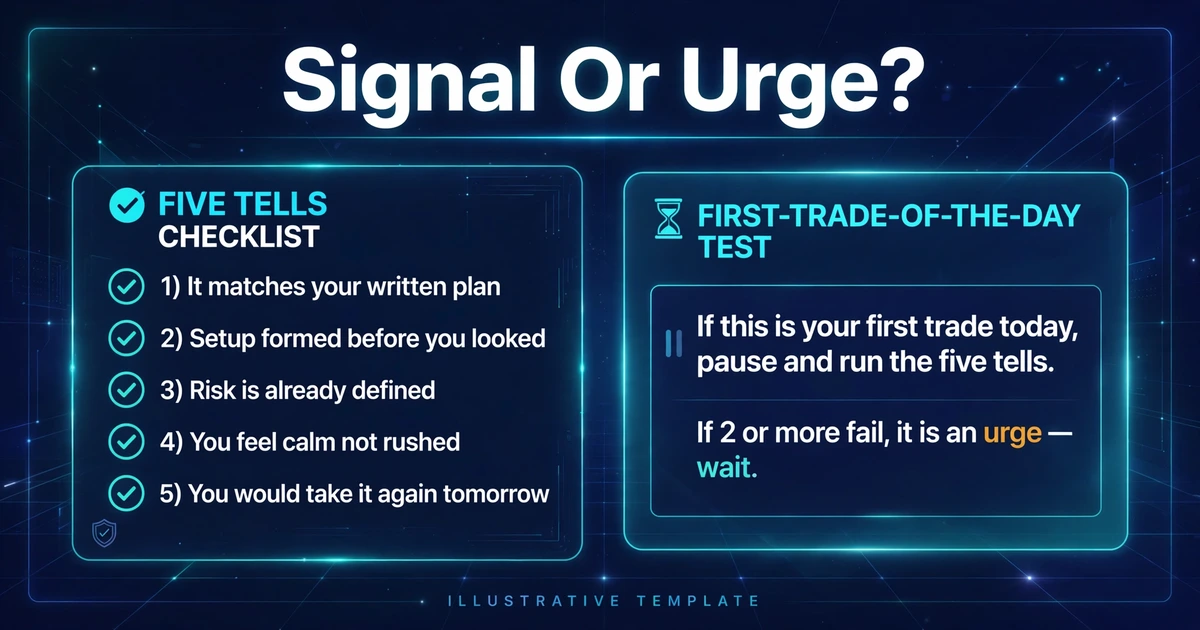
A practical test is to ask, “Would I take this exact trade if it were my first of the day and my balance hadn’t moved?” If the answer is no, the trade is probably driven by your state rather than the setup. The deeper emotional vocabulary behind these tells is the focus of the post on four core emotions in trading.
Lowering the Pressure Instead of Going Numb
You don’t need to become emotionless. You need to make the emotional moment smaller.
- Place the stop-loss and target when you enter. The decision is already made when feelings arrive. A stop can help limit losses, but it can’t promise a fill at your price in fast markets or gaps.
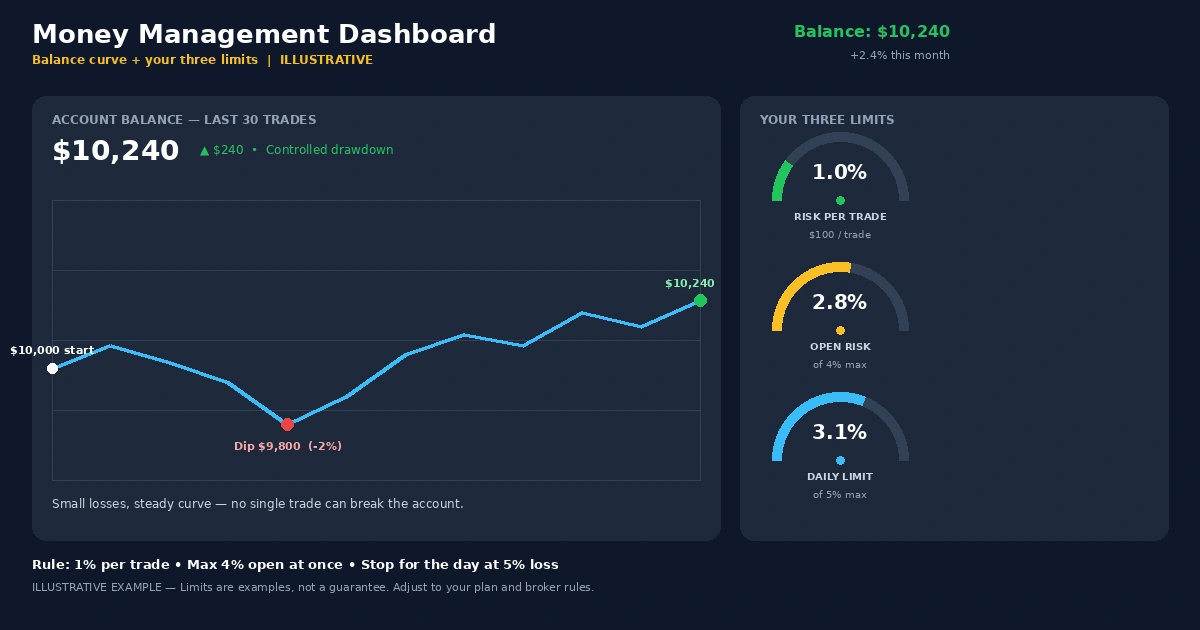
- Keep size fixed and small enough to sit through. If a normal loss makes your stomach drop, the position is too large for you, whatever the math says. Sizing methods are covered in the forex risk management guide.
- Use alerts instead of watching. Setting price alerts reduces the minute-by-minute seesaw.
- Name the feeling before you act. Many traders find that writing “anxious” or “bored” beside a trade note creates a pause between the feeling and the click.
- Take a defined break after a rule break. A fixed pause, such as the rest of the session, interrupts the chain.
- Review with a process lens. The psychology of a profitable trader describes how steadier traders score rule-following separately from outcomes.
Misreadings That Keep the Cycle Going
- Calling a strong urge “intuition.” Experienced traders may develop pattern recognition, but a sudden pull to break your rules after a loss is rarely that. It’s usually discomfort.
- Assuming calm means you’re safe. Overconfidence is an emotion too, and it tends to raise risk right before variance returns.
- Trading to fix a mood. Boredom, frustration, and loneliness are not market conditions. A trade placed to change how you feel is hard to defend later.
- Blaming the move for a decision you made. Spikes happen. Whether you sized and placed your stop for them is a choice.
- Waiting to feel confident before following the rules. Rules exist for the moments when confidence is missing.
Limits of Emotional Control as a Trading Fix
Better emotional habits reduce self-inflicted losses. They don’t make trading safe.
- No edge, no rescue. Calmly executing a plan that doesn’t have a positive expectancy only produces calm losses.
- Gaps and slippage. Slippage is the difference between your intended and filled price. Both can make a loss larger than planned, even with a perfect stop.
- Leverage still magnifies. Traders can lose some or all of the capital they deposit.
- Fatigue and stress distort judgment. Rules help, but a tired mind can still skip them.
- Over-engineering. Too many checklists and rituals can freeze a trader. A few clear rules usually serve better than a long list.
- No guaranteed outcome. Results vary with market conditions, execution, and risk management.
A Note on Stress That Outlasts the Trading Day
If trading anxiety is affecting your sleep, mood, or relationships, or you feel compelled to trade, consider pausing and speaking with a qualified professional. This article is educational and isn’t a substitute for mental health care.
Fear, Greed, Calm, and the Decisions in Between
Which emotion hurts traders most?
There’s no single answer, because it varies by person and situation. Fear often shows up as cutting winners short or skipping valid setups, while greed and hope show up as oversizing or holding losers. Many traders find that identifying their own recurring pattern in a journal is more useful than ranking emotions in general.
Can emotions ever help a trader?
Yes, in a limited way. Nervousness can be a useful signal that a position is too large, and discomfort after a rule break can prompt a review. The problem is acting on the feeling in the moment. Treat emotions as information to log and examine, not as instructions.
Why do I freeze right before entering a trade?
Freezing often reflects fear of loss, especially after recent losing trades or when the size is large relative to your comfort. Reducing position size, using a written entry checklist, and practicing on a demo account can lower the pressure. If freezing is persistent, review whether your risk per trade is too high.
Why do I close winning trades too early?
Often because holding a gain feels risky, since a profit you can lose is uncomfortable. Closing locks in relief. If your plan sets a target, placing it as an order at entry removes the in-the-moment decision. Closing early is not always wrong, but it should be a rule, not a reaction.
Does experience remove emotional trading?
Not entirely. Experienced traders commonly report that nerves, impatience, and doubt remain. What often changes is the response: clearer rules, steadier size, and routines for reviewing mistakes. Experience can improve self-awareness, but it doesn’t remove the need for safeguards, and it doesn’t guarantee better results.
Notice It, Name It, Then Let the Rule Decide
Emotions affect trading decisions mainly by editing a plan you already wrote, which means the fix is to protect the plan, not to silence the feeling. For your next ten trades, write one word beside each entry describing your state, then compare those words to the trades where you broke a rule. If you’d like labels that are more precise than “stressed” or “excited,” the guide to four core emotions in trading is the natural next read.
Disclaimer
This article is for educational purposes only and is not financial advice. Forex and CFD trading involves a high level of risk, and you can lose some or all of your capital. Leverage can magnify both gains and losses. Never trade with money you can’t afford to lose.
Any percentages or figures shown are historical averages or hypothetical examples, not guarantees. Past performance does not predict future results.
Join now
Comments (0)
Be the first to comment.