
Trading Psychology Explained: Why Mindset Matters More Than Strategy
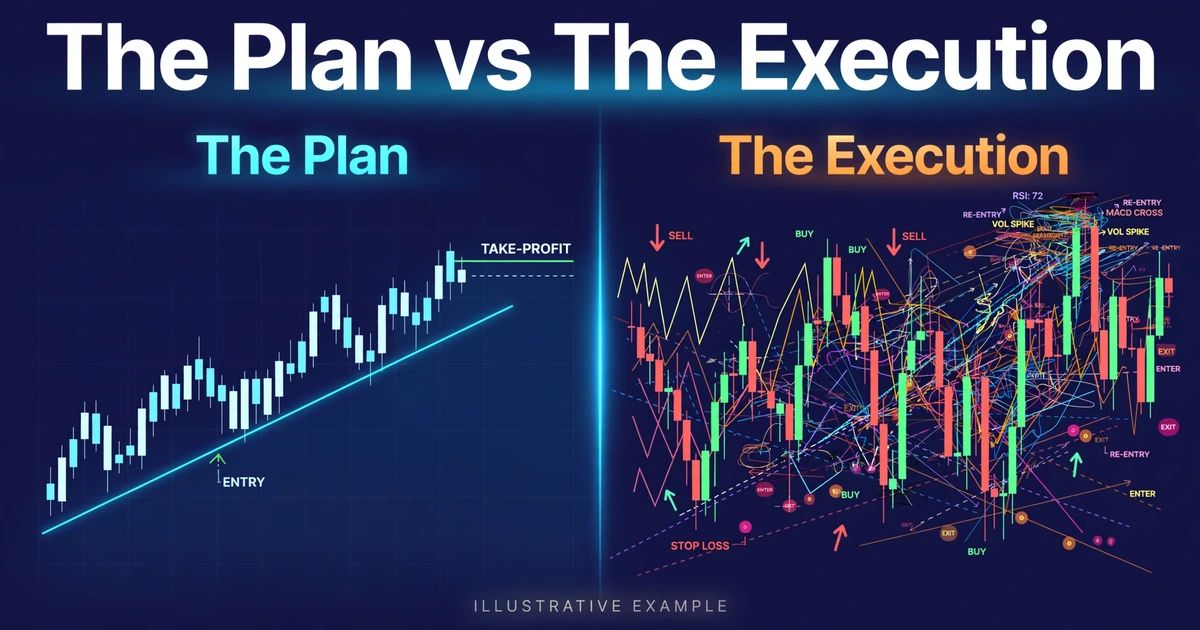
Picture a trader who writes her plan on Sunday: risk one percent per trade, place the stop-loss at the last swing low, and stop for the day after two losses. By Wednesday afternoon she has taken three losses, moved one stop, and entered a fourth trade that matches nothing on the page. The strategy didn’t change. The person using it did. That gap is what trading psychology studies: how fear, greed, impatience, and fatigue shape decisions once real money is attached. This guide covers where mindset really does outweigh strategy, where it doesn’t, and the habits that keep a written plan alive under pressure.
Strategy Picks the Trade; Behavior Decides the Result
- Trading psychology is the study of how emotions and habits affect the decisions you make, even when you already have a plan.
- A strategy defines what you do. Psychology determines whether you do it consistently, size positions sensibly, and survive a losing streak.
- Mindset can’t create an edge that a strategy lacks, but poor discipline can wreck an edge that exists.
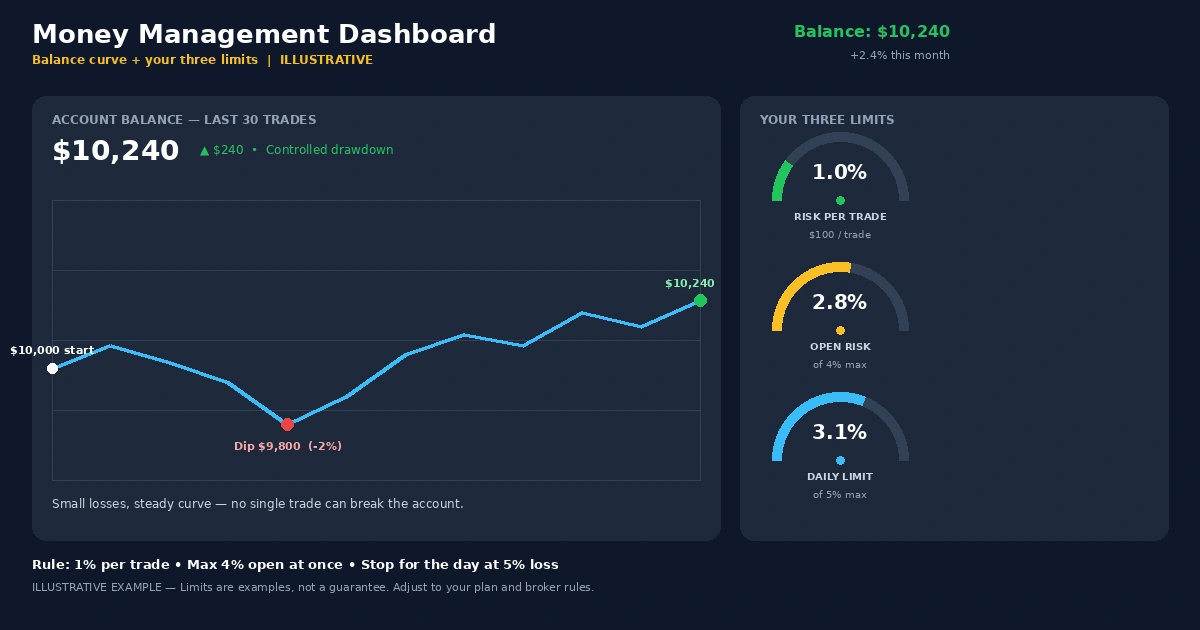
- The most reliable fixes are structural: fixed risk, written rules, daily loss limits, journaling, and scheduled breaks.
The Gap Between Your Written Plan and Your Clicked Trade
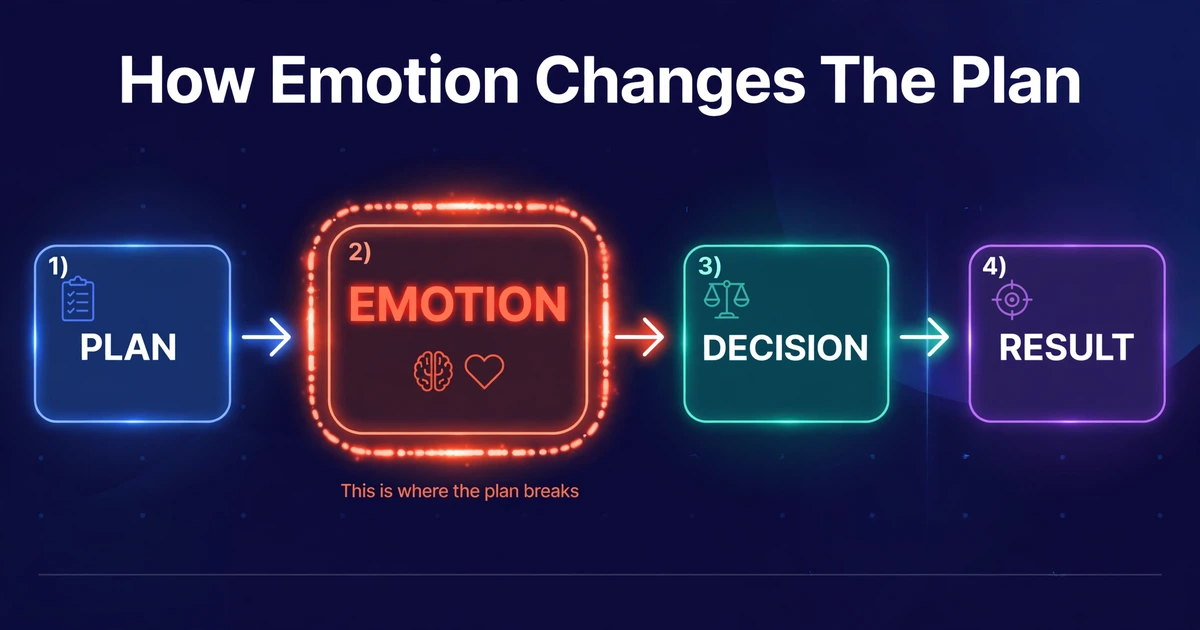
On a quiet weekend, rules feel obvious. “Exit at the stop” is easy to agree with when nothing is at stake. During a live trade, your brain treats a shrinking balance as a threat, and the rule that seemed simple now competes with a strong urge to do something.
This is why two traders can run the same strategy and get very different results. One places the stop and walks away. The other widens it “just this once,” skips the next valid setup after a loss, or doubles size to get back to even. Neither person lacked knowledge. They differed in execution under stress, a pattern explored further in how emotions affect trading decisions.
Leverage (borrowed buying power that lets you control a larger position than your deposit) makes this worse. It magnifies both gains and losses, so every price swing lands harder on your nervous system.
Mindset Versus Strategy: Splitting the Blame Fairly
The claim that “mindset matters more than strategy” is half true, and the half that’s false can cost you money.
Where mindset really dominates. If you have a reasonable, tested set of rules and you abandon them after three losses, psychology is the problem. Changing strategies won’t help, because the next one will get abandoned the same way.
Where strategy still matters. Perfect discipline applied to a plan with no edge simply loses money in an orderly fashion. A calm trader who follows a flawed rule set faithfully will faithfully lose.
A more useful way to see it: strategy sets the ceiling, and behavior decides how close you get to it. Beginners usually spend 95% of their time on the first and almost none on the second, which is why the second tends to be where results leak away.
Five Mental Traps That Wreck Sound Plans
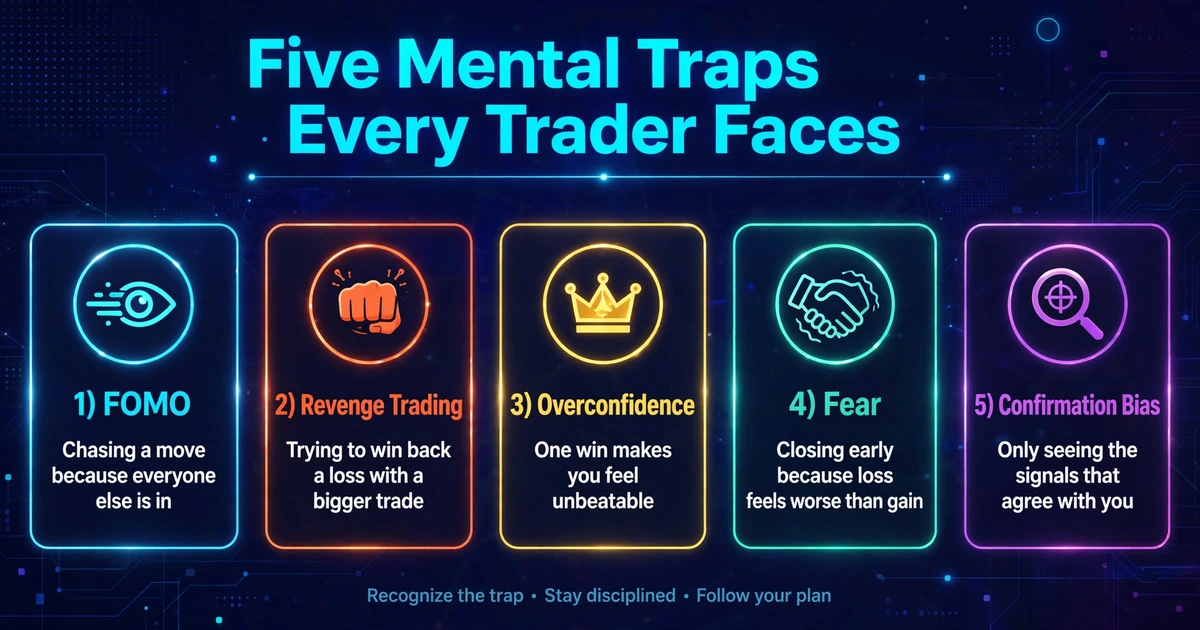
FOMO: Entering Because Price Already Moved
Fear of missing out is the urge to chase a move that has already run without you. The entry is late, the stop has to be wider to make structural sense, and the reward-to-risk ratio has quietly worsened. A useful check is whether the trade would qualify if you were seeing the chart for the first time.
Revenge Trading: Trading to Win Back a Loss
After a loss, the market feels like a debtor. Traders increase size or take marginal setups to “get it back.” The trade is no longer a decision about price; it’s a reaction to a number in your account.
Overtrading: Mistaking Activity for Progress
Boredom, excitement, and the sense that sitting still is wasteful all push traders to take setups that don’t meet their criteria. More trades also mean more spread and commission, which are costs that accumulate regardless of outcome.
Moving the Stop: Renegotiating With Yourself
Pulling a stop-loss further away because the trade “should turn around” converts a defined loss into an undefined one. A stop-loss can help limit losses, but it isn’t a guarantee: in fast markets or around gaps, price can fill beyond your level.
Loss Aversion: Cutting Winners, Riding Losers
People feel losses more sharply than equivalent gains. In trading, that often shows up as closing profitable trades early to “lock it in” while holding losing trades in the hope they recover. Over time, small wins and large losses make for a weak equation even when many trades win.
How a Losing Streak Rewrites the Rules: A Hypothetical Week
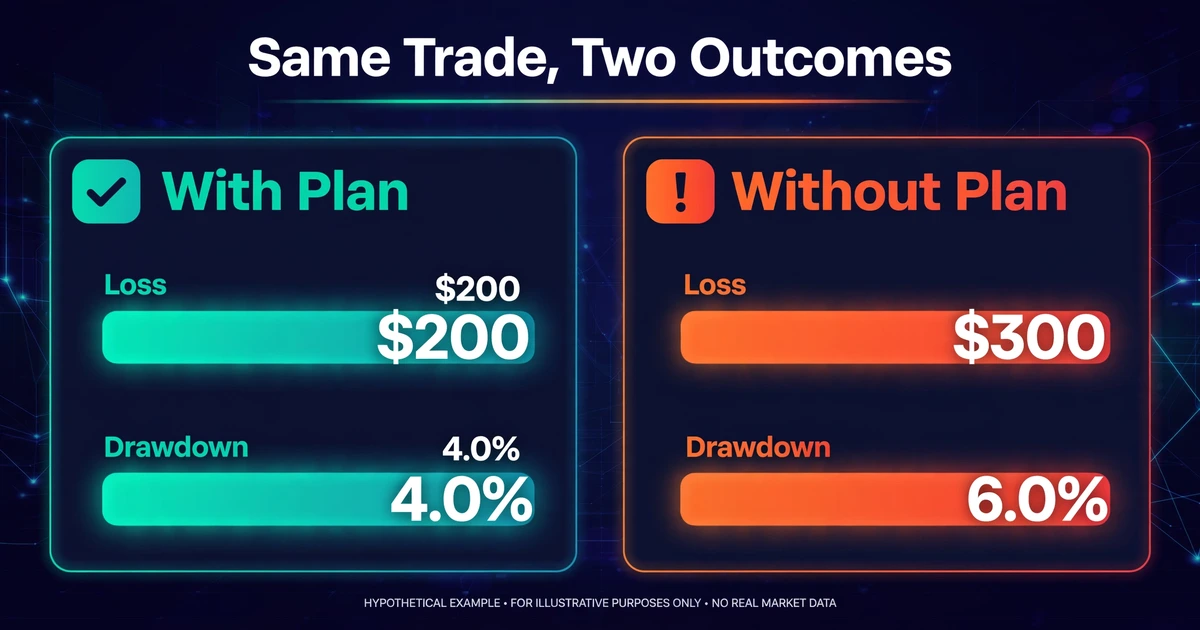
This is a hypothetical example for illustration only. Assume a $5,000 account with a plan to risk 1% ($50) per trade.
Monday through Wednesday, three trades hit their stops. That’s $150 lost, or 3% of the account. Now compare two responses to trade four, assuming it also loses:
| Following the plan | After the streak starts to sting | |
|---|---|---|
| Risk on trade 4 | $50 | $150 (three times normal size) |
| Total loss after four trades | $200 | $300 |
| Account balance | $4,800 | $4,700 |
| Drawdown (drop from peak balance) | 4.0% | 6.0% |
| Gain needed to return to $5,000 | about 4.2% | about 6.4% |
The plan’s rules hadn’t failed here; a string of losses is a normal part of any approach that doesn’t win every trade. The damage came from the size change. In a real week the fourth trade might win, but a rule that only works when you get lucky isn’t a rule.
Building Rules That Hold When You Don’t Feel Like Following Them
Willpower is unreliable under stress. Structure is cheaper. The goal is to decide the hard things while you’re calm and make them automatic.
A Pre-Trade Checklist That Tests Your State, Not Just the Setup
Most checklists cover price: trend, level, trigger. Add two lines about you: Am I trading because of a valid setup or because I want to recover something? Is my position size identical to my plan? If either answer is uncomfortable, skip the trade.
A Daily Loss Cap Written Before the Session
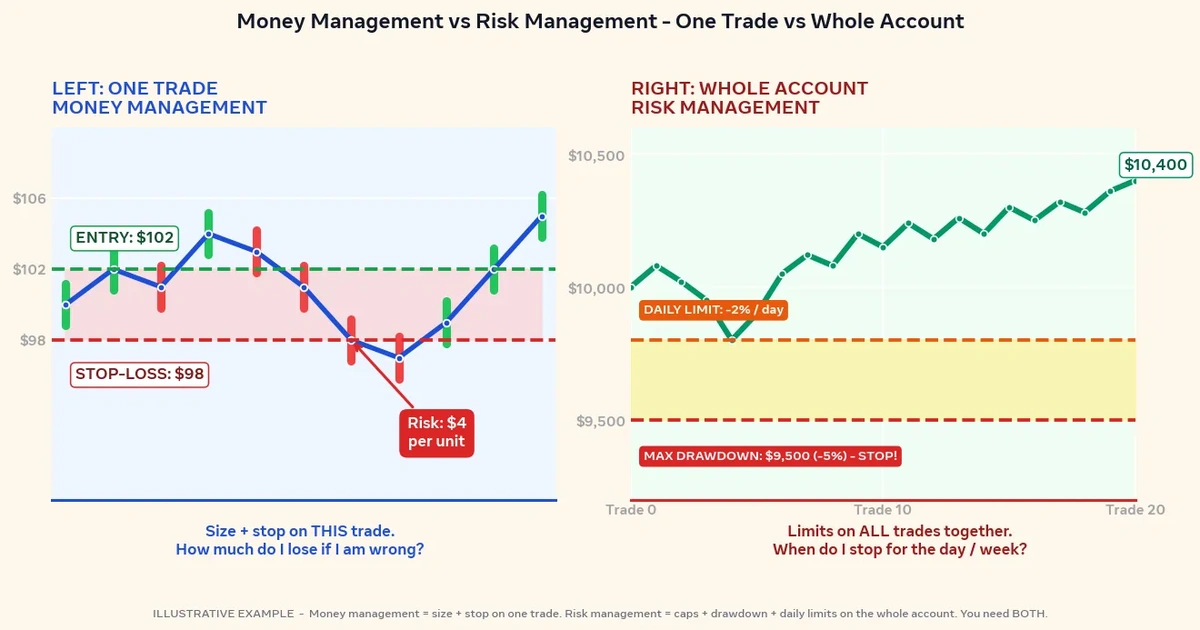
Pick a number, such as two stops or a fixed percentage, and write it on paper. When it’s hit, you’re done for the day. The decision was made by the version of you who wasn’t frustrated.
Journaling Feelings Next to Prices
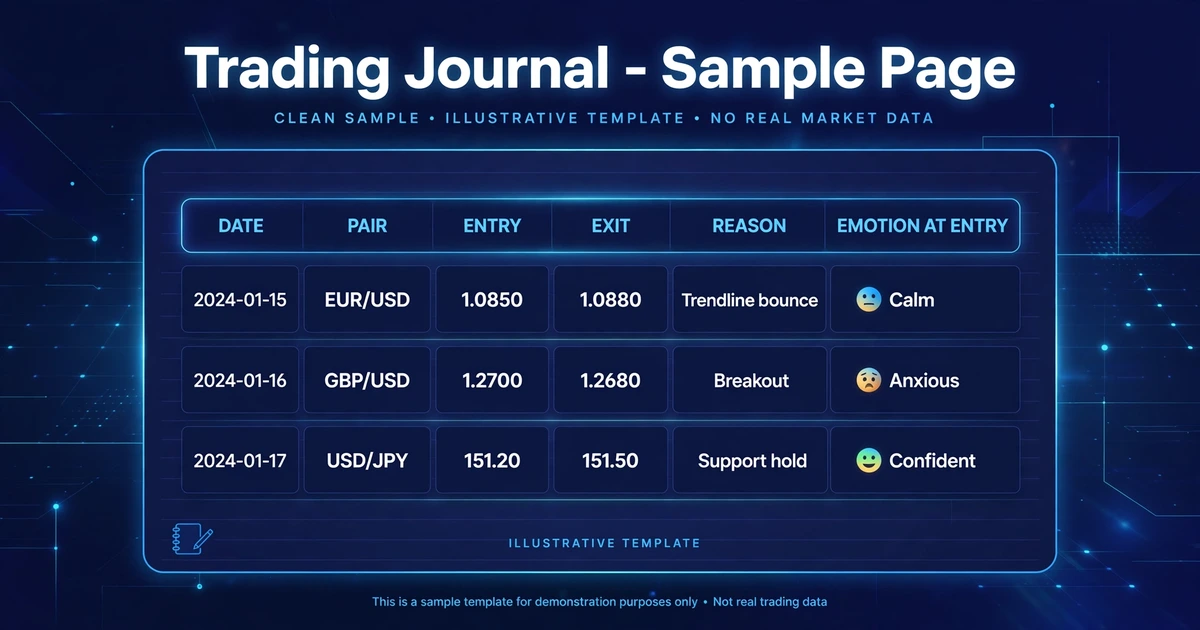
Record the entry, exit, and reason for each trade, plus a one-word note on your emotional state at entry. Reviewing weekly often reveals patterns that charts alone won’t show, such as most rule breaks happening after a loss or late in a session. Traders who study the psychology of a profitable trader often describe journaling as the habit that turns vague frustration into specific, fixable behavior.
Scheduled Breaks After a Loss Streak
A fixed rest period, such as a walk or the remainder of the day, interrupts the loop where each loss makes the next decision worse. It feels unproductive, but it protects the capital you’d otherwise put at risk.
Six Ways Traders Misdiagnose Their Own Mindset
- Treating each loss as a verdict on your ability. A loss within your rules is a cost of doing business, not evidence you’re failing.
- Switching strategies after every bad week. If the real problem is rule-breaking, a new system inherits the same problem.
- Trying to feel nothing. Suppression tends to fail. Noticing the emotion and letting a rule decide is more realistic.
- Trading size that’s too large to sit through. If a normal loss makes your stomach drop, the position is bigger than your temperament can handle. Size matters here, as covered in why risk management matters more than strategy.
- Skipping the journal because it feels tedious. The review is where the learning happens.
- Comparing yourself to social media screenshots. Selected wins say nothing about the losses, size, or luck behind them.
The Losses Discipline Can’t Prevent
Better psychology reduces self-inflicted damage. It doesn’t make trading safe.
- No edge, no rescue. Following a poor strategy consistently only makes the losses consistent too.
- Execution risk. Slippage (the difference between your intended price and the fill) and gaps can push losses beyond your planned amount, especially around news releases.
- Leverage still bites. With high leverage, a small adverse move can erase a large part of your deposit, and in some cases traders lose all the capital they put in.
- Rule rigidity. Strictly following rules that no longer fit market conditions is its own mistake. Review rules on a schedule, not in the middle of a trade.
- Backtested comfort. Rules that looked calm in historical testing may feel very different with real money and real spreads.
Psychology work lowers one kind of risk. It doesn’t remove the others.
If Trading Stress Starts Following You Home
Persistent anxiety, trouble sleeping, checking charts compulsively, or trading money you need for bills are signs to step back. This article is educational and isn’t a substitute for professional mental health support. If trading is affecting your health, relationships, or finances, consider speaking with a qualified professional and reducing or pausing your activity.
Straight Answers on Emotions, Discipline, and Losing Streaks
Is trading psychology more important than strategy?
Neither works alone. A strategy supplies the rules and, ideally, an edge; psychology determines whether you follow them. Discipline can’t rescue a plan with no edge, and a sound plan still fails if it’s abandoned after three losses. It helps to treat them as two separate skills and practice both on a demo account first.
How do I stop revenge trading?
Set a rule before the session: after a fixed number of losses or a fixed daily loss amount, you stop. Keeping position size identical after a loss removes much of the temptation. Some traders also write one line in a journal describing the urge before deciding whether any trade exists at all.
Can you remove emotion from trading?
Not entirely, and trying often backfires. Emotions are part of how people handle uncertainty and money. A realistic goal is to notice them early and let predefined rules, fixed risk, and loss limits carry the decision. Smaller position sizes can also lower emotional intensity enough to make a plan easier to follow.
How long does it take to build trading discipline?
There’s no reliable timeline, and anyone quoting one is guessing. Discipline tends to improve through repeating a defined process, honest journaling, and reviewing how often you followed your rules, not just whether trades won. Measuring rule adherence across a set number of trades is a more useful progress signal than your profit curve.
Does demo trading help with psychology?
It helps with mechanics and rule-following, but it can’t fully reproduce the pressure of real money, because nothing is at stake. Use it to test whether you can follow your checklist and loss limits consistently. If you move to a live account, expect it to feel different and start with a small size.
Protect the Decision, Not Just the Trade
Strategy tells you what to look for; psychology decides whether you act on it the same way on the fourth loss as on the first. Discipline is easier to build into structure than into willpower. Before your next session, write one stop rule on paper, such as a daily loss amount, and note how you felt at each entry. If you want a vocabulary for those feelings, the breakdown of the four core emotions in trading is a natural place to continue.
Disclaimer
This article is for educational purposes only and is not financial advice. Forex and CFD trading involves a high level of risk, and you can lose some or all of your capital. Leverage can magnify both gains and losses. Never trade with money you can’t afford to lose.
Any percentages or figures shown are historical averages or hypothetical examples, not guarantees. Past performance does not predict future results.
Join now
Comments (0)
Be the first to comment.