
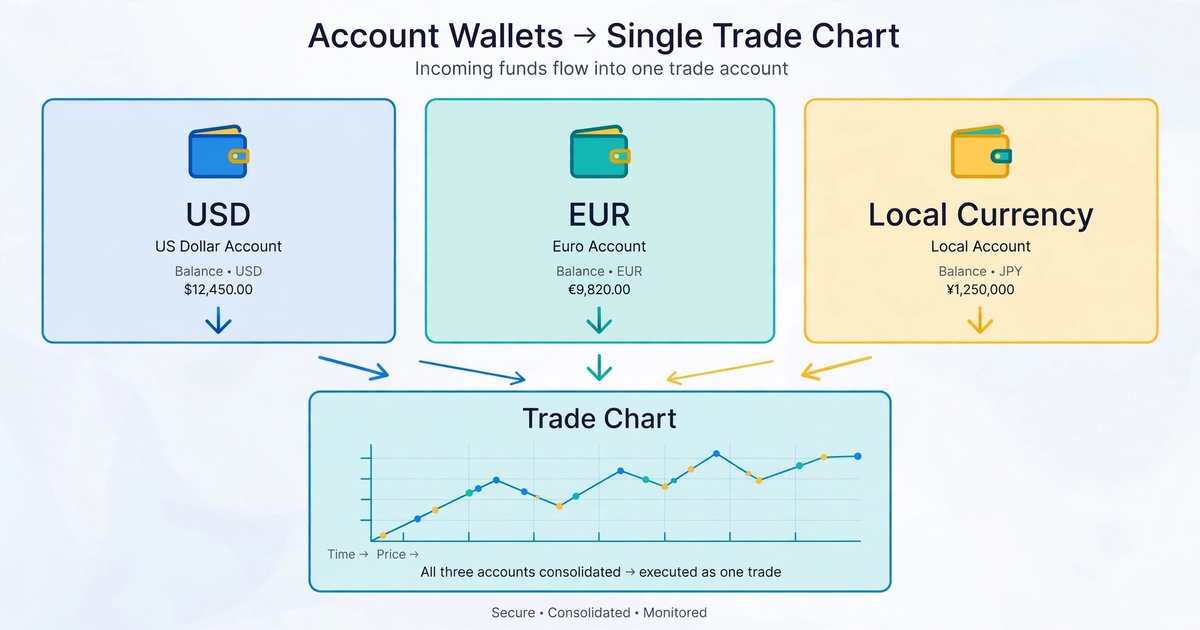
How to Choose Your Forex Account Currency (USD, EUR, or Local?)
The signup form asks for plenty of details, but one dropdown quietly shapes every number you’ll see afterward: account currency. Many beginners pick whatever is listed first. Months later they find that their pip values drift, their withdrawals cost a conversion margin, or their balance moved without a single trade.
Your forex account currency decides which currency your balance, profits, losses, and fees are measured in. This article shows how USD, EUR, and local-currency accounts differ in practice, where the hidden costs sit, and how to choose with a short checklist.
The Short Rule: Match Your Money First, Then Your Pairs
- Start with your cash flow. The currency you deposit from and withdraw into is usually the simplest choice, because it avoids extra conversions.
- Then check your pairs. An account held in the quote currency of the pairs you trade most (USD for EUR/USD and GBP/USD) gives you a fixed pip value.
- A USD account is a common default, but it adds exchange-rate exposure if your real expenses are in another currency.
- Check the broker’s policy before you fund. Many brokers don’t let you change an account’s currency later.
Where the Conversion Happens: From Quote Currency to Balance
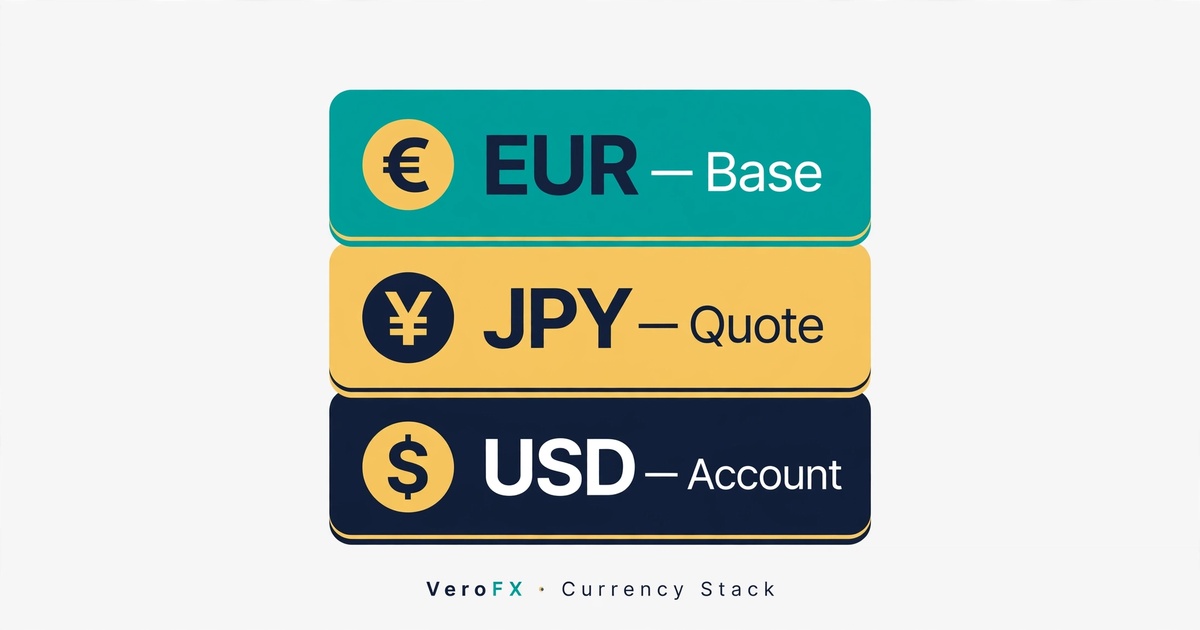
Every pair is priced in its quote currency. When you close a trade, the profit or loss is first calculated in that quote currency, then converted into your account currency. If you’re new to the terms, our guide to currency pair base vs. quote covers the basics.
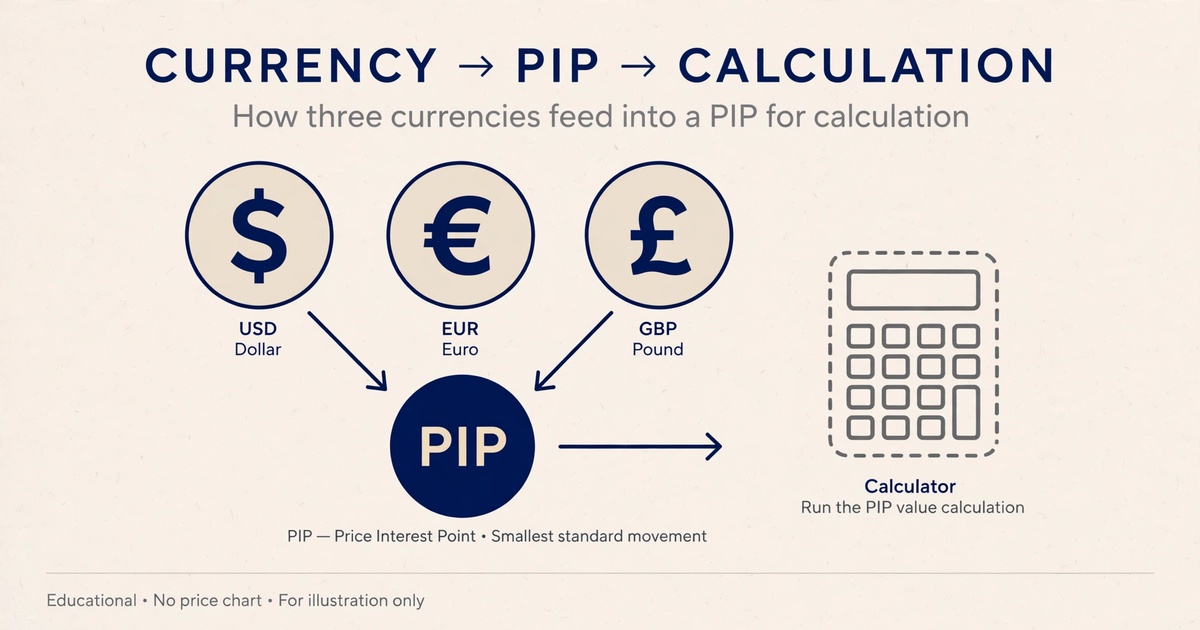
A pip is the smallest standard price move, usually 0.0001 (or 0.01 for yen pairs). A standard lot is 100,000 units of the base currency. How your account currency relates to the pair decides how simple the pip value is.
Quote Currency Matches: A Fixed Pip Value
Trade EUR/USD in a USD account and the quote currency is already your account currency. One pip on a standard lot is always $10, no matter where the price sits. This is the cleanest setup for position sizing.
Account Currency Is the Base: The Pip Value Drifts
Trade USD/JPY in a USD account and the pip value starts in yen. One pip on a standard lot is 1,000 JPY, which the broker converts to dollars at the current rate.
Here’s a hypothetical illustration. At a USD/JPY rate of 140.00, 1,000 ÷ 140 = $7.14 per pip. At 160.00, 1,000 ÷ 160 = $6.25 per pip. Same lot size, different dollar risk per pip.
Cross Pairs Need Two Steps
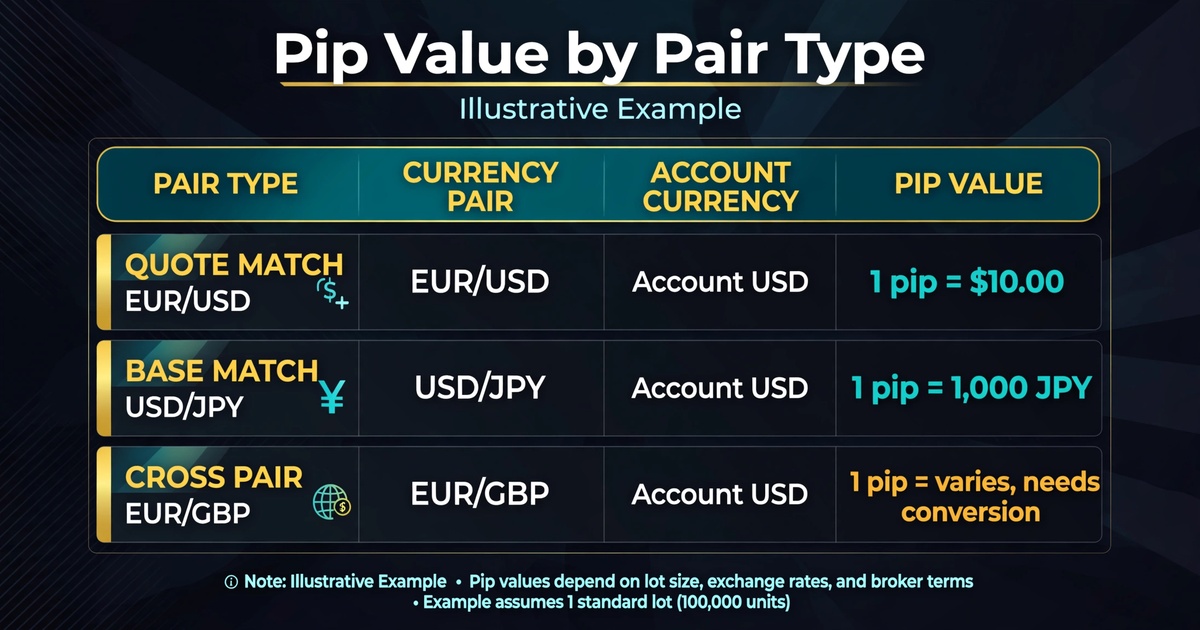
Trade EUR/GBP in a USD account and a pip is worth £10 per standard lot. That amount is then converted to dollars at the current GBP/USD rate. If you size positions with a fixed dollar number, you’ll be slightly off whenever you skip this step.
| Situation | Example (1 standard lot) | Pip value in your account currency |
|---|---|---|
| Account currency is the quote currency | EUR/USD in a USD account | $10, fixed |
| Account currency is the base currency | USD/JPY in a USD account | 1,000 JPY ÷ USD/JPY rate, changes with price |
| Neither currency matches | EUR/GBP in a USD account | £10 converted at the current GBP/USD rate |
Same Stop, Two Balances: A GBP/USD Trade in USD and EUR
Picture two traders with equal-sized accounts. One holds $10,000 in a USD account. The other holds €8,000 in a EUR account, which equals $10,000 at a hypothetical EUR/USD rate of 1.2500. Both plan to buy 0.50 lots of GBP/USD with a 40-pip stop.
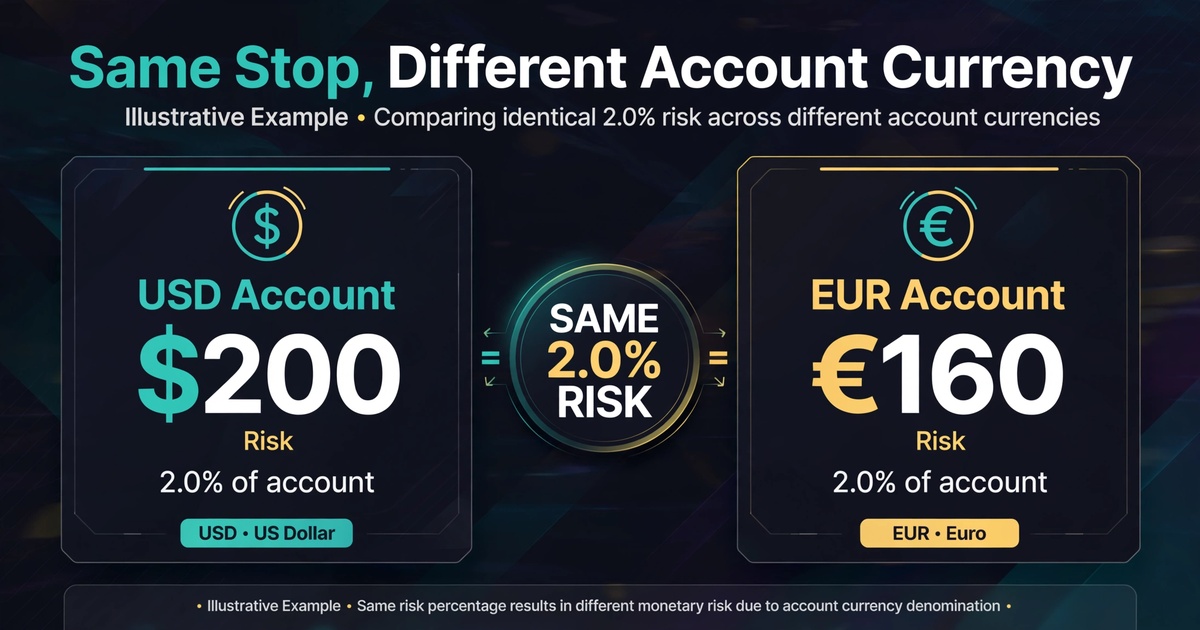
This is a hypothetical example for illustration only.
| USD account | EUR account | |
|---|---|---|
| Starting balance | $10,000 | €8,000 |
| Pip value (0.50 lots) | $5.00 | €4.00 (at 1.2500) |
| Loss if the 40-pip stop is hit | $200 | €160 |
| Loss as a share of balance | 2.0% | 2.0% |
The percentage risk is identical. Only the unit changed. The 2% figure is chosen purely to keep the arithmetic clean, not as a suggested risk level. Leverage still magnifies losses in either account, and a stop can fill worse than planned in fast markets.
The Quiet Exchange-Rate Position Inside Your Balance
Account currency matters most at the edges, when money goes in and out.
Say a trader living on euros deposits €8,000 into a USD account. At a hypothetical EUR/USD of 1.2500, that becomes $10,000. Over the next few months the trader breaks exactly even on trades, so the balance is still $10,000.
Now compare withdrawals:
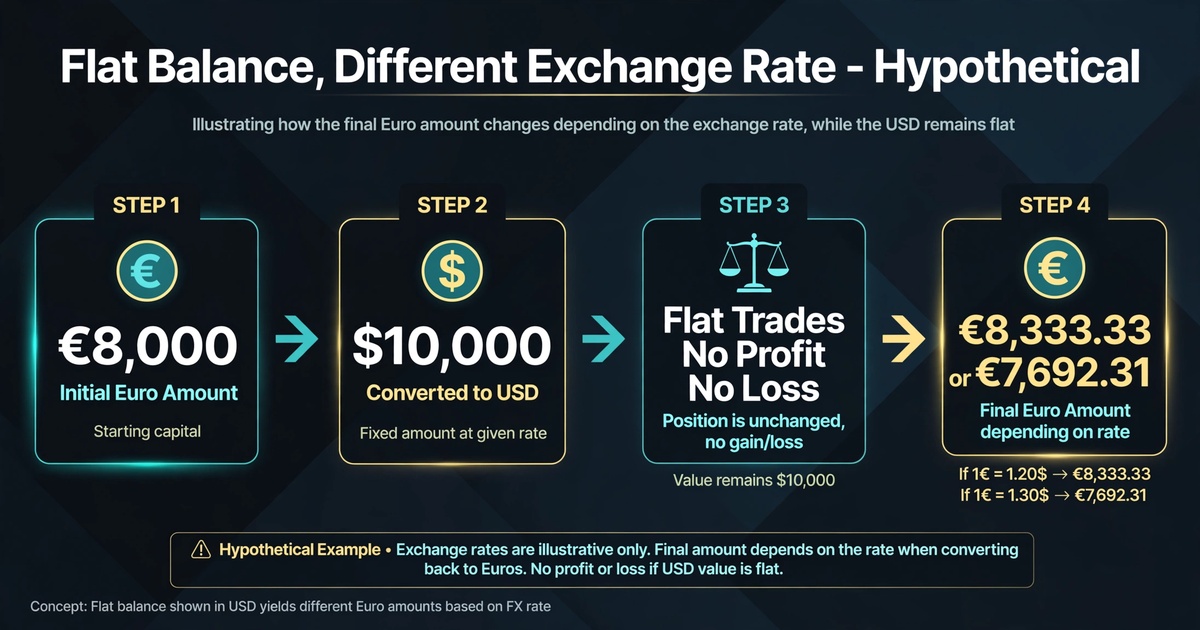
- If EUR/USD has fallen to 1.2000, $10,000 converts to €8,333.33. That’s a €333.33 gain with no trading edge involved.
- If EUR/USD has risen to 1.3000, $10,000 converts to €7,692.31. That’s a €307.69 loss on a flat trading record.
This is a hypothetical example for illustration only, and it ignores conversion fees, which would reduce both outcomes.
The same trader in a EUR account would see €8,000 before and after. Nothing to explain. The exchange-rate swing didn’t vanish, though. It simply moved inside each trade’s conversion instead of sitting in the balance.
Why Many Traders Default to a USD Account
The USD is the quote currency in several widely traded pairs, including EUR/USD, GBP/USD, and AUD/USD. Those pairs have fixed pip values in a USD account, which keeps sizing math simple. Much English-language education and many calculators also assume dollars, so the numbers you read online match the numbers on your screen.
The trade-off is exposure. If your salary, rent, and withdrawals are in another currency, the dollar’s exchange rate against that currency becomes part of your results, as the example above showed. A USD account isn’t wrong in that situation. It just means you’re tracking one more moving number.
When a EUR Account Makes Sense
If you’re paid, banked, and withdraw in euros, a EUR account removes the funding conversion at both ends. Your balance reads in the currency you actually spend.
Expect more conversion in the pip values, though. Trading EUR/USD in a EUR account makes the euro the base currency, so the $10 pip value is converted back to euros and shifts slightly with price. Pairs quoted in other currencies, like GBP/USD, need a conversion too. Good calculators handle this, but your mental shortcuts need to change.
The Case For (and Against) a Local-Currency Account
Some brokers offer accounts in local currencies, though availability varies by broker, region, and payment method. The appeal is straightforward: if you fund and withdraw through local banking, you may avoid a conversion on both ends.
The costs are less obvious:
- More conversion inside trades. Most pairs you’d trade don’t include your local currency, so pip values are converted on almost every trade.
- Fewer broker options, and calculators or journals often default to USD, EUR, or GBP.
- Distorted risk feel. If your currency has large nominal values, a balance that looks huge can make a normal loss feel small. Track risk as a percentage of the balance, not as a raw number.
- Rules differ by country. Payment methods and regulations vary, so check your local regulator and the broker’s current terms.
Fees Hide in the Funding Step, Not the Chart
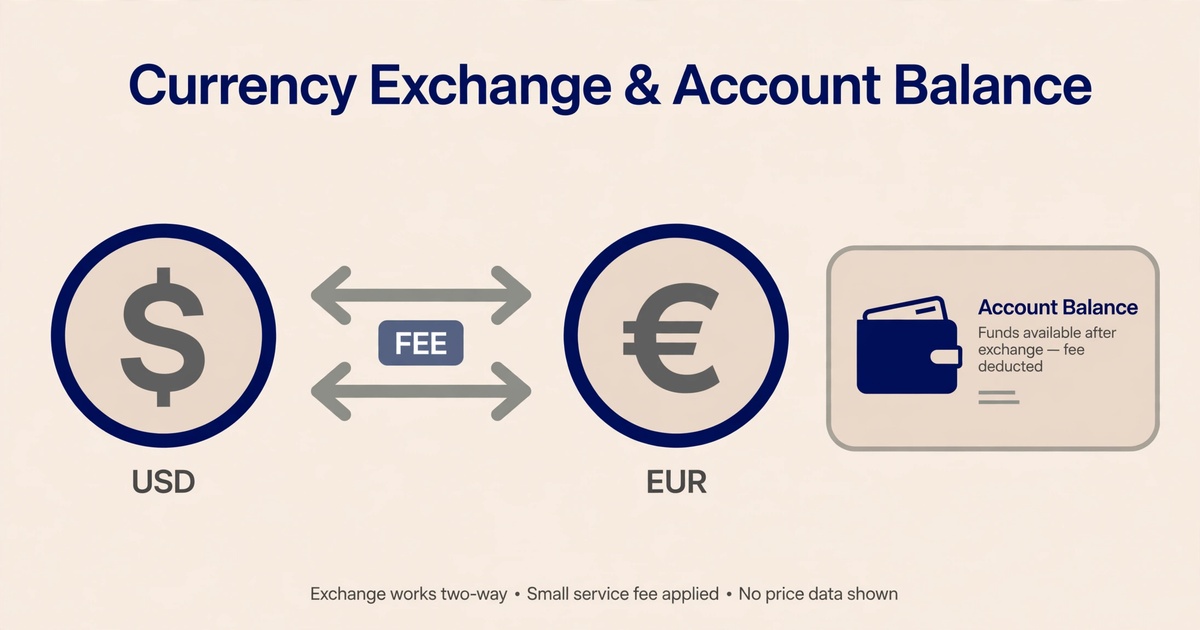
A tight spread doesn’t help much if every withdrawal loses a margin on the exchange rate. Conversion costs can show up in three places:
- Deposits and withdrawals. Your bank, payment processor, or the broker may convert at a rate that includes a markup.
- Profit and loss conversion. When the quote currency differs from your account currency, the broker applies its own conversion rate to each closed trade.
- Commissions and swaps. These may be quoted in one currency and converted into yours.
Fees vary by provider, so read the funding and conversion pages and compare the full path your money takes, not just the headline spread.
A Four-Question Test Before You Pick
- Which currency will you fund from and withdraw into?
- Which pairs will you trade most? Check whether your account currency appears in them. Our overview of major, minor, and exotic currency pairs shows how common pairs are built.
- What conversion do you face at each end? Look up the provider’s rate and fee terms.
- Can you switch later, and what does starting over cost?
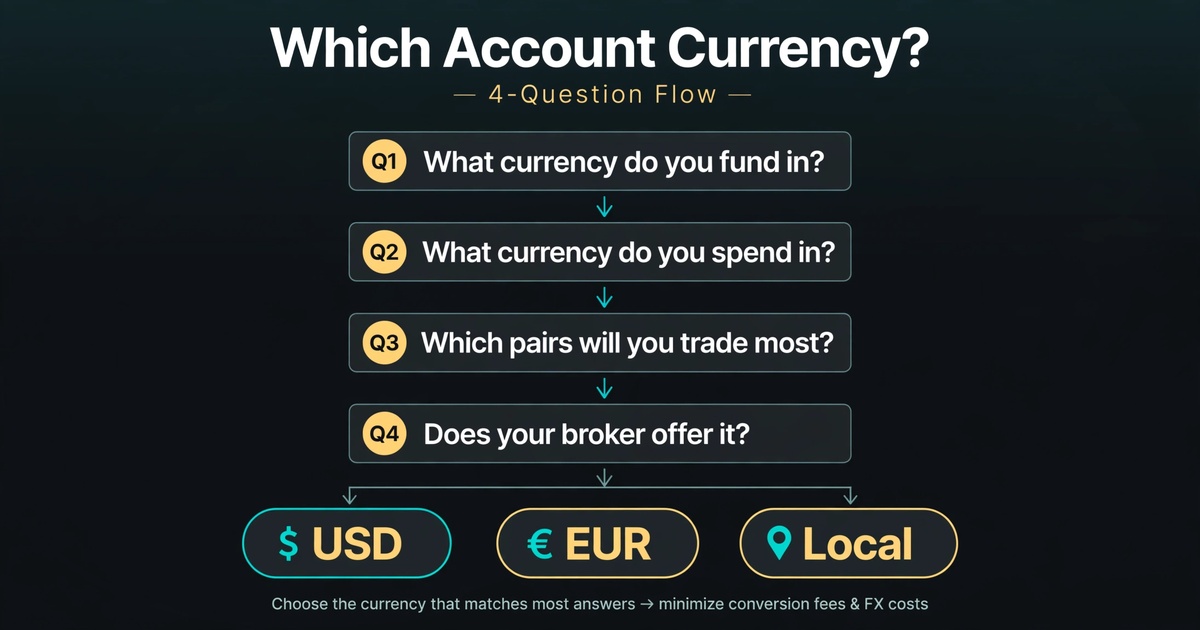
If questions 1 and 2 point to the same currency, the decision is easy. If they conflict, say a trader funds in euros but trades mostly USD-quoted pairs, you’re choosing which inconvenience to manage. A EUR account keeps funding simple but converts pip values. A USD account keeps pip values fixed but leaves exchange-rate exposure on the balance. Neither is wrong. Many demo accounts let you pick a currency, so you can compare how each feels before you commit real funds.
Choices Traders Regret After the First Withdrawal
- Taking the first dropdown option without checking how funding and withdrawal will work.
- Assuming the currency can be changed later, then discovering it means opening a new account.
- Reading results in the wrong currency. A flat USD balance can look like a gain or loss in your home currency, as the earlier example showed.
- Using a calculator set to the wrong account currency, which skews lot sizes on cross pairs.
- Treating a big nominal balance as a bigger cushion. Percentages matter, not the digits.
Exchange-Rate Risk That Sits Outside Your Strategy
Choosing an account currency doesn’t reduce trading risk. It decides where some extra risk shows up.
- Balance drift. If your account currency differs from the currency you live in, exchange-rate moves change the value of your balance on withdrawal, as in the flat-account example.
- Conversion costs. Markups on deposits, withdrawals, and trade conversions add up, especially on small accounts.
- Sizing errors. Using the wrong pip value on a cross pair can make your real risk larger than planned.
- Leverage. It magnifies both gains and losses in any currency, and you can lose some or all of your deposited capital.
- Availability and rules. Account currencies, payment methods, and protections differ by broker and country.
For a fuller look at managing these, see the complete guide to forex risk management.
Straight Answers on Base Currency and Funding
Can I change my forex account currency later?
Often not on the same account. Many brokers set the base currency when the account opens, so changing usually means opening a new account and transferring funds, which may involve conversion. Policies vary by broker, so check before you fund.
Does account currency change my profit or loss?
Not the price move itself. A 40-pip move is a 40-pip move. What changes is the unit it’s reported in and the conversion applied to pip value, so the same trade shows different numbers in a USD account and a EUR account.
Is a USD account better for beginners?
It’s a common choice because many pair quotes, lessons, and calculators use dollars. It isn’t automatically better. If you fund and withdraw in another currency, that exchange rate becomes part of your results.
Does the account currency affect leverage?
Leverage limits depend on the broker, your jurisdiction, and the instrument, not on the currency itself. Margin is held in your account currency, so check how your broker states requirements.
Do I need a different account currency for each pair?
No. One account trades many pairs, and the broker converts profit and loss into your account currency automatically. Pairs that include your account currency just make the math simpler.
Your Account Currency Is a Bookkeeping Choice With Real Edges
Account currency doesn’t predict anything or change what a pip is worth in the market. It changes where conversions happen and which exchange rate quietly rides along with your balance. Match it to how you fund and withdraw, then check it against the pairs you trade most.
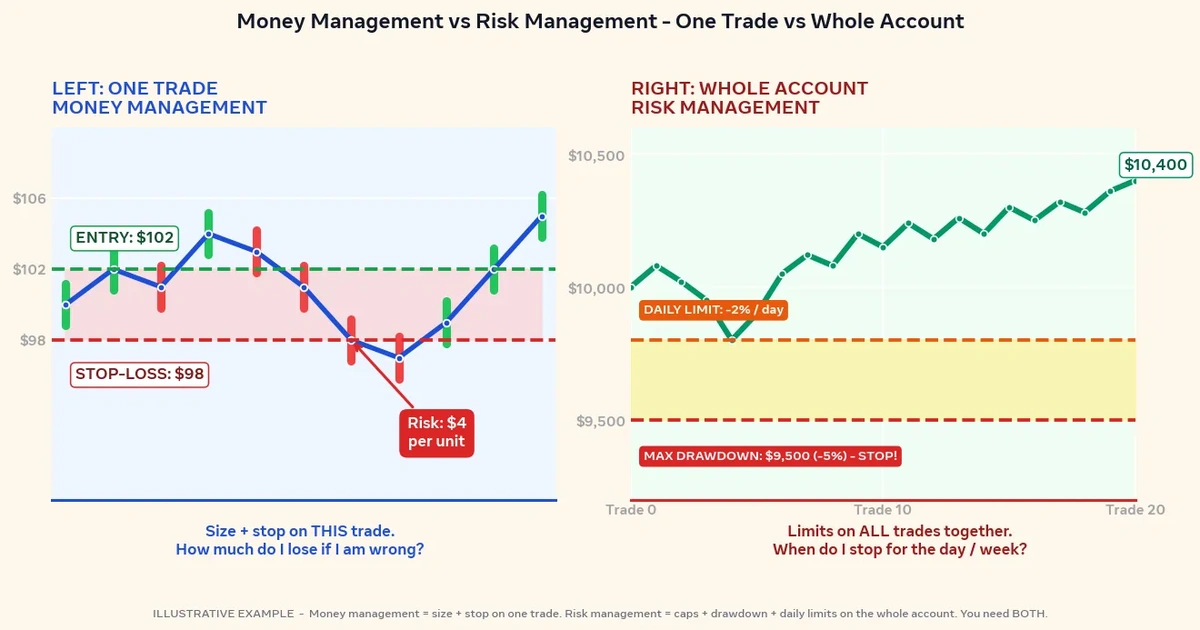
Before you open the signup form, write down your three most-traded pairs and your withdrawal currency. If you’d like to see how this connects to sizing positions, read our guide to money management in trading.
Disclaimer
This article is for educational purposes only and is not financial advice. Forex and CFD trading involves a high level of risk, and you can lose some or all of your capital. Leverage can magnify both gains and losses. Never trade with money you can’t afford to lose.
Join now
Comments (0)
Be the first to comment.