
Major, Minor, and Exotic Currency Pairs Explained
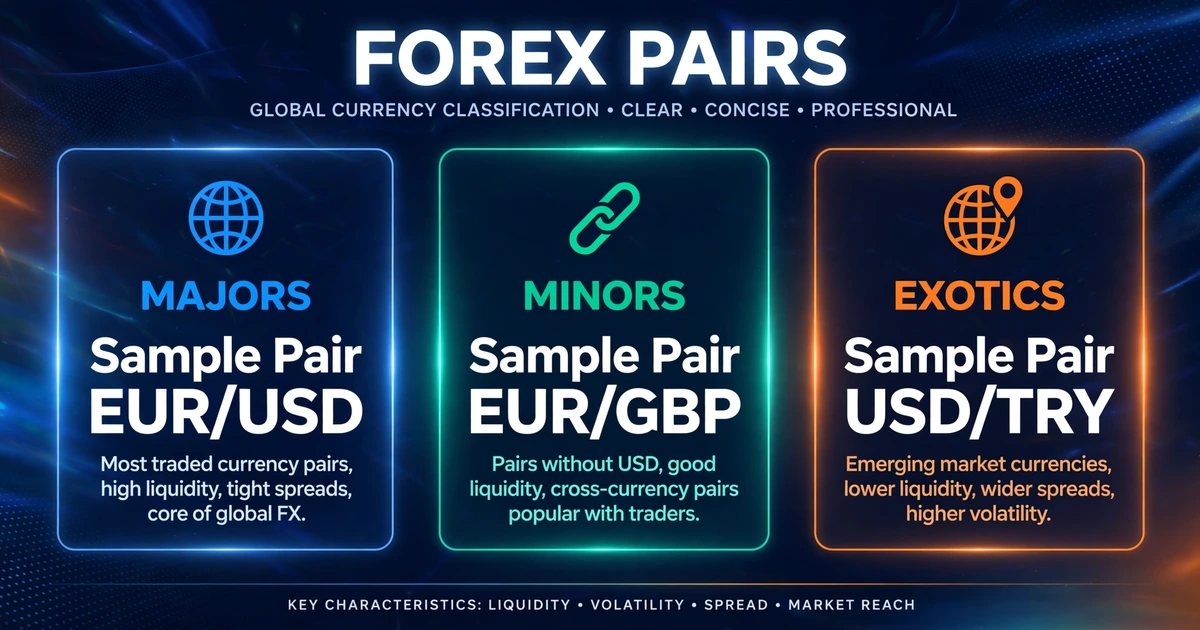
Forex brokers list dozens of pairs, and they’re usually sorted into three groups: majors, minors, and exotics. The labels sound technical, but they mostly describe how widely a pair is traded, and that affects what it costs and how it behaves. This guide explains major, minor, and exotic currency pairs, gives examples of each, and shows how trading costs and risk differ between them. You’ll see a hypothetical cost comparison with the math, plus a simple way to choose a pair without chasing whatever looks exciting.
Quick Answer
- Major pairs combine the US dollar with another widely traded currency, such as EUR/USD or USD/JPY. They’re generally the most liquid.
- Minor (cross) pairs combine two major currencies without the US dollar, such as EUR/GBP.
- Exotic pairs combine a major currency with one from a smaller or emerging economy, such as USD/TRY. They often have wider spreads and sharper swings.
- Exact lists vary by broker, and no group is risk-free.
How Currency Pairs Are Grouped
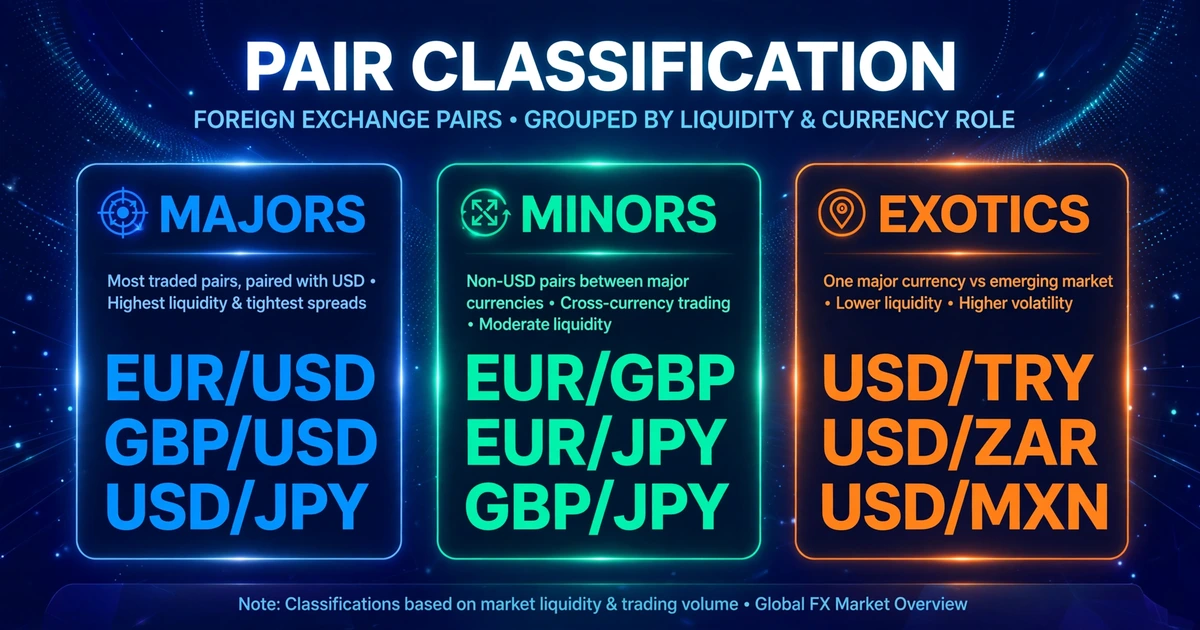
Every pair has a base and a quote currency, and the group it belongs to depends on which currencies are in it. If that idea is new, review base vs quote currency first.
The groups come from market convention, not a formal rulebook. Brokers and educators draw the lines slightly differently, so one platform’s “minor” might be another’s “exotic.” What matters is understanding the traits behind each label.
The US dollar is the reason for most of the structure. According to the BIS Triennial Survey, it sits on one side of most forex trades, which is why the dollar anchors the major pairs.
Major Currency Pairs
Majors pair the US dollar with another of the world’s most traded currencies. The usual list looks like this:
| Pair | Currencies | Common nickname |
|---|---|---|
| EUR/USD | Euro / US dollar | None |
| GBP/USD | British pound / US dollar | “Cable” |
| USD/JPY | US dollar / Japanese yen | None |
| USD/CHF | US dollar / Swiss franc | “Swissy” |
| AUD/USD | Australian dollar / US dollar | “Aussie” |
| USD/CAD | US dollar / Canadian dollar | “Loonie” |
| NZD/USD | New Zealand dollar / US dollar | “Kiwi” |
Some sources count only the first four as majors and call the rest “commodity pairs.” Both lists are common.
Why Majors Are Different
- Deep liquidity. Many buyers and sellers are active at once, so orders tend to fill smoothly. Liquidity comes from the dealer network behind the market, which you can read about in how the forex market works.
- Lower typical costs. Spreads are generally tighter than on other pairs, though they still vary by broker and widen around news.
- Easier math. For pairs quoted in US dollars, such as EUR/USD, pip value is simple on a US dollar account.
Majors can still move sharply. High liquidity doesn’t prevent slippage or gaps around major news.
Minor (Cross) Currency Pairs
Minors, also called cross pairs, combine two major currencies but leave out the US dollar. Examples include:
- EUR/GBP
- EUR/JPY
- GBP/JPY
- AUD/JPY
- EUR/CHF
- EUR/AUD
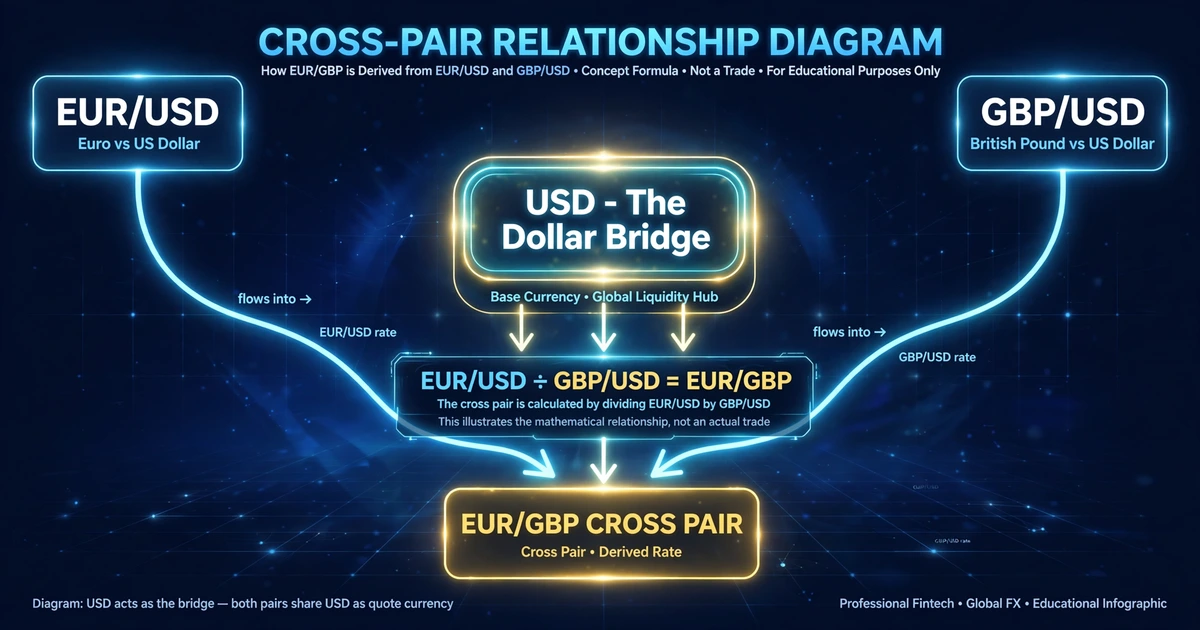
A cross price is closely linked to the two dollar pairs behind it. For instance, EUR/GBP relates to EUR/USD and GBP/USD.
What to Expect From Minors
- Moderate liquidity. They trade actively, but usually less than majors.
- Often wider spreads. The difference can be small or noticeable depending on the pair and the broker.
- Varied behavior. Some crosses stay calm for long stretches. Others, like pairs involving the British pound and Japanese yen, are known among traders for larger swings.
Many traders use crosses to isolate the relationship between two currencies without the dollar in the middle.
Exotic Currency Pairs
Exotics combine a major currency with the currency of a smaller or emerging economy. Common examples include:
- USD/TRY (US dollar / Turkish lira)
- USD/ZAR (US dollar / South African rand)
- USD/MXN (US dollar / Mexican peso)
- EUR/TRY
What Makes Exotics Riskier
- Thin liquidity. Fewer participants trade them, so orders can be harder to fill at the price you see.
- Wider spreads. The cost of entering and exiting is typically higher, sometimes much higher than on majors.
- Large swings. Economic and political events in the smaller economy can move prices quickly, and sometimes in jumps.
- Bigger overnight swaps. Interest rate differences between the two currencies can make holding costs (or credits) larger.
- Possible restrictions. Some brokers limit leverage or trading hours on exotics.
Because of these traits, exotics usually call for smaller position sizes and extra caution.
Majors vs Minors vs Exotics at a Glance
| Feature | Majors | Minors | Exotics |
|---|---|---|---|
| Includes the US dollar | Yes | No | Usually yes |
| Liquidity | Generally highest | Moderate | Generally lowest |
| Typical spread cost | Generally lower | Moderate | Generally higher |
| Volatility | Varies, often moderate | Varies, some pairs larger | Often higher, can jump |
| Overnight swaps | Usually moderate | Usually moderate | Can be large |
These are general tendencies, not rules. Check live conditions on your own platform.
A Hypothetical Cost Comparison
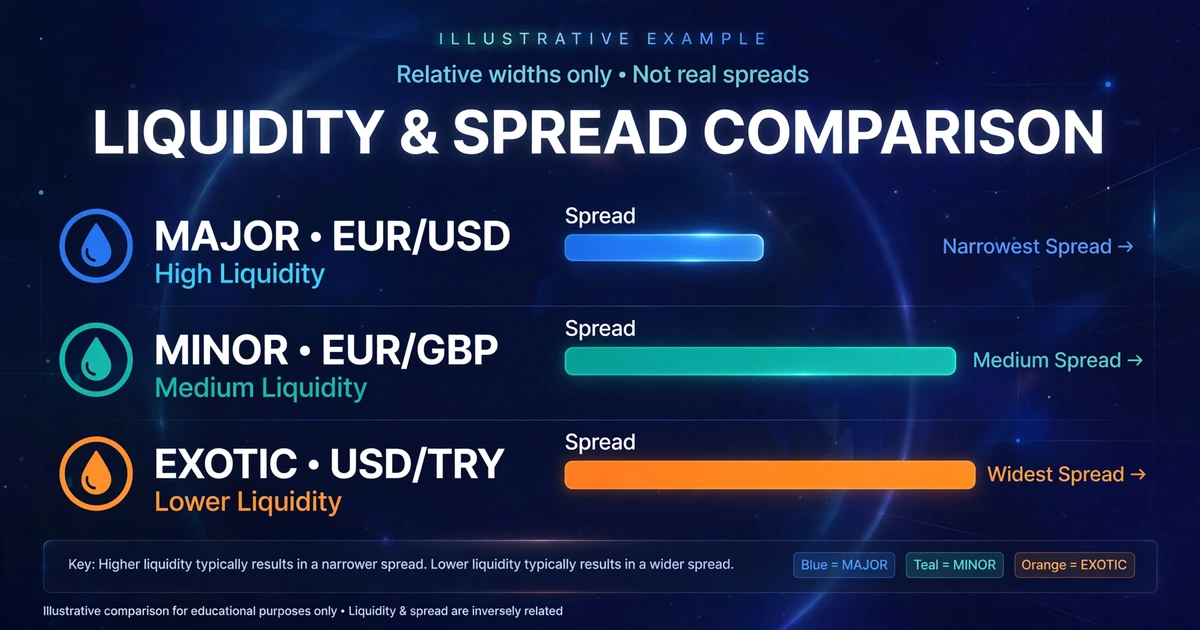
Trading costs shape results more than many beginners expect. This is a hypothetical example for illustration only.
Assume you trade 1 micro lot and, for simplicity, each pip is worth $0.10. (Real pip values differ by pair and account currency.)
- Pair A (a major): 1-pip spread, so entry cost = 1 × $0.10 = $0.10
- Pair B (an exotic): 25-pip spread, so entry cost = 25 × $0.10 = $2.50
On Pair B, the price has to move 25 pips in your favor before you reach break-even. On Pair A, it needs only 1. Over many trades, that gap adds up. Real spreads vary by broker and market conditions, so use your own platform’s numbers.
How to Choose a Pair
There’s no universally right pair. Many traders weigh a few practical factors.
- Cost. Compare spreads, commissions, and swaps on the pairs you’re considering.
- Trading hours. Pairs tend to be most active when their home sessions are open. EUR/USD, for example, is typically busier during the London and New York hours, while yen and Australian dollar pairs tend to see more activity during Asian hours. See forex trading sessions for the schedule.
- Pip value. Know what one pip is worth in your account currency before sizing a trade.
- Behavior. Review how the pair has typically moved on your timeframe. Past behavior doesn’t guarantee future moves.
- Focus. Learning a small number of pairs well is generally easier than watching many at once.
Watch for Overlapping Exposure
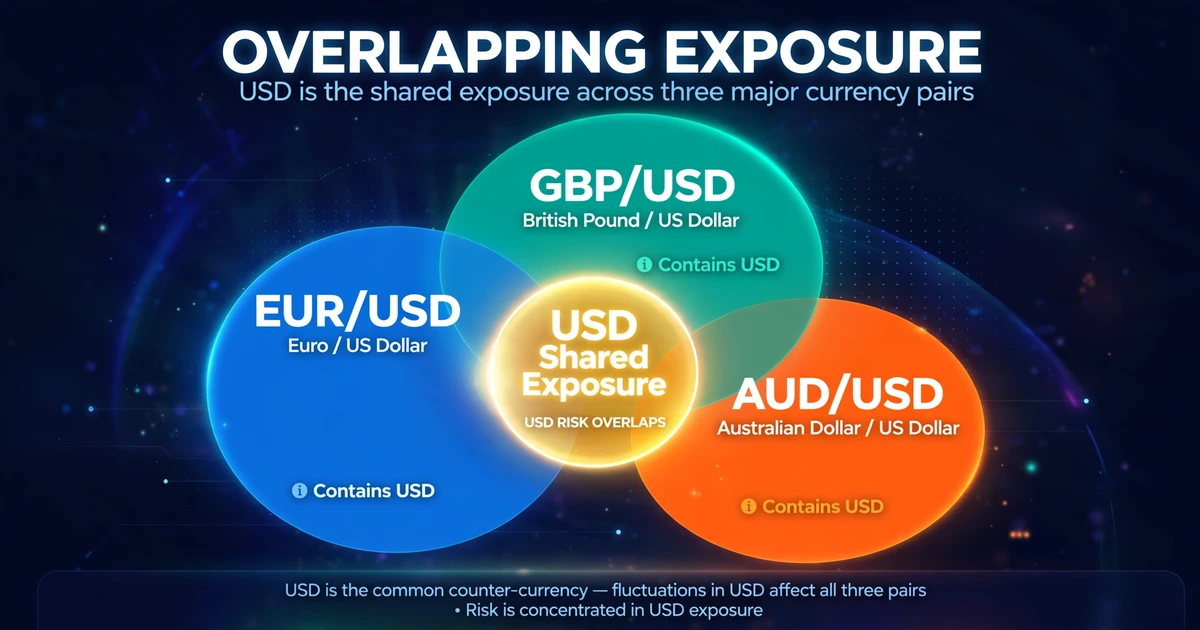
Pairs that share a currency can move together at times. EUR/USD, GBP/USD, and AUD/USD all include the US dollar, so holding all three can multiply your exposure to a single move. The same applies to EUR/JPY and GBP/JPY with the yen. Correlations change, so treat them as a prompt to check your total risk, not as a rule.
Common Beginner Mistakes
- Starting with exotics for the “bigger moves.” Larger swings mean larger losses too, and wider spreads work against you from the start.
- Ignoring spreads. A pair that moves a lot but costs a lot may not suit your style.
- Trading a pair at the wrong hours. Liquidity and spreads can change a lot outside the pair’s active sessions.
- Over-diversifying. Trading many pairs at once makes it harder to track risk.
- Stacking correlated positions. Several trades on dollar pairs can behave like one large trade.
- Assuming every broker groups pairs the same way. Lists and conditions vary.
Risks and Limitations
- Leverage works both ways. It magnifies losses on every pair, and you can lose some or all of your deposit.
- Slippage and gaps. Fills can land at worse prices, especially on exotics or during major news.
- Spreads aren’t fixed. They can widen sharply in thin or volatile conditions, on any pair.
- Event risk. Central bank decisions, elections, and economic shocks can move pairs suddenly.
- Exotic-specific risks. Thin liquidity, large swaps, and possible broker restrictions can raise costs and make exits harder.
- Rules vary by country. Leverage limits and available pairs depend on your regulator and broker.
Results vary, and there is no guarantee of profit.
Frequently Asked Questions
Which currency pairs are the majors?
The majors are generally EUR/USD, GBP/USD, USD/JPY, and USD/CHF, and many lists add AUD/USD, USD/CAD, and NZD/USD. Each pairs the US dollar with another widely traded currency. The exact list differs slightly between brokers and educators.
What is a minor currency pair?
A minor, or cross pair, combines two major currencies without the US dollar. EUR/GBP, EUR/JPY, and GBP/JPY are common examples. Minors usually have lower liquidity and wider spreads than majors, though the difference depends on the pair and the broker.
Why are exotic pairs more expensive to trade?
Fewer participants trade them, so dealers quote wider spreads to cover their own risk. Exotics can also carry larger swap charges and sharper price jumps. Together, those factors can make exotic pairs noticeably costlier than majors.
Should beginners trade exotic pairs?
Exotics aren’t required, and many beginners learn the basics on more liquid pairs first. Wider spreads and sharper swings make mistakes costlier. Whichever pair you choose, practice on a demo account and keep position sizes small.
Does the same strategy work on all pairs?
Not necessarily. Pairs differ in volatility, spreads, and active hours, so a strategy that suits one pair may perform differently on another. Test any approach on a demo account, pair by pair, and remember that past results don’t guarantee future performance.
Key Takeaway and Next Step
Major, minor, and exotic currency pairs mainly differ in liquidity, cost, and how sharply they move. Majors are generally the most liquid, minors sit in the middle, and exotics usually cost more and swing harder. Before you trade any pair, check its spread, its active hours, and what one pip is worth in your account currency. A sensible next step is to watch two or three pairs on a demo account and compare their spreads at different times of day. If the basics still feel unclear, revisit what forex trading is.
Disclaimer
This article is for educational purposes only and is not financial advice. Forex and CFD trading involves a high level of risk, and you can lose some or all of your capital. Leverage can magnify both gains and losses. Never trade with money you can’t afford to lose.
Any percentages or figures shown are historical averages or hypothetical examples, not guarantees. Past performance does not predict future results.
Join now
Comments (0)
Be the first to comment.