
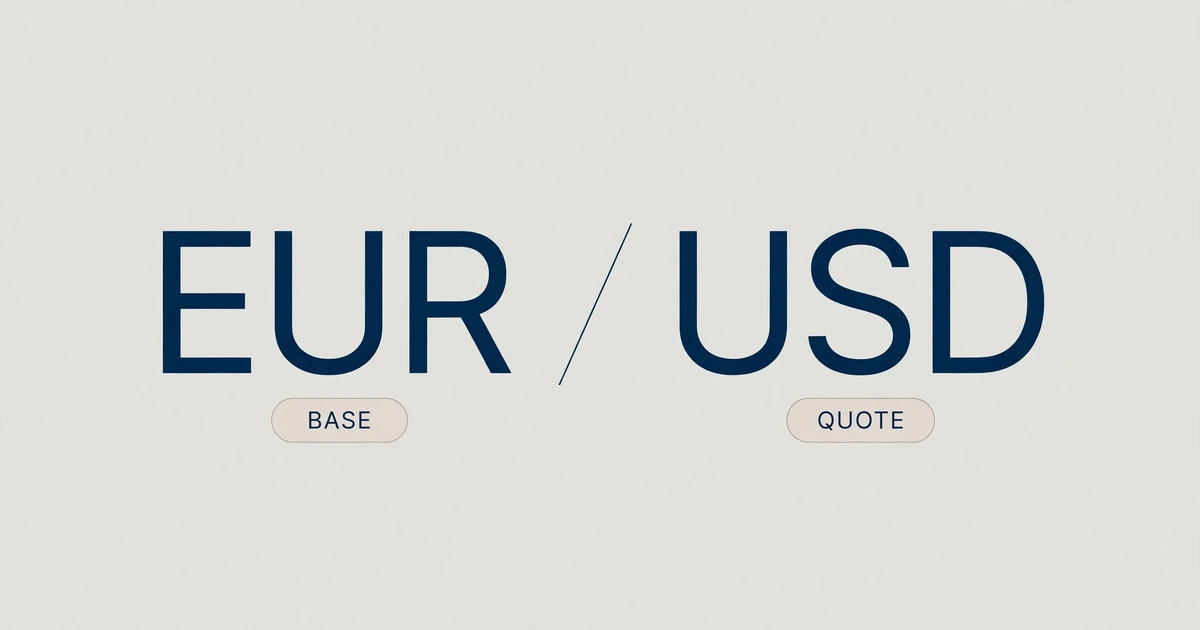
What Is a Currency Pair? Base vs Quote Currency Explained
Every forex trade involves two currencies, not one. A currency pair is how the market quotes them, with one currency priced in terms of the other. Misreading it is one of the most common beginner errors, and it can leave you buying when you meant to sell. This guide explains what a currency pair is, how base and quote currencies work, and how to read a quote such as EUR/USD. You’ll see worked examples with hypothetical numbers, plus the mistakes to avoid and the risks that come with trading pairs.
Quick Answer
- A currency pair shows the value of one currency (the base) in terms of another (the quote).
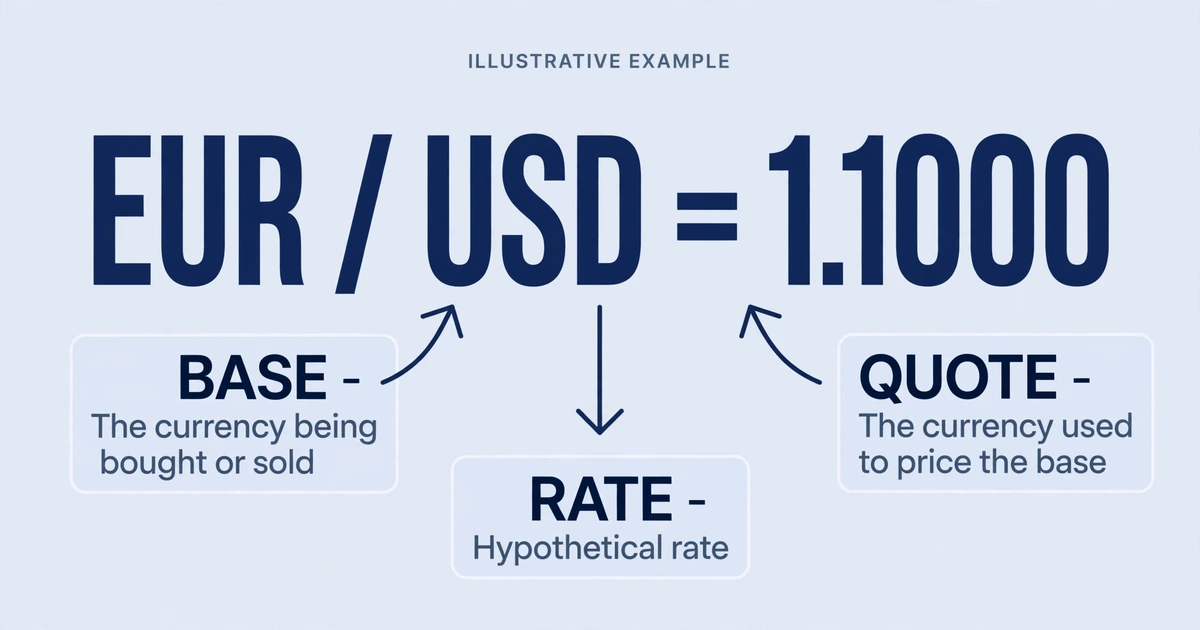
- In EUR/USD, EUR is the base and USD is the quote. A rate of 1.1000 means 1 euro costs 1.1000 US dollars.
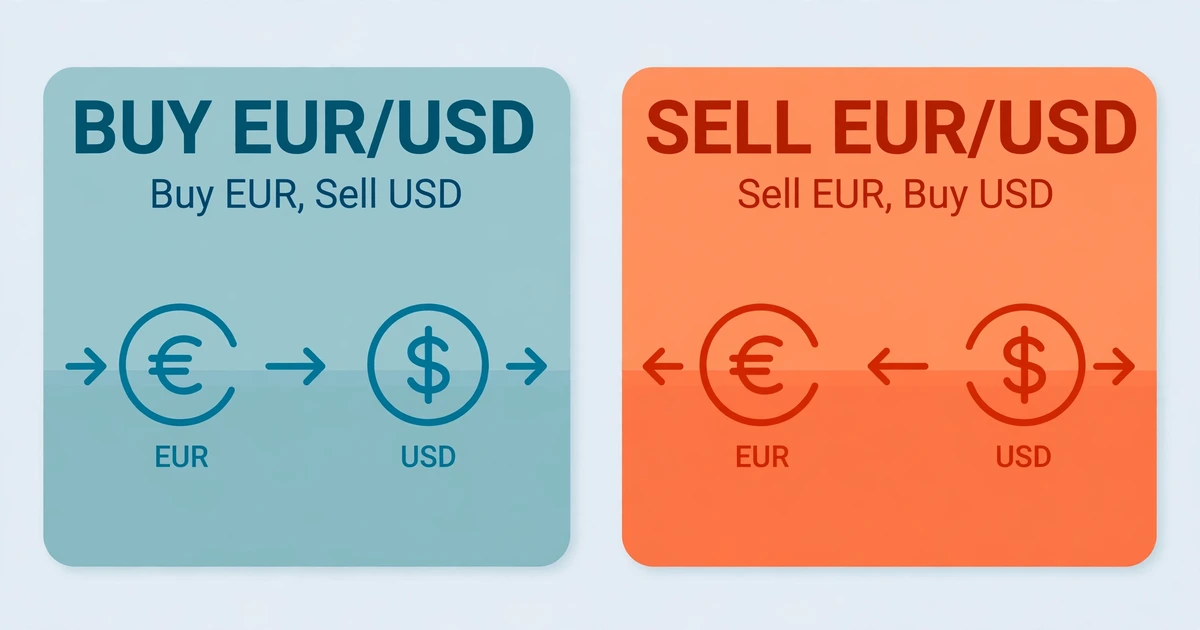
- Buying a pair means buying the base and selling the quote. Selling a pair does the opposite.
- Pip value is calculated in the quote currency, then converted to your account currency.
What Is a Currency Pair?
A currency pair is a quote that shows how much of one currency you need to buy one unit of another. Forex has no single “price of the euro.” The euro only has a price relative to something else, such as the US dollar or the Japanese yen.
That’s why every forex trade is two trades in one. When you open a position, you buy one currency and sell the other at the same time. Your profit or loss depends on how the two currencies move relative to each other.
Base vs Quote Currency
Every pair is written as BASE/QUOTE.
- The base currency is the first one listed. It’s always worth exactly 1 unit in the quote.
- The quote currency is the second one listed. It’s the currency used to price the base.
Here’s a hypothetical quote for illustration only:
| Part of the quote | Example (EUR/USD = 1.1000) | What it means |
|---|---|---|
| Base currency | EUR | The currency being priced (always 1 unit) |
| Quote currency | USD | The currency used to set the price |
| Rate | 1.1000 | 1 EUR costs 1.1000 USD |
A simple way to remember it: the base is the thing you’re buying or selling, and the quote is the money you’re measuring it in. If the rate rises, the base is worth more in quote currency terms. If it falls, the base is worth less.
Buying and Selling a Currency Pair
This is where beginners get confused, so here’s the rule:
- Buy (go long) EUR/USD: you buy euros and sell dollars. You expect the euro to strengthen against the dollar.
- Sell (go short) EUR/USD: you sell euros and buy dollars. You expect the euro to weaken against the dollar.
You always act on the base currency. The quote currency is on the other side of the trade.
A Hypothetical Example
Assume EUR/USD is quoted at 1.1000, you trade 1 micro lot (1,000 units of the base), and one pip is worth $0.10 on a US dollar account. This is a hypothetical example for illustration only.
If you buy at 1.1000 and the rate rises to 1.1050:
- Move: 1.1050 − 1.1000 = 0.0050, or 50 pips
- Result: 50 × $0.10 = $5 gain
If you sell at 1.1000 and the rate falls to 1.0950:
- Move: 50 pips in your favor
- Result: $5 gain
If the rate moves against you by the same 50 pips in either case, the result is a $5 loss. Leverage can turn small price moves into large account swings, so position size matters.
Bid, Ask, and the Spread
A pair shows two prices, not one.
- The ask is the price you pay to buy the base currency.
- The bid is the price you receive when you sell it.
- The spread is the difference between them.
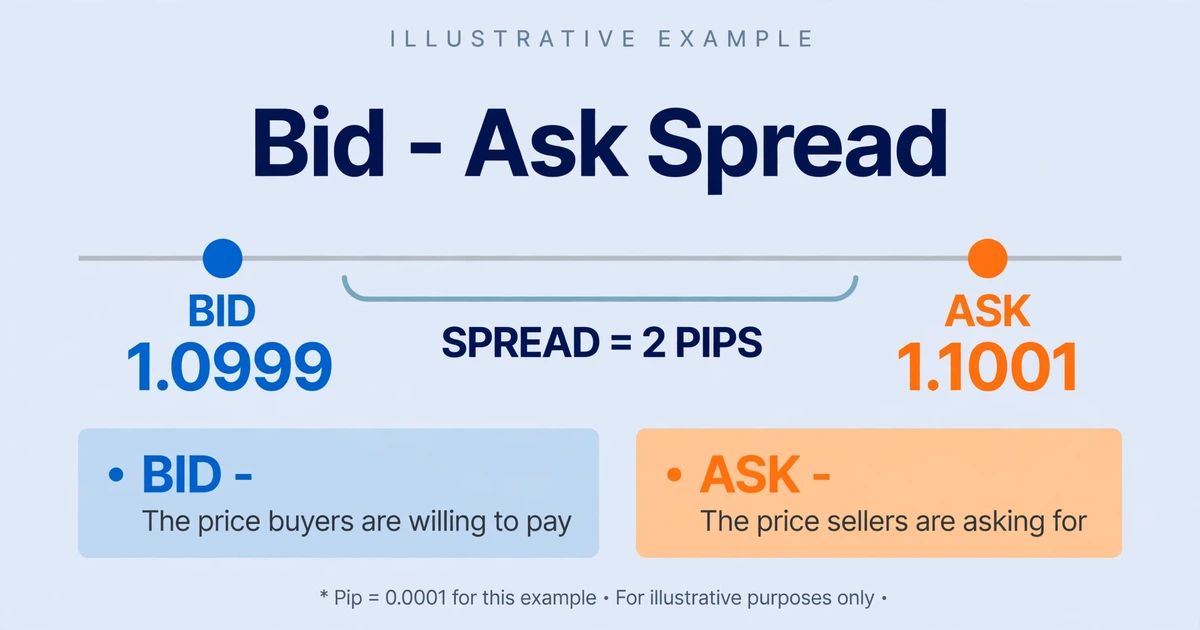
Say a hypothetical quote is bid 1.0999 and ask 1.1001. The spread is 0.0002, or 2 pips. On a micro lot, that’s about 2 × $0.10 = $0.20, which you pay as a cost the moment you open the trade. Spreads vary by pair, broker, and market conditions.
Prices come from a global network of banks and liquidity providers rather than a single exchange. For the bigger picture, see how the forex market works.
Why Pairs Are Written in a Set Order
You’ll see EUR/USD, not USD/EUR. Pair names follow market convention. The euro, British pound, Australian dollar, and New Zealand dollar are typically quoted as the base against the US dollar (EUR/USD, GBP/USD, AUD/USD, NZD/USD). The US dollar is usually the base against the Canadian dollar, Swiss franc, and Japanese yen (USD/CAD, USD/CHF, USD/JPY).
This matters because the order tells you which currency you’re actually buying or selling. A platform won’t flip the pair for you. If you want to take the opposite side of EUR/USD, you sell it. You don’t look for USD/EUR.
Types of Currency Pairs
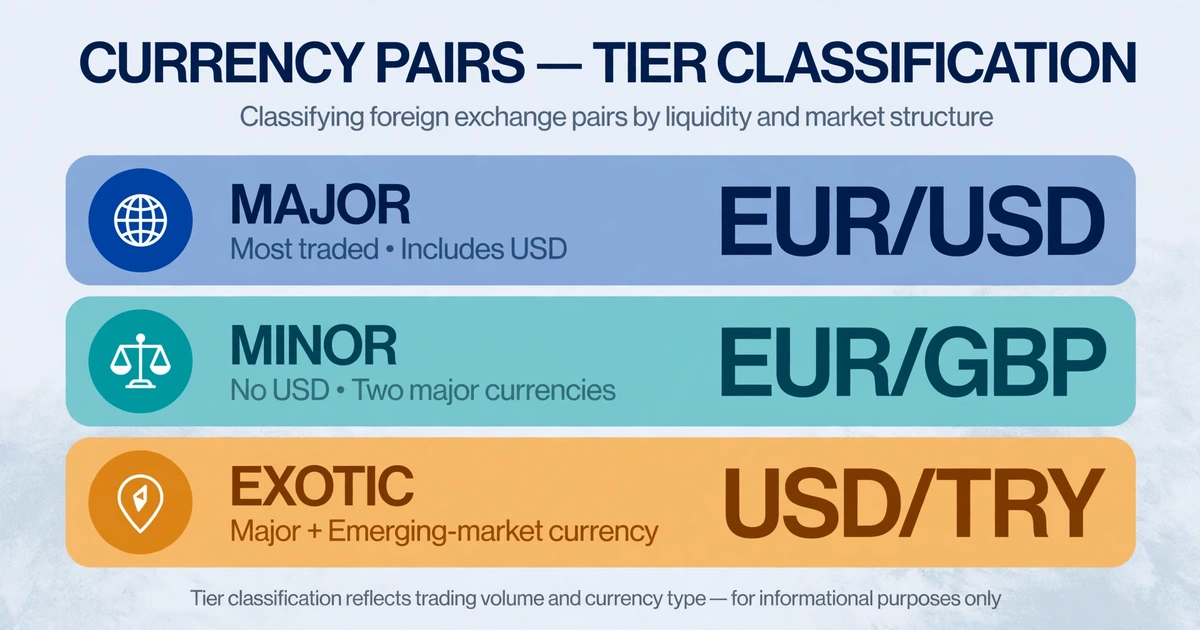
Pairs are commonly grouped by how widely they’re traded. Here’s a brief summary, and you can read more about major, minor, and exotic currency pairs in a dedicated guide.
- Majors include the US dollar paired with another widely traded currency, such as EUR/USD or USD/JPY. They’re generally the most actively traded.
- Minors (cross pairs) don’t include the US dollar, such as EUR/GBP. They’re typically less liquid than majors.
- Exotics pair a major currency with the currency of a smaller or emerging economy. They often come with wider spreads and larger price swings.
Costs, liquidity, and volatility differ across all three groups, so check the conditions on your own platform before trading any pair.
How the Quote Currency Affects Pip Value
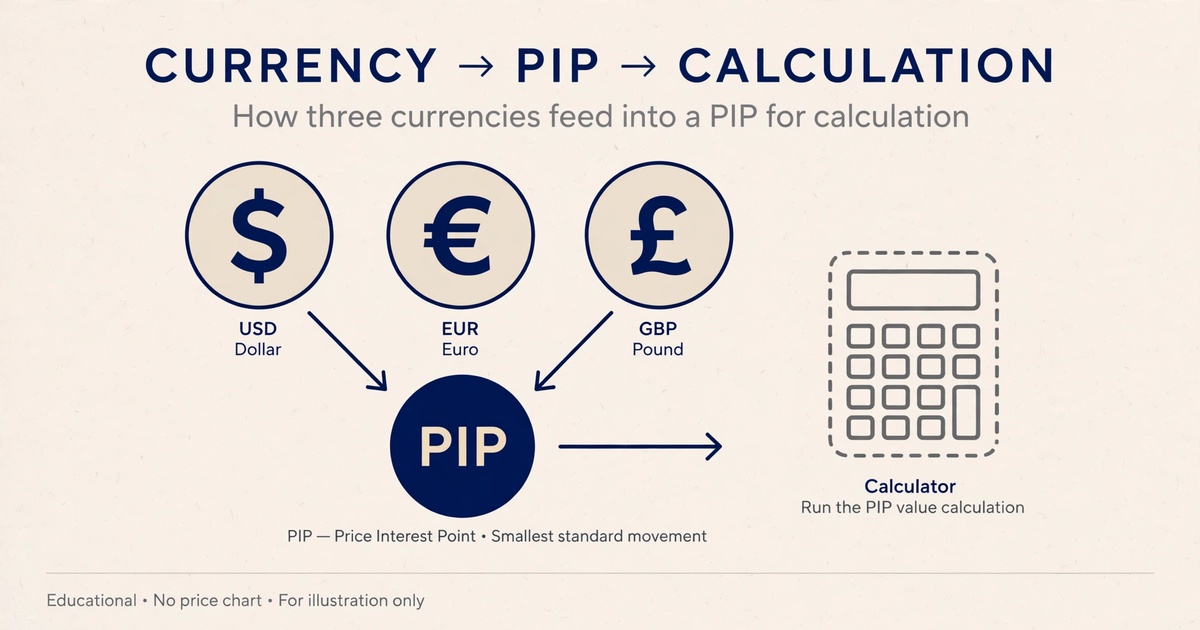
A pip is the standard unit of price movement. For most pairs it’s the fourth decimal place (0.0001), and for pairs involving the yen it’s usually the second (0.01).
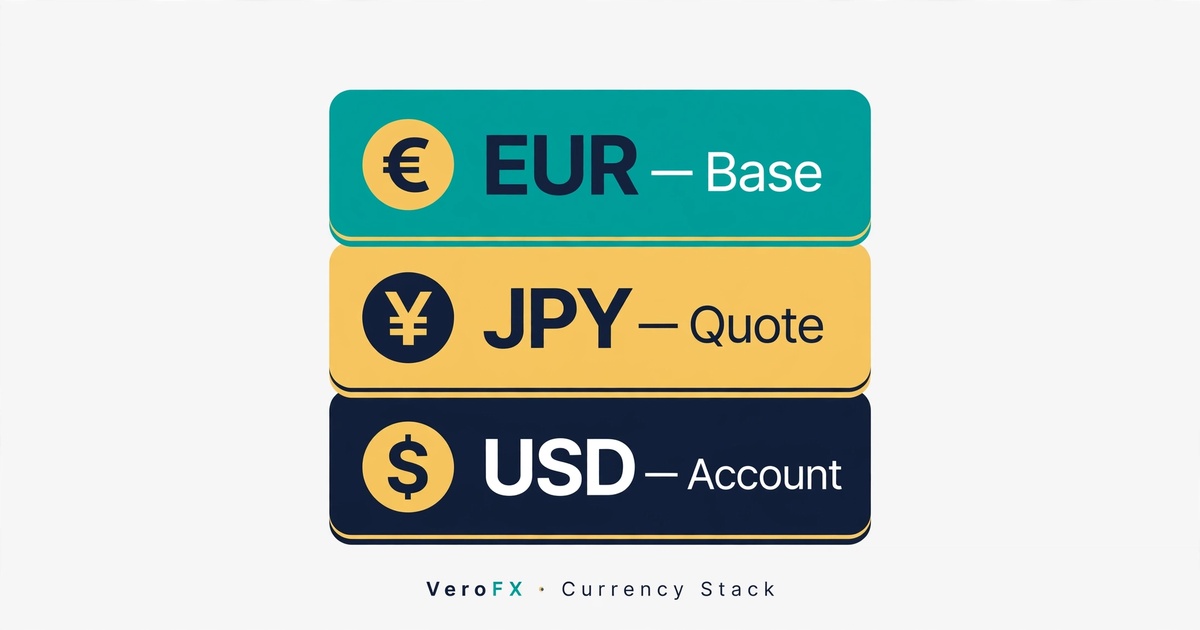
Pip value is first calculated in the quote currency, then converted to your account currency.
- EUR/USD: one standard lot (100,000 units) moves $10 per pip, so a US dollar account needs no conversion.
- USD/JPY: one standard lot moves 1,000 yen per pip (100,000 × 0.01). Your broker converts that into your account currency at the current rate.
So the same lot size can produce different pip values depending on the pair and your account currency. A position size calculator handles this, but understanding why helps you avoid sizing errors.
What You’re Really Trading
A pair’s price moves because of the relative strength of two currencies. If EUR/USD rises, it could be because the euro strengthened, the dollar weakened, or both.
Pairs that share a currency can also move together at times. EUR/USD and GBP/USD, for example, both involve the dollar, so holding both can effectively double your exposure to the same move. That correlation isn’t constant, so don’t rely on it, but keep it in mind when you open more than one position.
Common Beginner Mistakes
- Mixing up base and quote. Always check which currency you’re buying before you click buy or sell.
- Forgetting the other side of the trade. You’re never trading one currency alone.
- Ignoring pip value on non-USD pairs. A pair quoted in yen or Swiss francs doesn’t have a $10 pip.
- Trading a pair without checking its cost. Spreads and swaps differ by pair and provider.
- Stacking correlated pairs. Opening several pairs that share a currency can multiply the same risk.
- Picking pairs by name recognition. Know how a pair behaves, and when it’s most active, before you trade it.
Risks and Limitations
Understanding currency pairs doesn’t remove the risk of trading them.
- Leverage magnifies losses as well as gains. A small adverse move can cost a large share of your account, and you can lose some or all of your deposit.
- Prices can gap or slip. A stop-loss order may fill at a worse price in fast markets or around major news.
- Costs add up. Spreads, commissions, and swaps apply whether or not a trade wins.
- Pairs behave differently. Volatility and liquidity vary by pair and by time of day, so a rule that suits one pair may not suit another.
- Rules vary by country. Leverage limits and trading regulations differ, so check your local regulator.
Results vary, and there is no guarantee of profit.
Frequently Asked Questions
What is the base currency in a currency pair?
The base currency is the first one listed in a pair. In EUR/USD, the euro is the base. It’s always worth exactly one unit, and the quote currency tells you how many units of it you need to buy one unit of the base.
How do I tell the base and quote currency apart?
Read the pair left to right. The first currency is the base, and the second is the quote. In GBP/JPY, the pound is the base and the yen is the quote. A quote of 190.00 means one pound costs 190 yen (a hypothetical figure).
Why is it EUR/USD and not USD/EUR?
It’s a market convention for how pairs are named and quoted. The euro is conventionally quoted as the base against the dollar. Trading platforms follow this standard, so if you want the opposite exposure, you sell EUR/USD rather than look for a reversed pair.
Does buying EUR/USD mean the euro will rise?
Buying EUR/USD means you expect the euro to strengthen relative to the dollar. The rate can rise because the euro gains, because the dollar weakens, or both. You’re trading the relationship between two currencies, and the outcome isn’t guaranteed.
How many currency pairs can I trade?
Brokers typically offer dozens of pairs, but the list varies by provider and region. Majors are usually available everywhere, while some minors and exotics may not be. Check your own platform’s list and each pair’s costs before you trade.
Key Takeaway and Next Step
A currency pair is one price built from two currencies, with the base on the left and the quote on the right. Before any trade, you should be able to say which currency you’re buying, which you’re selling, and what one pip is worth in your account currency. A sensible next step is to open a demo account and place a few practice trades on a single pair, noting what each quote means. If the basics still feel shaky, revisit what forex trading is.
Disclaimer
This article is for educational purposes only and is not financial advice. Forex and CFD trading involves a high level of risk, and you can lose some or all of your capital. Leverage can magnify both gains and losses. Never trade with money you can’t afford to lose.
Any percentages or figures shown are historical averages or hypothetical examples, not guarantees. Past performance does not predict future results.
Join now
Comments (0)
Be the first to comment.