
What Is Forex Trading? A Complete Beginner’s Guide
Forex trading is the buying and selling of currencies in the hope that an exchange rate moves in your favor. The idea is simple. The details are where beginners get tripped up: pips, lots, leverage, spreads, and the risk that comes with all of them. This guide explains what forex trading is, how a trade works, what it costs, and where the danger sits, using hypothetical examples with the math shown. It’s based on widely taught trading concepts, not personal trade results, and it won’t promise profit. It will give you a solid foundation before you open even a demo account.
Quick Answer
- Forex trading means speculating on the price of one currency against another, such as the euro against the US dollar (EUR/USD).
- You profit if the rate moves the way you predicted, and you lose if it moves against you.
- Most retail traders use leverage, which magnifies both gains and losses and can wipe out your deposit.
- Learn the mechanics and practice on a demo account first. There’s no guarantee of profit.
What Is Forex Trading?
Forex (foreign exchange) is the global market where currencies are exchanged. Businesses use it to pay overseas suppliers, banks use it to move money, and travelers use it every time they swap cash at an airport. Speculators, including retail traders like you, use it to try to profit from price changes. According to the BIS Triennial Survey, which tracks the market every three years, trading volume runs to trillions of dollars a day, making it one of the largest financial markets in the world.
As a retail trader, you don’t take delivery of currency. In many regions, brokers offer forex through margin products or contracts for difference (CFDs). You open a position, the price moves, and you close it for a gain or a loss.
Currency Pairs: Base and Quote
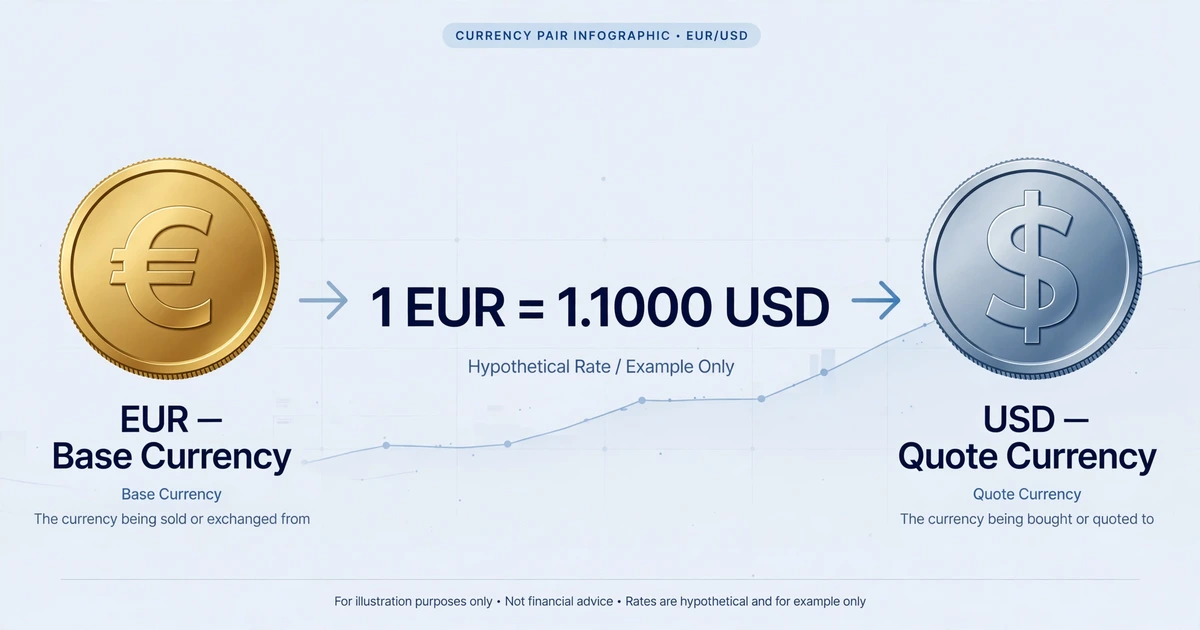
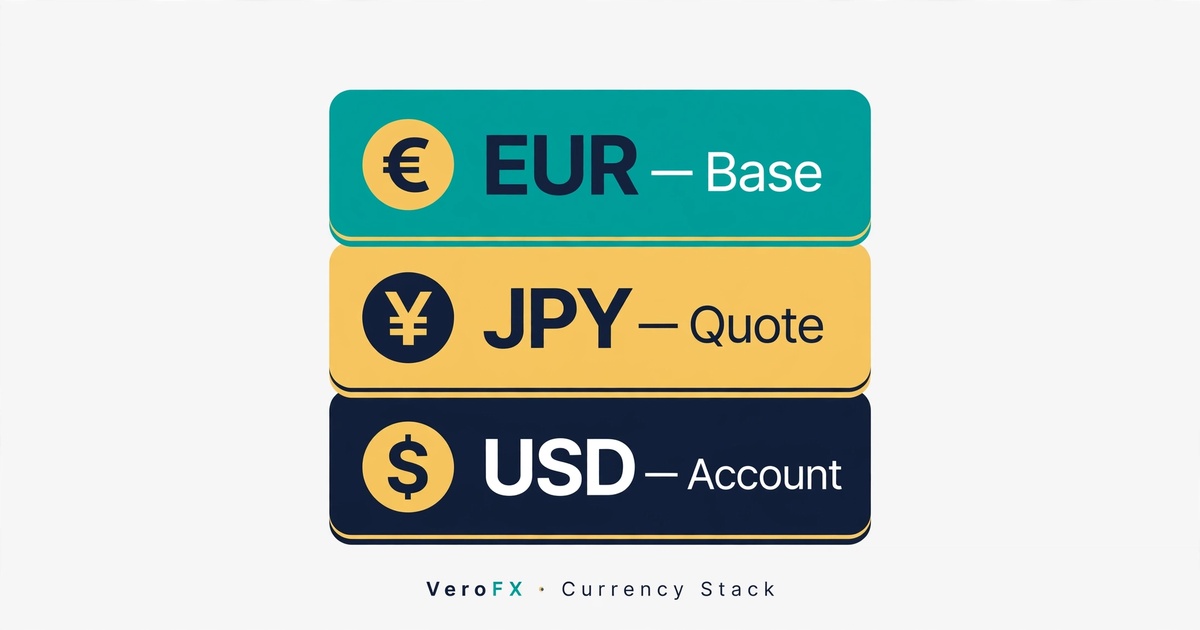
Currencies always trade in pairs. In EUR/USD, the first currency (EUR) is the base and the second (USD) is the quote. If EUR/USD is 1.1000, one euro costs 1.10 US dollars.
- Buying (going long) the pair means you expect the base currency to strengthen against the quote.
- Selling (going short) means you expect it to weaken.
You never trade a currency in isolation. Every trade is a bet on the relative strength of two economies’ currencies.
How Forex Trading Works: A Simple Example
Here’s a hypothetical example for illustration only.
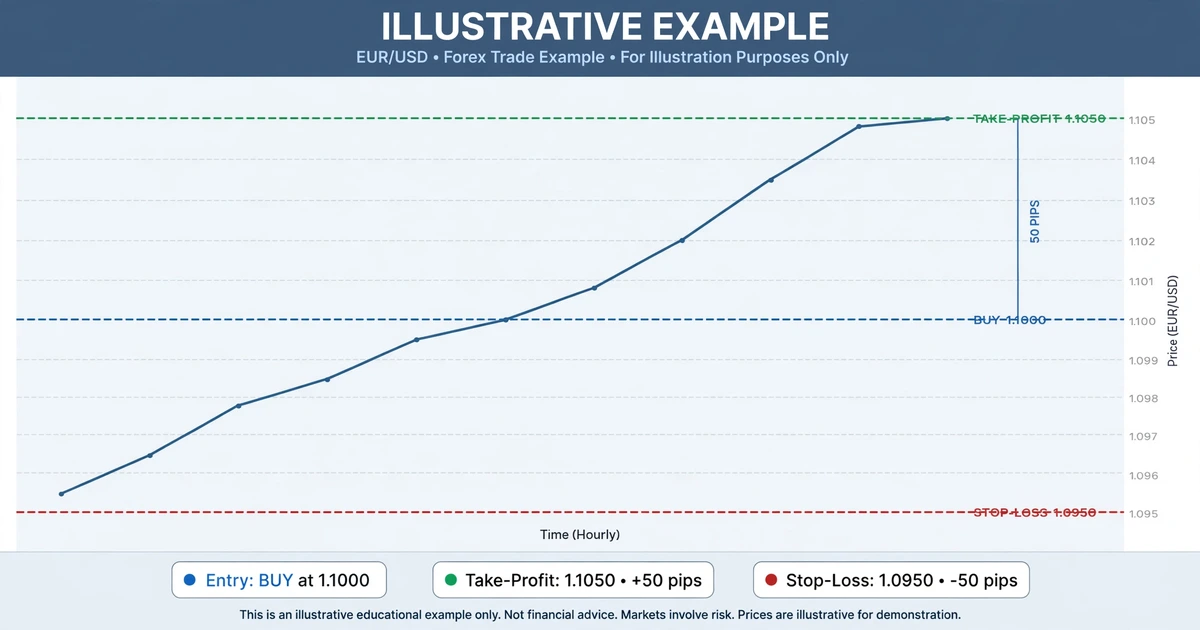
Say EUR/USD is trading at 1.1000, and you believe the euro will strengthen. You buy 1 micro lot (1,000 euros’ worth). Later, the price rises to 1.1050, and you close the trade.
- Price change: 1.1050 − 1.1000 = 0.0050, or 50 pips
- Gain: 1,000 × 0.0050 = $5
If the price had instead fallen to 1.0950, the same math gives a $5 loss. The market doesn’t care which direction you hoped for.
Basic Order Types
- Market order: Buy or sell immediately at the current price.
- Limit order: Buy or sell only at a price you choose or better.
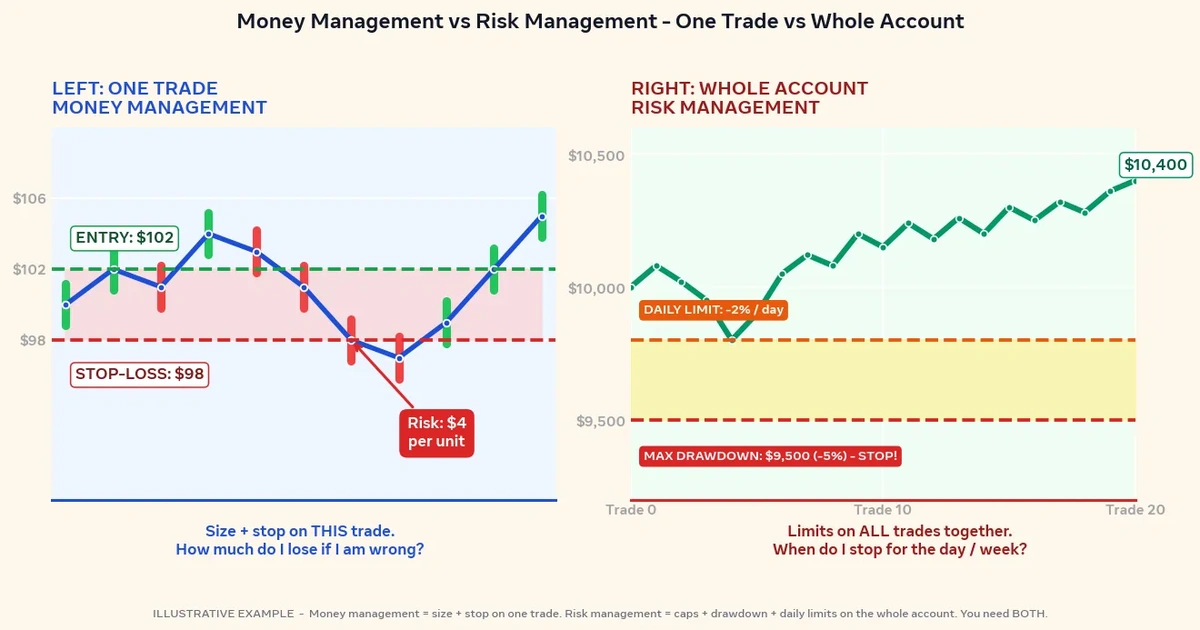
- Stop-loss: An order that closes your trade if price moves against you by a set amount.
- Take-profit: An order that closes your trade when it reaches a target gain.
A stop-loss can help limit losses, but it isn’t a guarantee. In fast markets or around news events, your order can fill at a worse price than you set. This is called slippage.
Pips, Lots, and Pip Value
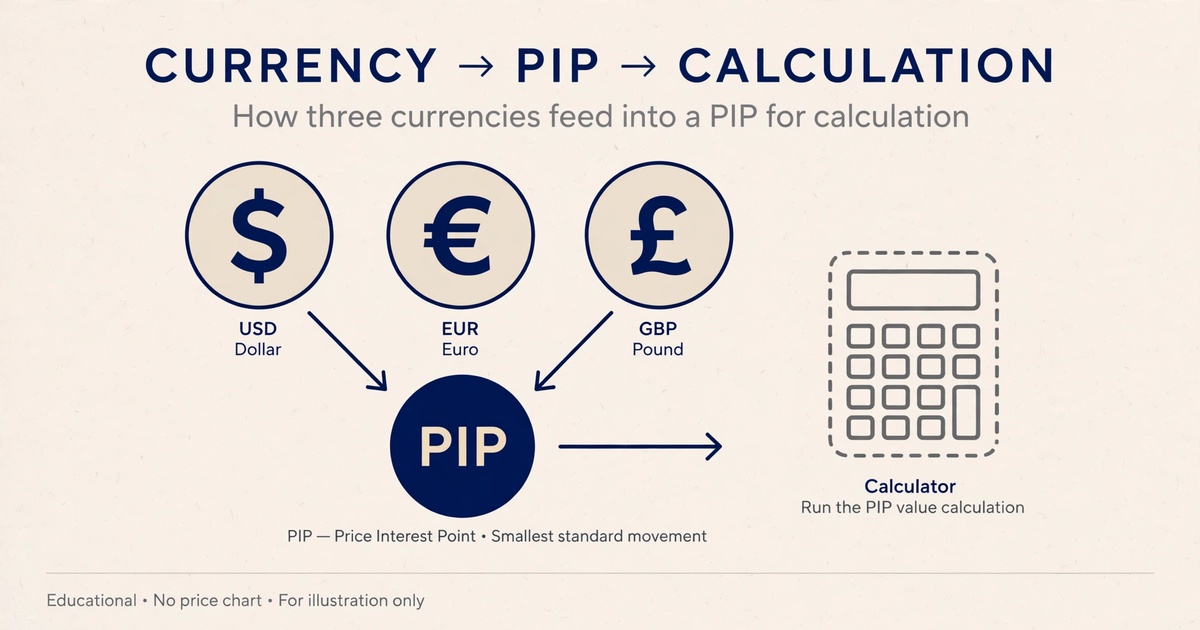
A pip is the standard unit for measuring price movement. For most pairs it’s the fourth decimal place (0.0001). For pairs involving the Japanese yen, it’s usually the second decimal place (0.01).
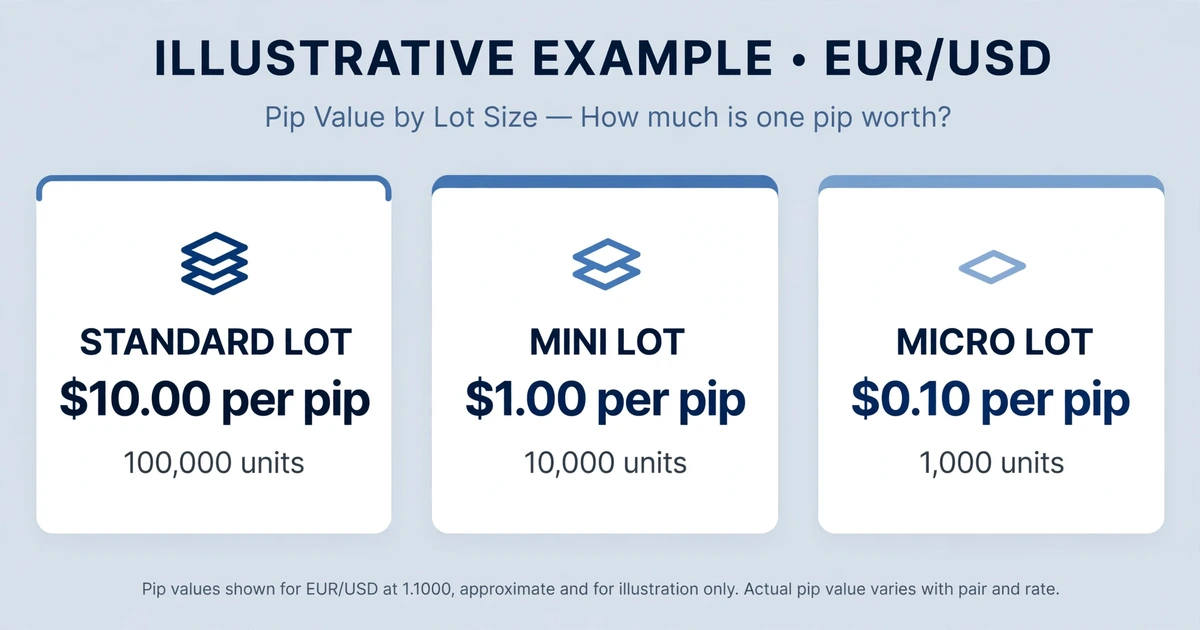
A lot is the size of your trade. The table below shows approximate pip values for EUR/USD on a US dollar account.
| Lot size | Units of base currency | Value of 1 pip (EUR/USD, USD account) |
|---|---|---|
| Standard | 100,000 | $10 |
| Mini | 10,000 | $1 |
| Micro | 1,000 | $0.10 |
Pip value changes with the pair and your account currency, so don’t assume these numbers apply everywhere. A position size calculator handles the conversion for you.
Leverage and Margin Explained
Leverage lets you control a larger position than your deposit would normally allow. Margin is the portion of your account the broker sets aside to keep that position open. It’s a deposit, not a fee.
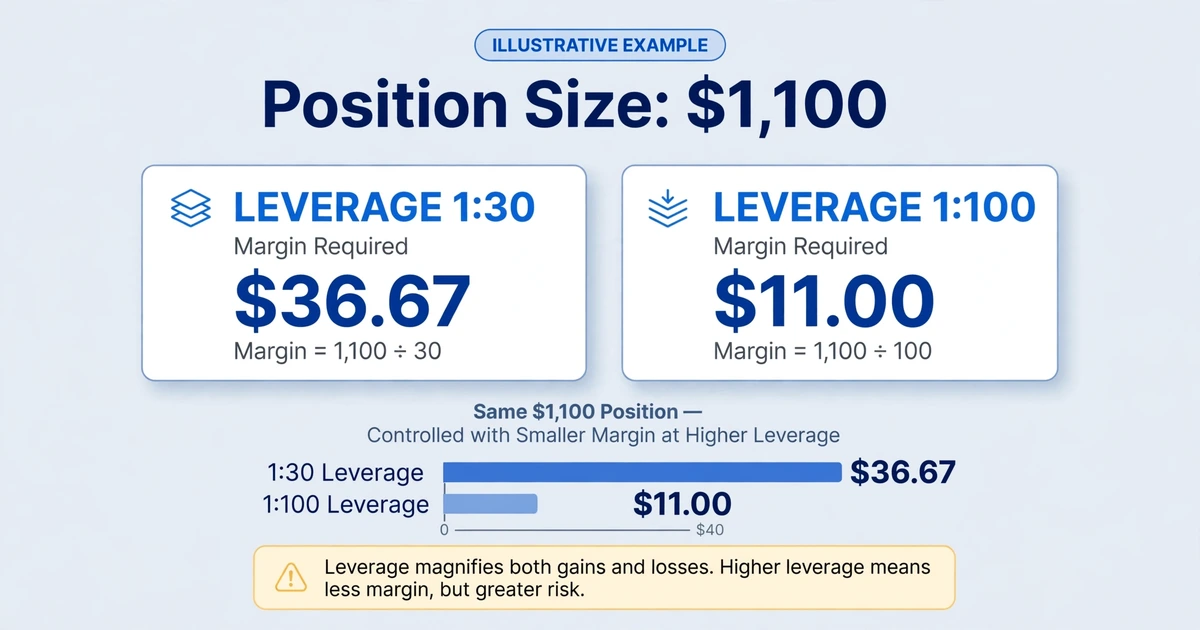
Here’s a hypothetical example. A 1,000-euro position in EUR/USD at 1.1000 is worth about $1,100.
- With 1:30 leverage, the margin required is about $1,100 ÷ 30 = $36.67.
- With 1:100 leverage, it’s about $1,100 ÷ 100 = $11.
Lower margin feels cheaper, but the position is the same size, so a 50-pip move still costs or earns $5 either way. The danger is that leverage makes it easy to open positions far too large for your account. A few bad trades can then wipe out your balance, and in some cases you can lose all the money you deposited. Leverage limits for retail traders vary by country and regulator.
What Does Forex Trading Cost?
You pay to trade even when you’re right, so costs matter.
- Spread: The gap between the buy (ask) and sell (bid) price. If the bid is 1.0999 and the ask is 1.1001, the spread is 2 pips. On a micro lot, that’s about 2 × $0.10 = $0.20 the moment you open the trade.
- Commission: Some account types charge a fee per lot instead of, or on top of, the spread.
- Swap (rollover): A fee or credit for holding a position overnight, based on interest rate differences between the two currencies.
Fees vary by provider and account type. Compare the full cost, not just the headline spread.
When Can You Trade? Forex Sessions
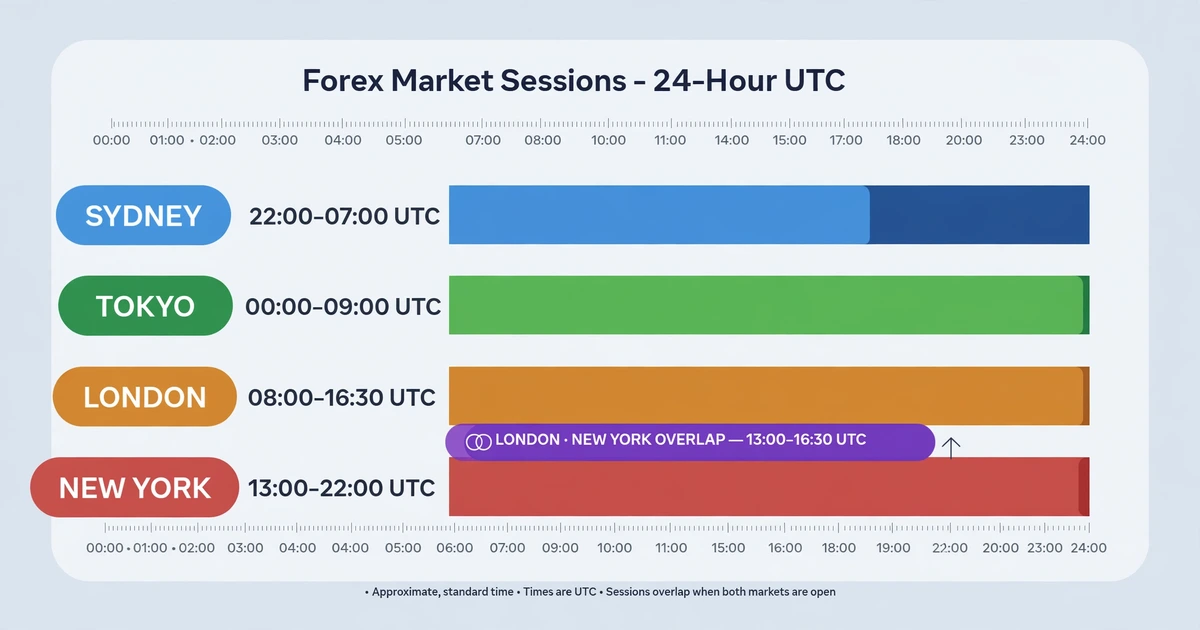
The forex market runs 24 hours a day, five days a week, because trading rolls between financial centers. Activity tends to rise when major sessions overlap, such as London and New York.
| Session | Approximate hours (UTC, standard time) |
|---|---|
| Sydney | 22:00–07:00 |
| Tokyo | 00:00–09:00 |
| London | 08:00–17:00 |
| New York | 13:00–22:00 |
These hours are approximate. They shift by about an hour when daylight saving time starts or ends in each region, and UTC itself never changes. The London–New York overlap falls roughly between 13:00 and 17:00 UTC in standard time.
Who Trades Forex?
The market includes central banks, commercial banks, hedge funds, multinational companies hedging currency exposure, and retail traders. Retail traders are a small share of total volume. You’re trading alongside participants with far more capital, data, and experience, which is one reason a cautious, process-first approach matters.
A Simple Risk Example: Sizing a Trade
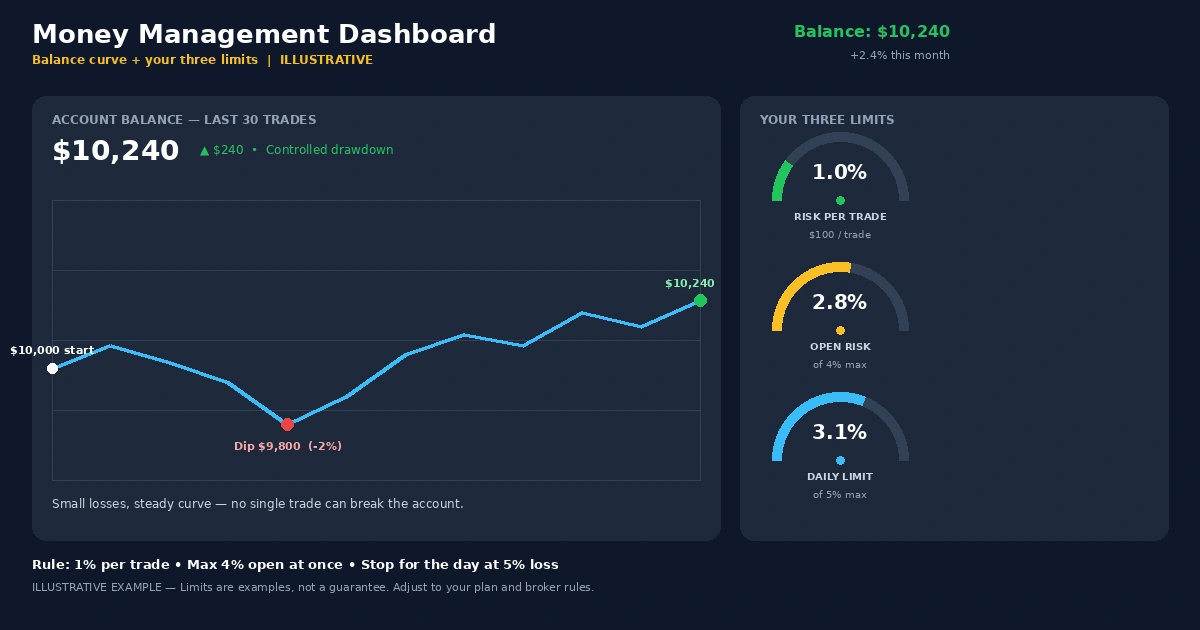
Many traders risk only a small fixed percentage of their account on each trade. The right level depends on your situation, so treat this as an illustration, not a recommendation.
Hypothetical example, for illustration only:
- Account size: $1,000
- Risk per trade: 1% = $10
- Stop-loss distance: 30 pips
- Pip value per micro lot (EUR/USD): $0.10
Risk per micro lot = 30 pips × $0.10 = $3.
Position size = $10 ÷ $3 ≈ 3.3, so about 3 micro lots (0.03 standard lot).
Check: 3 × 30 × $0.10 = $9 of risk, just under the $10 limit.
The stop-loss comes first, and the position size follows from it. Beginners often do it backward.
Common Beginner Mistakes
- Over-leveraging. Opening positions too large for the account is the fastest way to blow it up.
- Trading without a stop-loss plan. Deciding where you’re wrong before you enter keeps losses defined.
- Skipping the demo account. You can learn the platform and test your process without risking capital.
- Revenge trading. Trying to win back a loss immediately usually leads to bigger ones.
- Ignoring costs. Spreads, commissions, and swaps add up, especially on short-term trades.
- Following signals blindly. A tip from social media or a stranger isn’t a trading plan.
- Believing the marketing. Promises of easy or fast profit are a warning sign.
How to Get Started Responsibly
- Learn the vocabulary first. Pips, lots, margin, and spreads should feel familiar before you place a trade.
- Open a demo account. Practice placing orders and setting stops using virtual money.
- Check the broker. Look for one regulated by a recognized authority where you live. Rules vary by country, so check your local regulator.
- Write a simple plan. Define what you trade, when you trade it, and how much you’ll risk.
- Start small if you go live. Use an amount you can afford to lose, and keep a journal.
Who Should Skip Forex Trading?
Forex may not suit you if you need the money for rent or bills, if you expect steady income, or if you’d be seriously distressed by losing your deposit. It also takes time to learn. If you don’t have that time or interest, a different approach to your money may fit better.
Risks and Limitations
Forex trading is speculative, and the risks are real.
- Leverage works both ways. It magnifies losses as well as gains, and you can lose some or all of your deposit.
- Slippage and gaps. Prices can jump past your stop-loss, especially around major news or over the weekend.
- Costs erode results. Spreads, commissions, and swaps apply whether or not a trade wins.
- Demo isn’t live. Real money brings fear and greed that a demo account can’t fully reproduce.
- Unregulated providers. Some firms operate with little oversight, and scams exist.
- Rules differ by country. Regulation, leverage limits, and tax treatment vary, so check your local rules.
Results vary, and there is no guarantee of profit.
Frequently Asked Questions
Is forex trading gambling?
Not by definition, but it can become gambling if you trade without a plan, size positions recklessly, or chase losses. Structured traders use defined rules, limited risk per trade, and a journal. Even then, outcomes are uncertain, and losing is a normal part of trading.
How much money do you need to start forex trading?
It depends on the broker and account type. Some allow small deposits, but a small account doesn’t make trading low-risk. Only use money you can afford to lose, and consider starting on a demo account before depositing anything.
Can beginners learn forex trading?
Yes, the basics are learnable. Start with currency pairs, pips, leverage, and risk management, then practice on a demo account. Expect a learning curve, and expect losing trades along the way. Education reduces avoidable mistakes but doesn’t remove risk.
What’s the difference between forex and stocks?
Stocks represent ownership in a company, while forex involves exchanging one currency for another. Forex trades nearly around the clock on weekdays, and retail traders commonly use leverage. Both carry risk, and the right choice depends on your goals, knowledge, and local regulations.
Is forex trading legal?
It depends on where you live. Many countries regulate forex brokers and set rules on leverage and client protection, while some restrict or prohibit retail forex. Rules vary by country, so check your local regulator before opening an account.
Where to Go From Here
If you remember one thing about forex trading, make it this: it’s a leveraged, speculative activity, and protecting your capital matters more than any single trade. Understand pips, lot sizes, and costs, and decide your risk before you enter. A sensible next step is to open a demo account and practice placing orders and stop-losses until the mechanics feel routine.
Disclaimer
This article is for educational purposes only and is not financial advice. Forex and CFD trading involves a high level of risk, and you can lose some or all of your capital. Leverage can magnify both gains and losses. Never trade with money you can’t afford to lose.
Any percentages or figures shown are historical averages or hypothetical examples, not guarantees. Past performance does not predict future results.
Join now
Comments (0)
Be the first to comment.