
Currency Conversion Fees in Forex: Why Account Currency Matters
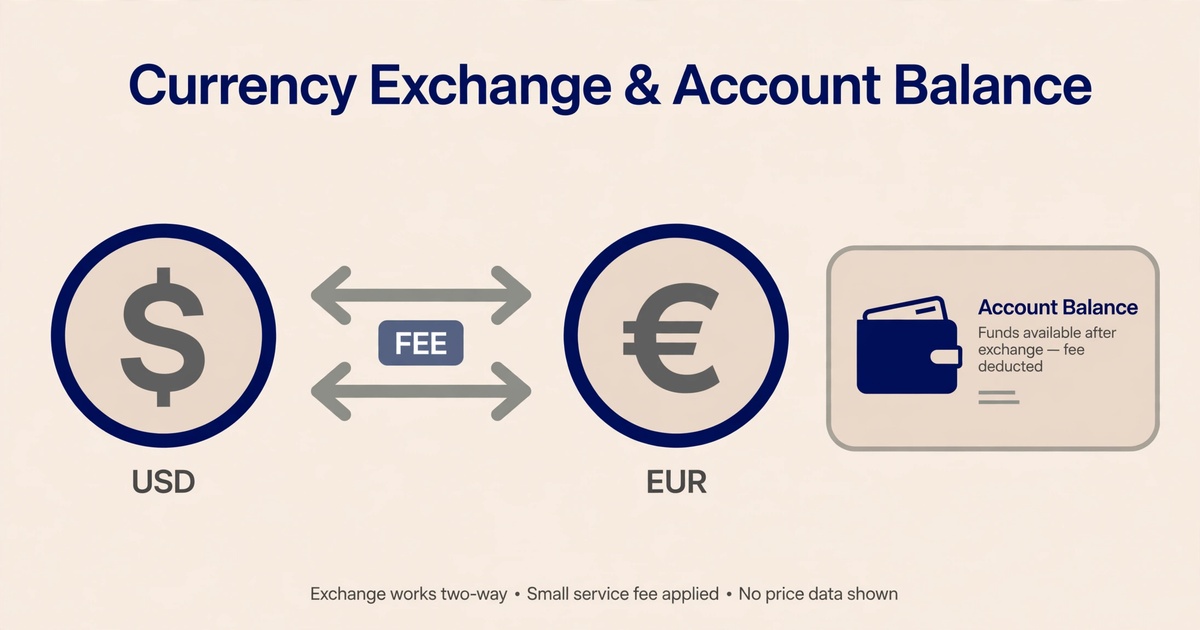
Deposit £2,000, change your mind a week later, and withdraw everything without placing a single trade. Depending on how your provider converts currency, you could get back noticeably less than you sent. Currency conversion fees in forex rarely appear as one clear line item. They sit inside exchange rates, payment steps, and profit-and-loss figures. This guide shows where they come from, how your account currency decides how often you pay them, and how to spot them on your own statements.
Three Places a Conversion Fee Can Hide
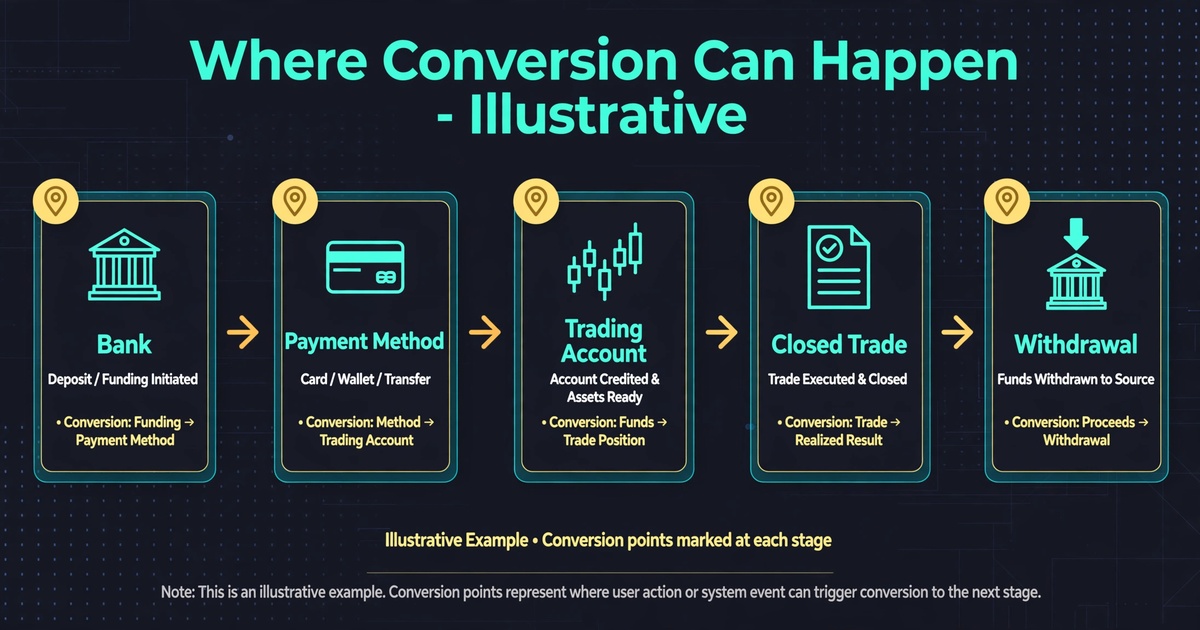
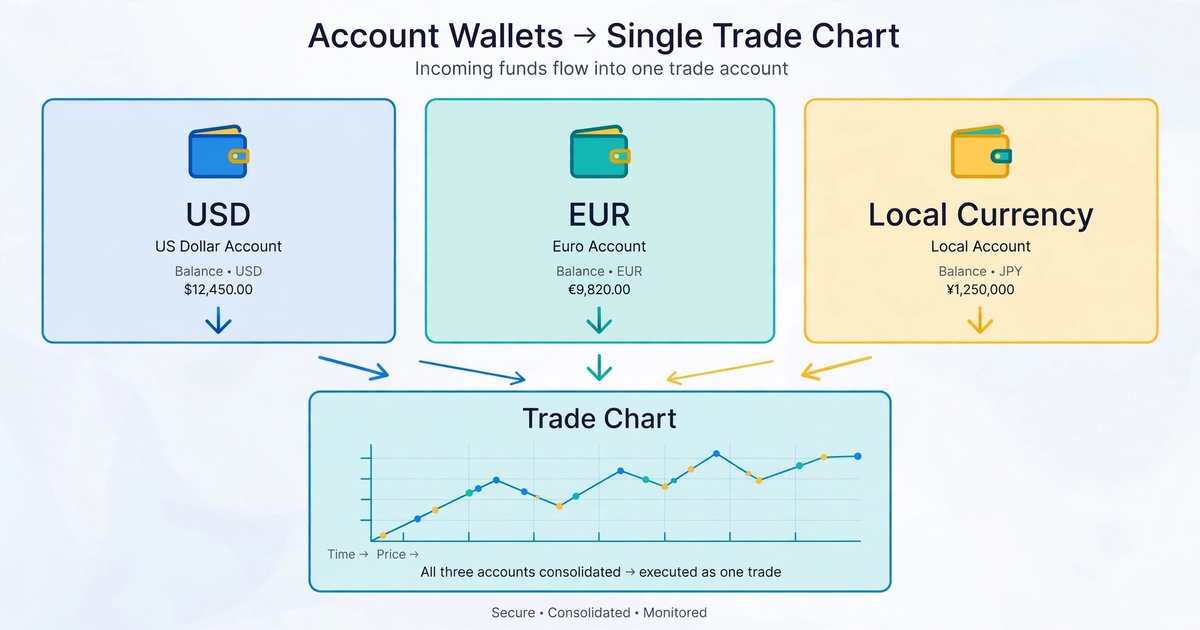
- Funding and withdrawing: if your bank or payment method uses a different currency from your trading account, a conversion happens at each end.
- Closing trades: if the pair’s quote currency differs from your account currency, each profit or loss is converted when the trade closes.
- Smaller charges: commissions and overnight swaps may be quoted in one currency and billed in another.
- A matching account currency removes some conversions but not all of them, and the cost depends on the rate your provider applies.
Mid-Market Rate, Markup, and Flat Fee: Telling Them Apart
The mid-market rate is the midpoint between the buy and sell prices of a currency pair in the wholesale market. It’s the benchmark you see on a rate-comparison site. The rate you actually receive usually differs from it, and the gap is where most conversion cost lives.
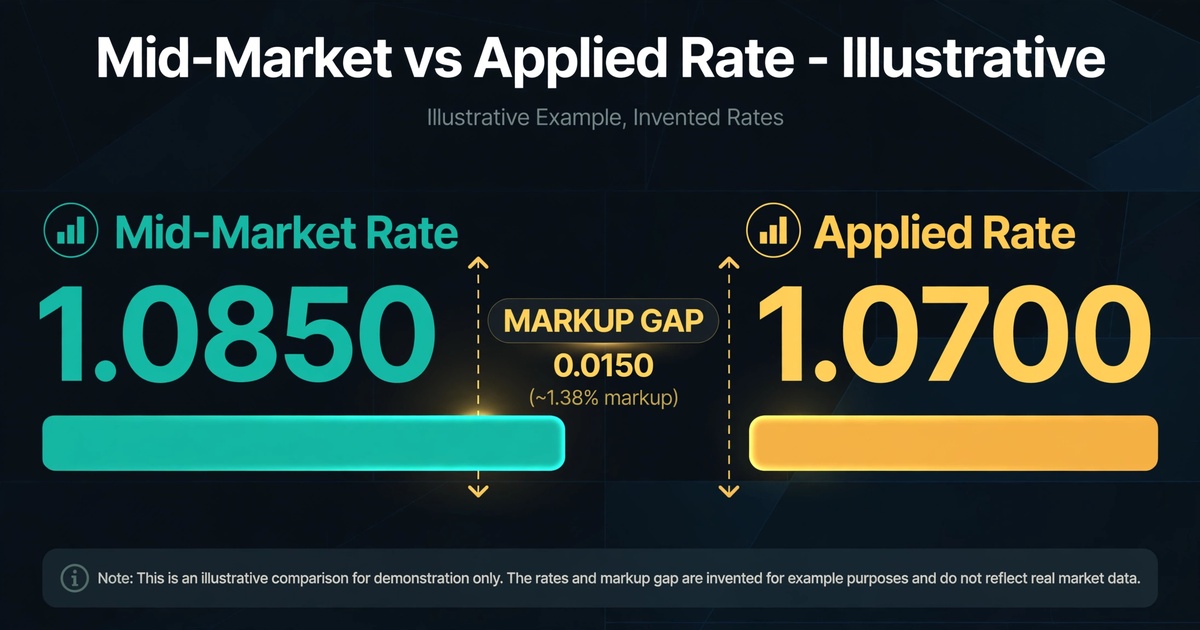
A markup is a percentage added to the rate, so the provider keeps the difference. A flat fee is a fixed charge, such as a set amount per transfer. Some providers use one, some use both, and some show neither clearly. A spread, the gap between the buy and sell price, can also be built into a conversion. All of these vary by provider and can change, so check current terms.
For the basic definition of the currency your balance is held in, what an account currency is covers it in a few paragraphs.
Deposits and Withdrawals: The Fee You Pay Outside the Platform
Money often passes through several hands before it lands in a trading account. A bank may convert at its own rate. A card network may add its own step. An e-wallet may charge a conversion fee on top. Sometimes the trading account itself converts the incoming amount.
Two habits reduce the surprise:
- Look for the exchange rate on the confirmation, not just the fee line. A transfer marked “no fee” can still carry a markup in the rate.
- Compare what leaves your bank with what arrives in your trading account, in the same currency terms.
Withdrawals work the same way in reverse, and they often get less attention than deposits.
A £2,000 Round Trip Through a Dollar Account
Take a hypothetical trader with a GBP bank account and a USD trading account. The mid-market GBP/USD rate is 1.2700 on both days, and the provider applies a 1.5% markup each way. Both numbers are invented.
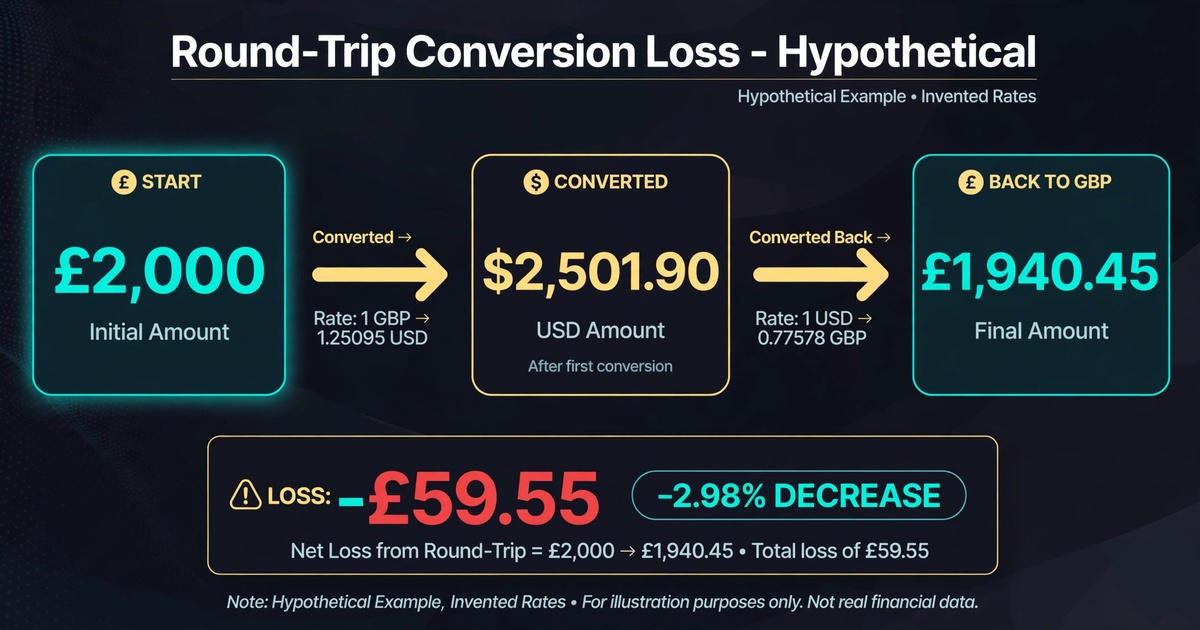
- Deposit £2,000: at mid-market, that would be £2,000 × 1.2700 = $2,540. With the markup, the trader receives $2,540 × 0.985 = $2,501.90.
- Withdraw the full $2,501.90 back to the bank: at mid-market that would be $2,501.90 ÷ 1.2700 = £1,970.00. With the markup, the trader receives £1,970.00 × 0.985 = £1,940.45.
- Net result with zero trades: £2,000 − £1,940.45 = £59.55 lost, or about 2.98% of the original deposit.
The markup looks small on each leg, but it applies twice, and the second leg works on a smaller base, so the total lands just under double the single-leg percentage. This is a hypothetical example for illustration only.
Closing Trades in a Currency Your Account Doesn’t Hold
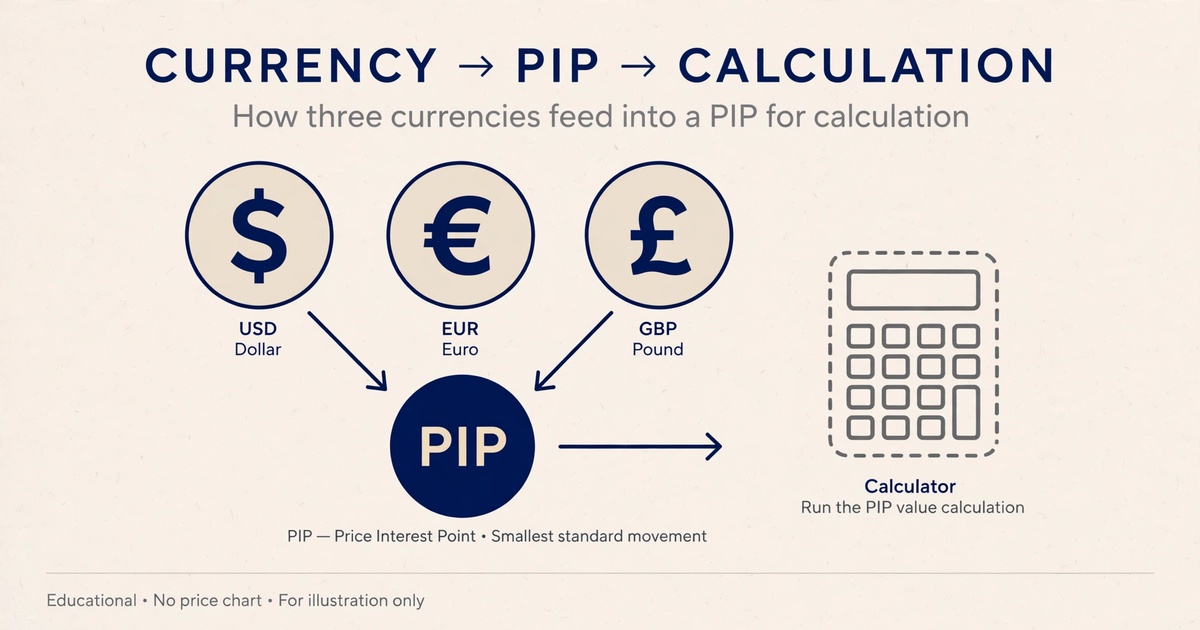
When a trade closes, your profit or loss is first calculated in the pair’s quote currency, then converted into your account currency. The mechanics of that first calculation are covered in how pip value and profit convert into your account currency. The fee side works like this.
Suppose a hypothetical EUR account closes a GBP/USD trade with a $200 gain. At a mid-market EUR/USD of 1.0800, that’s $200 ÷ 1.0800 = €185.19. If the platform’s conversion includes a 0.5% markup, the credited amount is €185.19 × 0.995 = €184.26, which is €0.93 less.
The markup also applies to losses, only in the unfavorable direction. A $200 loss converts to about €185.19 at mid-market, but with the same markup you’d be charged roughly €186.11, again about €0.93 worse.
One trade barely matters. A trader who closes 40 such positions a month would see about €37.20 of conversion cost in that month under these invented numbers, before spreads and commissions. Frequent trading with a mismatched currency adds up faster than infrequent trading.
Some platforms convert only at close, others convert continuously for margin and floating profit. Contract specifications and conversion methods differ, so check how yours works. This is a hypothetical example for illustration only.
Matching Account Currency to the Pairs You Trade
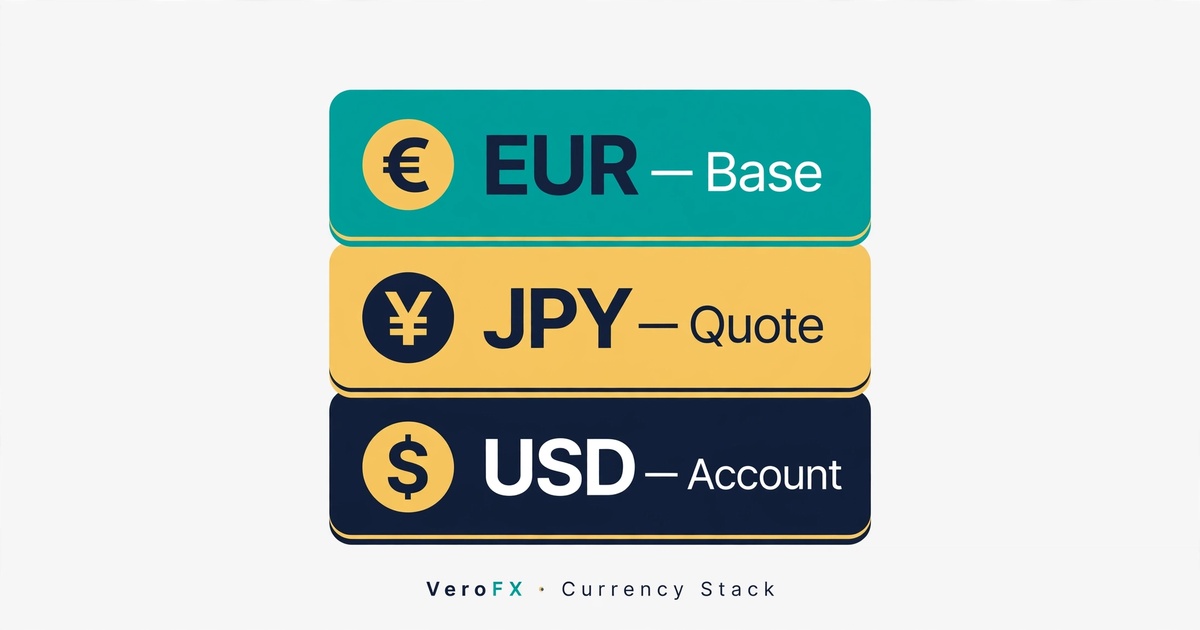
How often conversions occur depends on the overlap between your account currency and the pairs you trade. How the base, quote, and account roles differ is explained in account currency versus base and quote currency. The table below shows the practical effect.
| Your situation | Trade P&L converted? | What to watch |
|---|---|---|
| USD account, trading EUR/USD | No, the quote currency is USD | Spread and commission |
| USD account, trading USD/JPY | Yes, yen to dollars | Rate used at close |
| EUR account, trading EUR/USD | Yes, dollars to euros | Rate used at close |
| EUR account, trading GBP/JPY | Yes, through one or more rates | How the platform chains the rates |
| GBP bank, USD account | Not on trades, but yes on deposits and withdrawals | Rate on each transfer |
A matching currency is not automatically the cheaper account. A broker with a low-cost conversion rate and a mismatched currency can come out ahead of a matching account with wide spreads. The comparison has to include every cost, not just conversion.
Reading Your Statements for Hidden Conversion Costs
You can estimate your own conversion cost with a few checks:
- Find the mid-market rate for the same day and time, from a neutral rate source.
- Compare it with the rate your provider applied, then work out the percentage gap.
- Do this for one deposit, one withdrawal, and one closed trade, since providers can price each differently.
- Check whether commission and swap are quoted in your account currency or converted from another one.
- Write the results in your trading journal, and repeat the check after a change in provider or payment method.
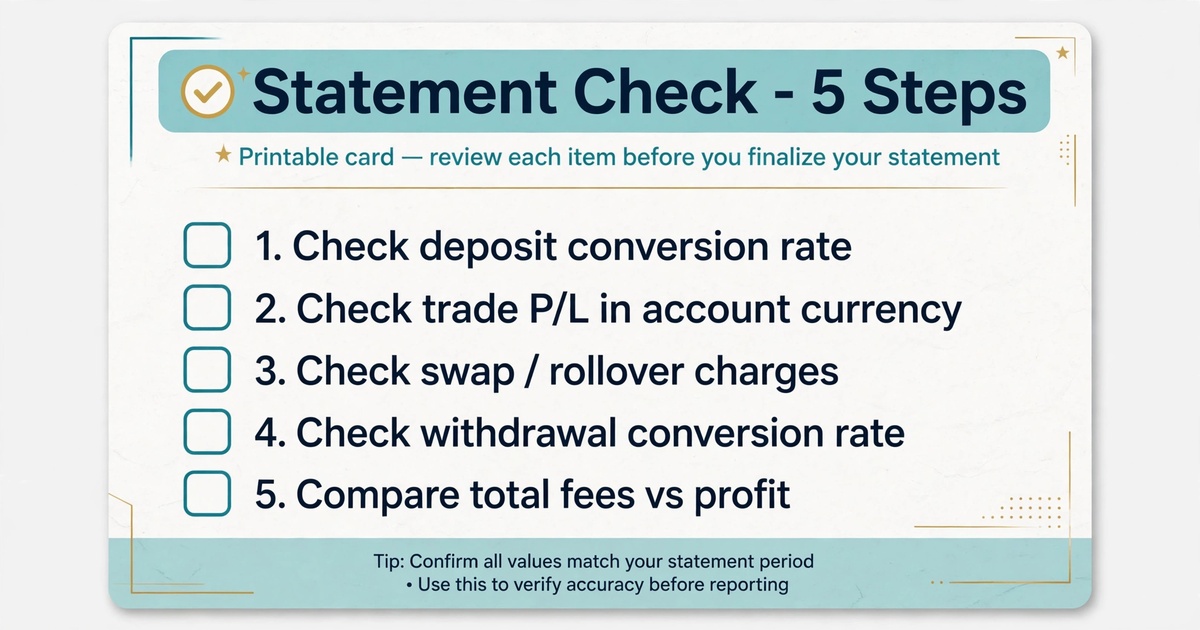
Timestamps matter. Rates move during the day, so a small difference may be market movement rather than a fee.
Cheap-Looking Accounts That Cost More: Comparison Traps
- Judging by the headline fee only. A “free” conversion with a wide markup can cost more than a visible flat fee.
- Ignoring the withdrawal leg. Many traders compare deposit costs and forget that money has to come back out.
- Comparing at different times. Rates move, so a fair comparison uses the same moment.
- Counting only large trades. Conversion cost scales with frequency, so small trades closed often can add up.
- Assuming a matching currency means zero cost. Spread, commission, and swaps still apply.
Where Conversion Costs Turn Into a Slow Leak
Conversion fees rarely wreck an account in one move. The risk is repetition: a small percentage taken again and again, on deposits, on withdrawals, and on every closed trade, which works against you even when your analysis is right. For a short-term strategy, that cost sits on top of spreads and slippage, which can push the break-even point higher than a pip chart suggests.
Leverage makes this less visible. Position sizes are larger than the deposit, so converted profits and losses are larger too, and you can lose some or all of your capital. Conversion terms can also change, and policies differ between providers and countries. Never rely on an old fee schedule.
Conversion Fee Questions From New Account Holders
Does my broker always convert my profits?
Only when the pair’s quote currency differs from your account currency. If you trade a pair quoted in your account currency, the trade’s profit needs no conversion. Deposits, withdrawals, commissions, and swaps may still involve conversion, depending on how your provider handles them.
Is a conversion fee the same as the spread?
No. The spread is the gap between buy and sell prices on a trade. A conversion fee applies when one currency is exchanged for another, and it may appear as a markup in the rate or a separate charge. Both can apply to the same trade.
Can I avoid conversion fees completely?
Not always. Matching your account currency to your bank and your usual pairs reduces the number of conversions, but some providers still apply charges. The practical goal is fewer conversions and a clearer view of what each one costs.
How do I find out my provider’s conversion rate?
Check the account terms, fee schedule, or contract specifications, then confirm with an actual transaction. Compare the applied rate with a neutral mid-market rate from the same time. If the terms aren’t clear, ask the provider’s support team in writing.
Should I choose my account currency based on fees alone?
Fees are one factor, not the only one. Your bank currency, the pairs you trade, how often you trade, and how comfortable you are tracking your results in that currency all matter. Compare the full set of costs rather than one line.
A Small Percentage, Repeated
The cost of conversion isn’t any single fee. It’s the same small percentage applied at every step where your money changes currency. Your account currency decides how many of those steps you face.
For your next step, open your latest statement and find one deposit, one withdrawal, and one closed trade, then compare each applied rate with a neutral mid-market rate. If the results point to a mismatch, choosing a forex account currency is a sensible next read.
Disclaimer
This article is for educational purposes only and is not financial advice. Forex and CFD trading involves a high level of risk, and you can lose some or all of your capital. Leverage can magnify both gains and losses. Never trade with money you can’t afford to lose.
This is educational content, not personalized investment advice. Your financial situation, goals, and local regulations are different, so consider speaking with a licensed financial professional before making decisions.
Any percentages or figures shown are historical averages or hypothetical examples, not guarantees. Past performance does not predict future results.
Payment methods, fees, processing times, and availability vary by provider and country. Always check current terms with the provider before you deposit or withdraw.
Join now
Comments (0)
Be the first to comment.