
How Account Currency Affects Pip Value and Profit Calculation
Two traders close the same 60-pip USD/JPY trade at the same moment. One sees +$39.84 on her screen. The other sees +€36.92. Neither platform is wrong. That gap is how account currency affects pip value and profit calculation: every pip is first measured in the pair’s quote currency, then converted into the currency your balance is held in. This guide shows the formula, the three conversion cases, and hypothetical numbers you can check by hand.
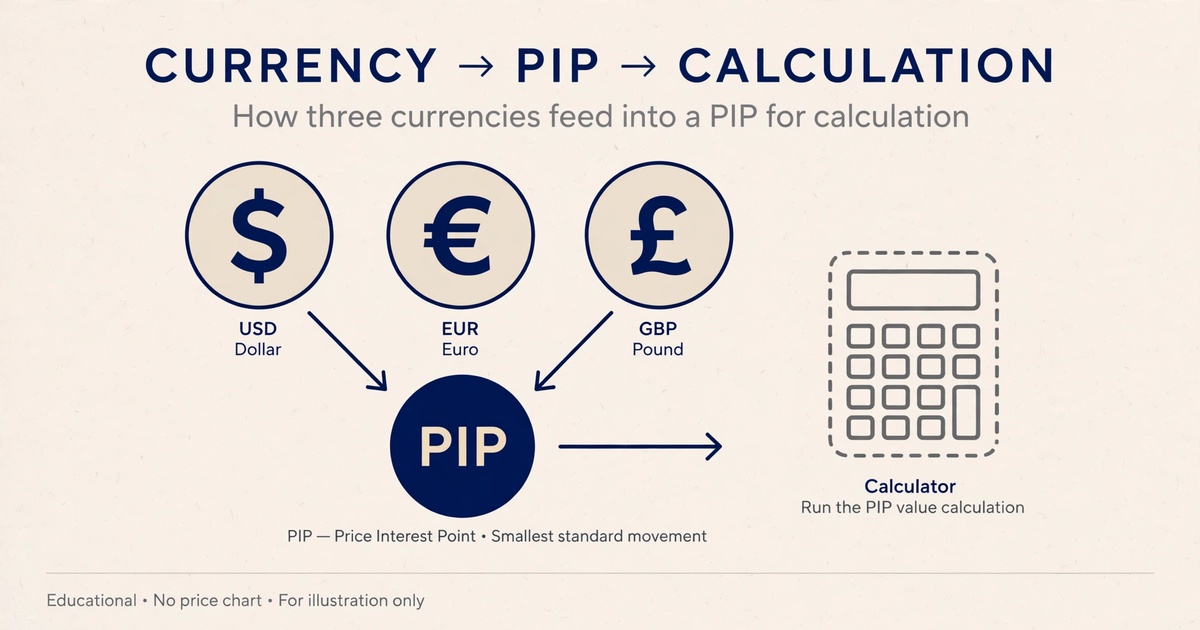
Pip Value Always Starts in the Quote Currency
- A pip’s value equals the pip size multiplied by your position size in units, and the result is in the pair’s quote currency (JPY for USD/JPY, USD for GBP/USD).
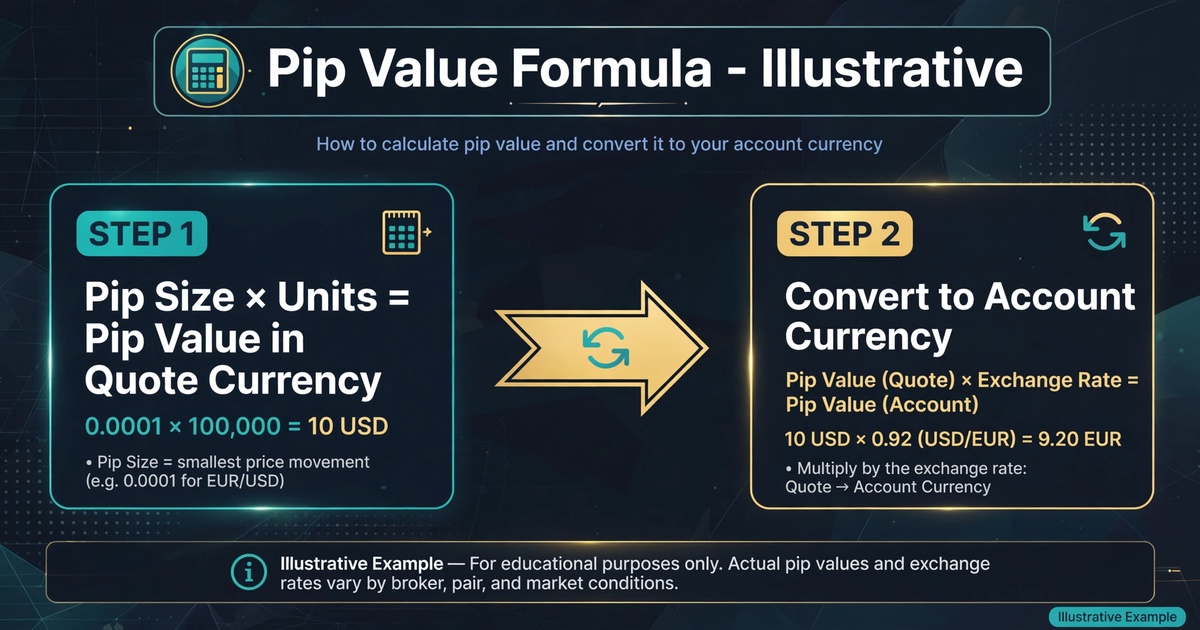
- Your platform then converts that figure into your account currency at the current exchange rate.
- If your account currency is neither currency in the pair, a third exchange rate is involved.
- Exchange rates keep moving, so any pip value figure is a snapshot, not a constant.
Pip Size, Lot Size, and the Number Your Platform Starts With
A pip is the standard unit of price movement: 0.0001 for most pairs, and 0.01 for pairs quoted in yen. A lot is the position size: 100,000 units for a standard lot, 10,000 for a mini, 1,000 for a micro. The quote currency is the second currency in a pair, the one the price is expressed in.
Your account currency is the currency your balance, margin, and profit and loss are shown in. If you want the basics of what it is and how it gets set, what is account currency covers that side.
The first step of any pip value calculation ignores your account entirely:
Pip value (in quote currency) = pip size × position size in units
For a 0.10 lot (10,000 units) in USD/JPY: 0.01 × 10,000 = 100 JPY per pip. That’s a real number, but it’s in yen. Unless your account is in yen, it still needs converting.
Converting Into Your Account Currency
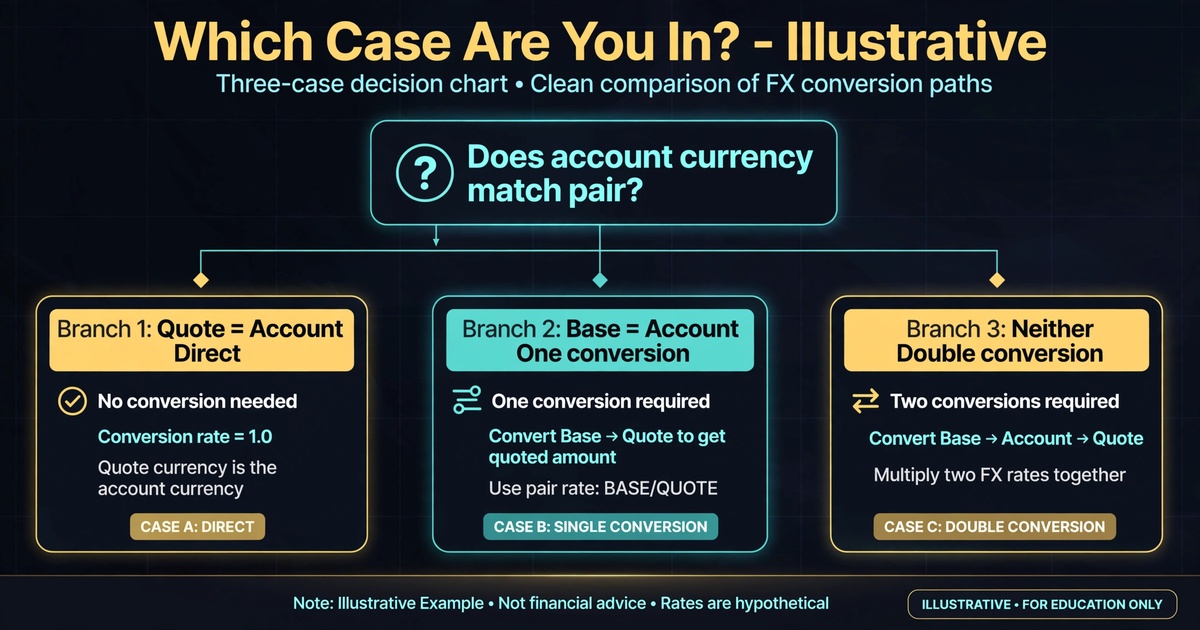
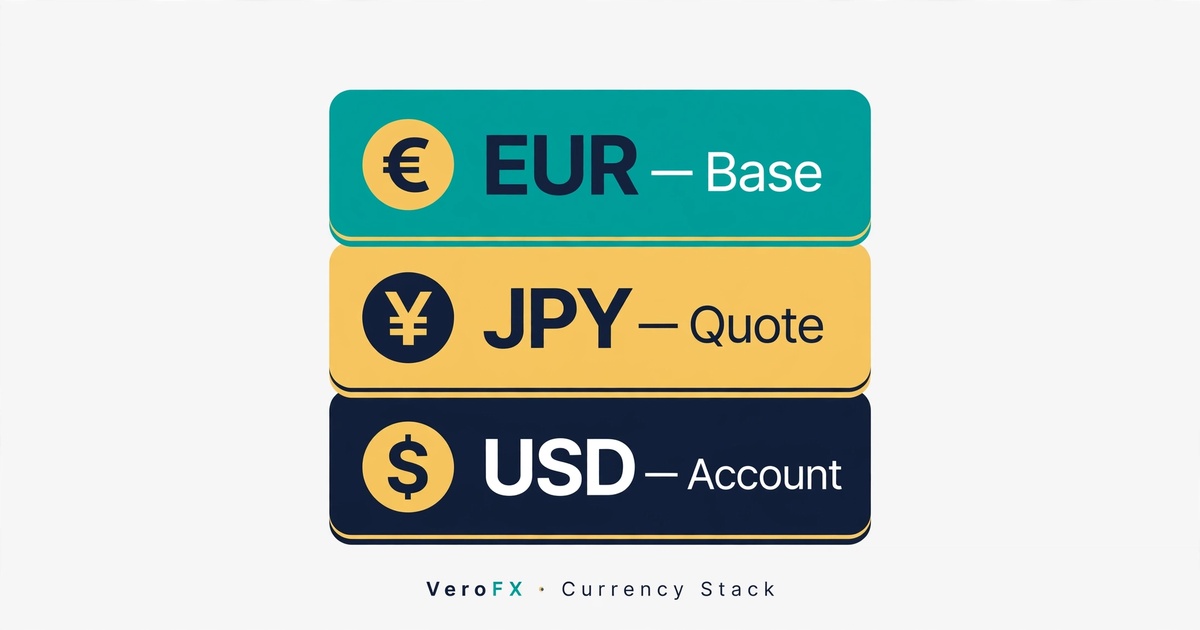
How you convert depends on how your account currency relates to the pair. The distinction between those roles is explained in more depth in account currency vs base currency vs quote currency. Here is the practical version.
When the Quote Currency Is Your Account Currency
No conversion is needed. On GBP/USD with a USD account, one standard lot gives 0.0001 × 100,000 = $10 per pip. This is the case behind the “a pip is worth $10” shortcut you’ll see everywhere, and it only holds here.
When the Pair’s Base Currency Is Your Account Currency: Divide by the Price
The quote-currency figure is divided by the pair’s current price. With a GBP account on GBP/USD at a hypothetical 1.2700, the $10 pip becomes $10 ÷ 1.2700 = £7.87.
When a Third Currency Is Involved
If your account is in EUR and you trade GBP/USD, the platform converts the dollar value into euros using EUR/USD. At a hypothetical 1.0800, that’s $10 ÷ 1.0800 = €9.26.
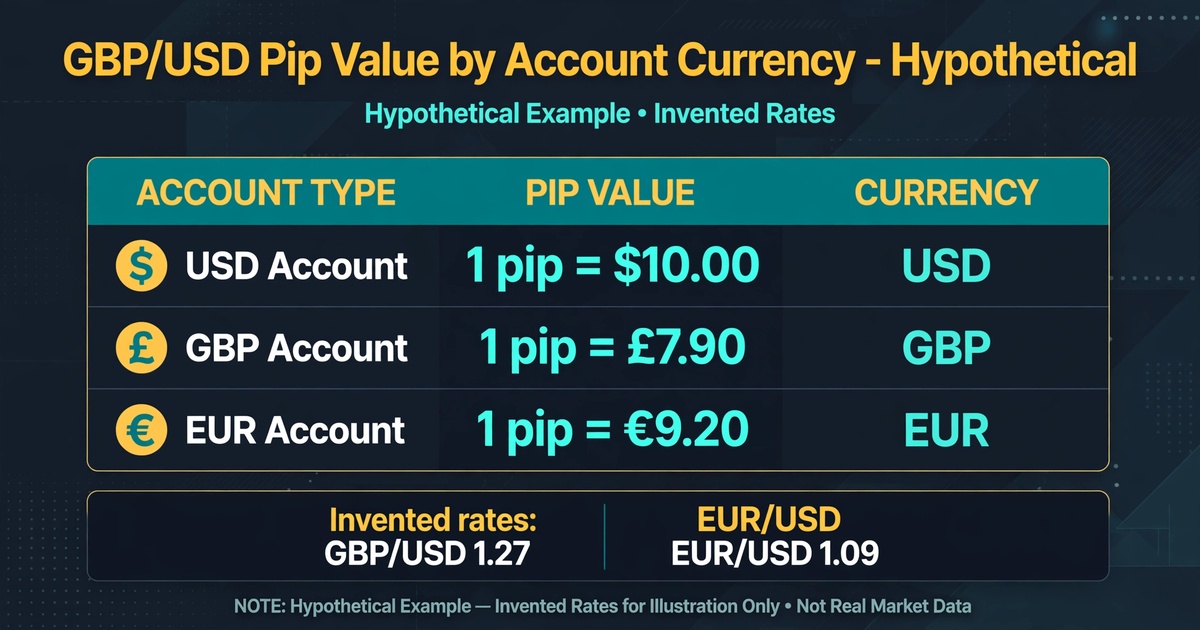
One GBP/USD Lot, Three Balances
Rates used here (all invented): GBP/USD 1.2700, EUR/USD 1.0800.
| Account currency | Calculation | Pip value per standard lot |
|---|---|---|
| USD | No conversion | $10.00 |
| GBP | $10 ÷ 1.2700 | £7.87 |
| EUR | $10 ÷ 1.0800 | €9.26 |
Scale by position size. A 0.25 lot position is a quarter of each figure. This is a hypothetical example for illustration only.
Turning Pips Into Profit: A 60-Pip USD/JPY Gain in Two Currencies
Profit is price change times units, measured in the quote currency, then converted at the rate when the trade closes. That last detail matters.
Suppose a hypothetical buy of 0.10 lot (10,000 units) USD/JPY from 150.00 to 150.60:
- Gain in yen: 0.60 × 10,000 = 6,000 JPY
- USD account, converted at 150.60: 6,000 ÷ 150.60 = $39.84
- EUR account, converted at a hypothetical EUR/JPY of 162.50: 6,000 ÷ 162.50 = €36.92
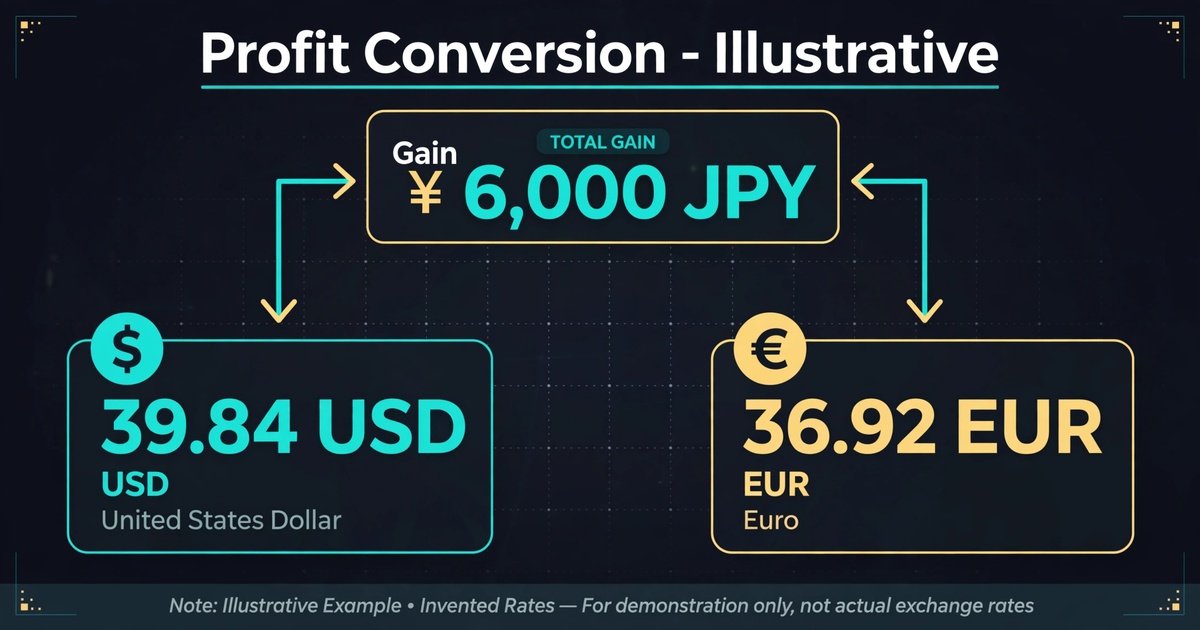
Notice the shortcut’s weakness. Multiplying 60 pips by the entry-time pip value of $0.6667 (100 ÷ 150.00) gives $40.00, which is 16 cents above the true figure, because the yen rate moved during the trade. For small positions the difference is small, but it grows with size and with larger rate moves. A loss works the same way in reverse, and spread and commission are also charged in your account currency. This is a hypothetical example for illustration only.
Position Sizing With a Euro Balance
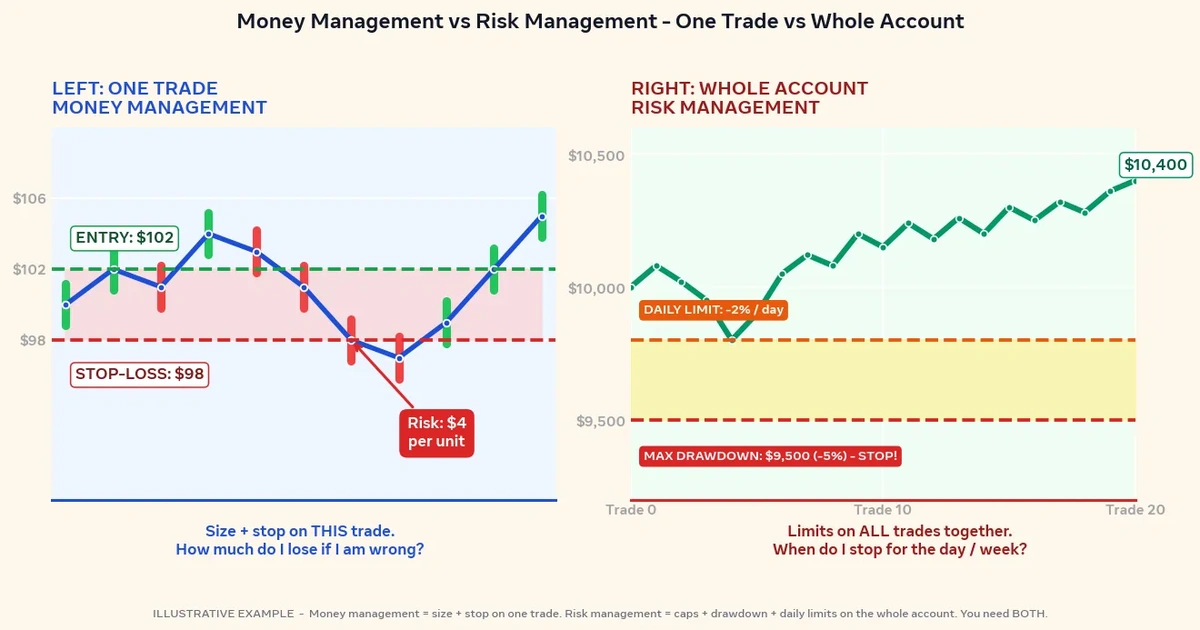
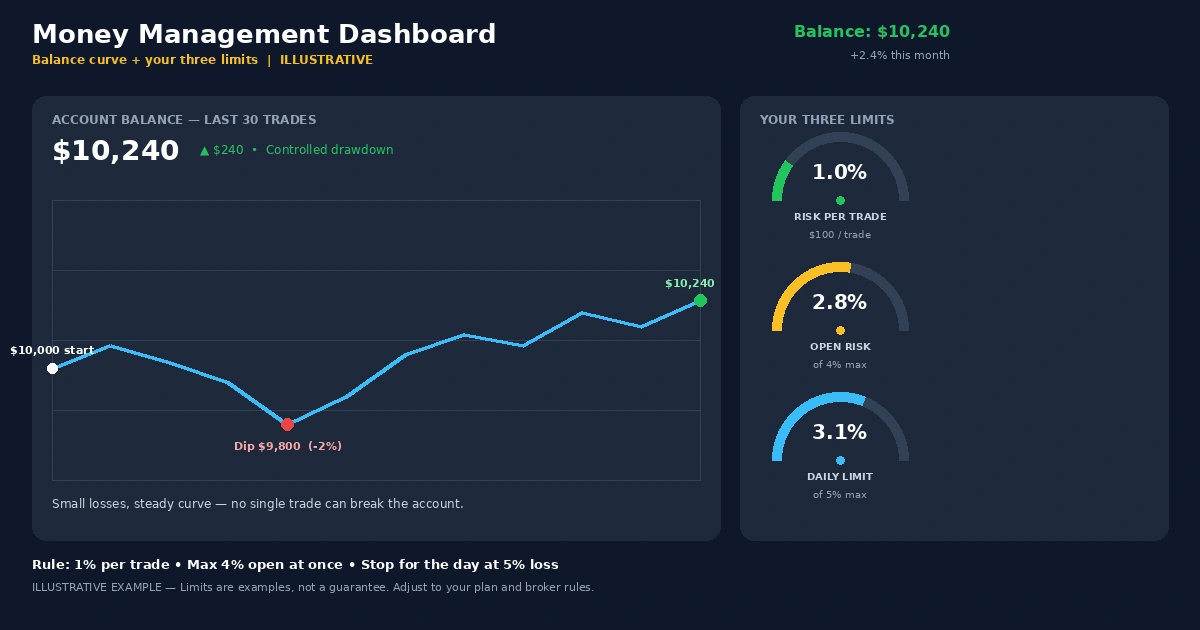
Pip value in your own currency is what position sizing needs. Suppose a hypothetical €2,500 account where a trader chooses to risk 1% (€25) on a USD/JPY trade with a 30-pip stop. Many traders risk a small fixed percentage per trade; the right level depends on your situation.
- One standard lot of USD/JPY: 0.01 × 100,000 = 1,000 JPY per pip
- In euros at a hypothetical EUR/JPY of 162.00: 1,000 ÷ 162.00 = €6.17 per pip
- A 30-pip stop on one lot: 30 × €6.17 = €185.19
- Position size: €25 ÷ €185.19 ≈ 0.135, rounded down to 0.13 lot, risking about €24.07
A stop-loss isn’t a guaranteed exit price. Gaps and slippage can make the real loss larger than planned. This is a hypothetical example for illustration only.
Slips That Distort Pip Value Math
- Using $10 per pip for everything. That figure belongs to a standard lot on USD-quoted pairs in a USD account. Yen pairs and crosses differ.
- Forgetting the yen pip is 0.01. Using 0.0001 on USD/JPY understates pip value a hundredfold.
- Converting at the entry rate. Profit converts at the closing rate, so entry-based estimates drift.
- Borrowing someone else’s pip value table. A table built for a USD account is wrong for a EUR or GBP account.
- Ignoring rounding. Platforms may round lot sizes or conversion rates differently from your spreadsheet.
Currency Exposure Hiding Inside Your P&L
When your account currency differs from the pair, your result depends on two things at once: the pips gained and the conversion rate that moves while you hold. A winning trade can convert into a slightly smaller number, and a losing one into a slightly larger number.
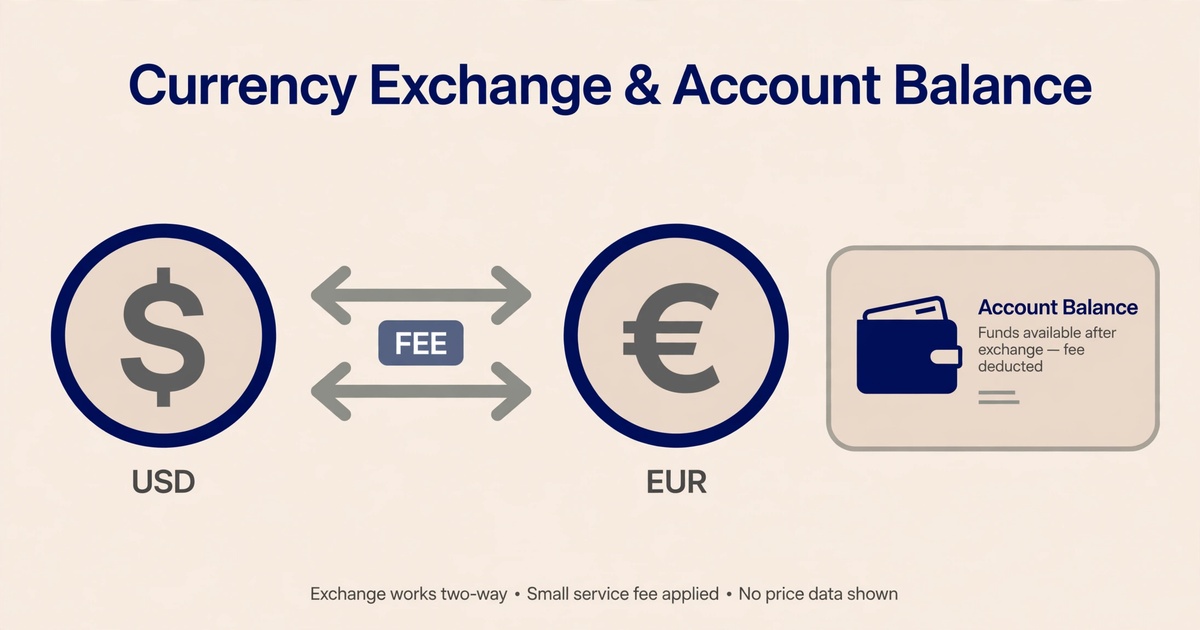
Leverage magnifies this because position sizes are larger than the deposit, and you can lose some or all of your capital. Some brokers convert profit and loss at their own rate, which may include a markup, and fees vary by provider. Forex currency conversion fees and account currency looks at where those costs appear. Overnight swaps are also credited or charged in your account currency, adding another small conversion.
Before You Pick a Currency: What Traders Ask About Pip Value
Does my account currency change how many pips I make?
No. Pips measure price movement, which is the same for everyone. Account currency only changes what each pip is worth in your balance, because the pip’s value is converted into your currency.
Is a pip always worth $10 per standard lot?
No. It’s about $10 only when USD is the quote currency (such as EUR/USD or GBP/USD) and your account is in USD. For USD/JPY, EUR/GBP, or other accounts, the number changes, so calculate it for each pair.
Why does my platform show a different pip value than my calculator?
Usually because of timing and inputs. Exchange rates move constantly, calculators may use a different rate or rounding, and platforms apply contract specifications and their own conversion rates. Small differences are normal; large ones deserve a closer look.
Is a JPY account riskier than a USD account?
Not inherently. The currency of the balance doesn’t create the risk; position size, leverage, and stop placement do. What changes is how often conversion happens and which rates your broker applies.
Do I get charged to convert profits into my account currency?
It depends on the provider. Some build the cost into the rate they use, others charge a visible fee, and some pairs need no conversion at all. Check current terms with your provider.
Convert Once, Calculate Clearly
Pip value is a two-step number: quote-currency value first, account-currency value second. Keep those steps separate and most calculation errors disappear.
For your next step, pick the three pairs you trade most and write each one’s pip value per 0.01 lot in your account currency in your trading journal, then refresh the entries after a large exchange rate move. If you haven’t settled on a balance currency yet, how to choose a forex account currency is the natural next read.
Disclaimer
This article is for educational purposes only and is not financial advice. Forex and CFD trading involves a high level of risk, and you can lose some or all of your capital. Leverage can magnify both gains and losses. Never trade with money you can’t afford to lose.
This is educational content, not personalized investment advice. Your financial situation, goals, and local regulations are different, so consider speaking with a licensed financial professional before making decisions.
Any percentages or figures shown are historical averages or hypothetical examples, not guarantees. Past performance does not predict future results.
Payment methods, fees, processing times, and availability vary by provider and country. Always check current terms with the provider before you deposit or withdraw.
Join now
Comments (0)
Be the first to comment.