

How Does the Forex Market Work? A Beginner’s Guide
The forex market has no central exchange, no trading floor, and no single price that everyone sees. Instead, banks, funds, companies, and individual traders exchange currencies through a global network of dealers and electronic platforms. This guide explains how the forex market works: who takes part, how prices are formed, how retail traders connect to it, and what a trade looks like from start to finish. You’ll see hypothetical examples with the math shown, plus the risks that come with trading. There are no profit promises here, just the mechanics.
Quick Answer
- The forex market is a decentralized, over-the-counter (OTC) market. Currencies trade directly between participants, not on one central exchange.
- Prices come from supply and demand, quoted by banks and other dealers as a bid (sell) price and an ask (buy) price.
- Retail traders usually access the market through a broker, and some brokers take the other side of your trade.
- The market runs 24 hours a day, five days a week, and leverage can magnify both gains and losses.
What Is Being Traded?
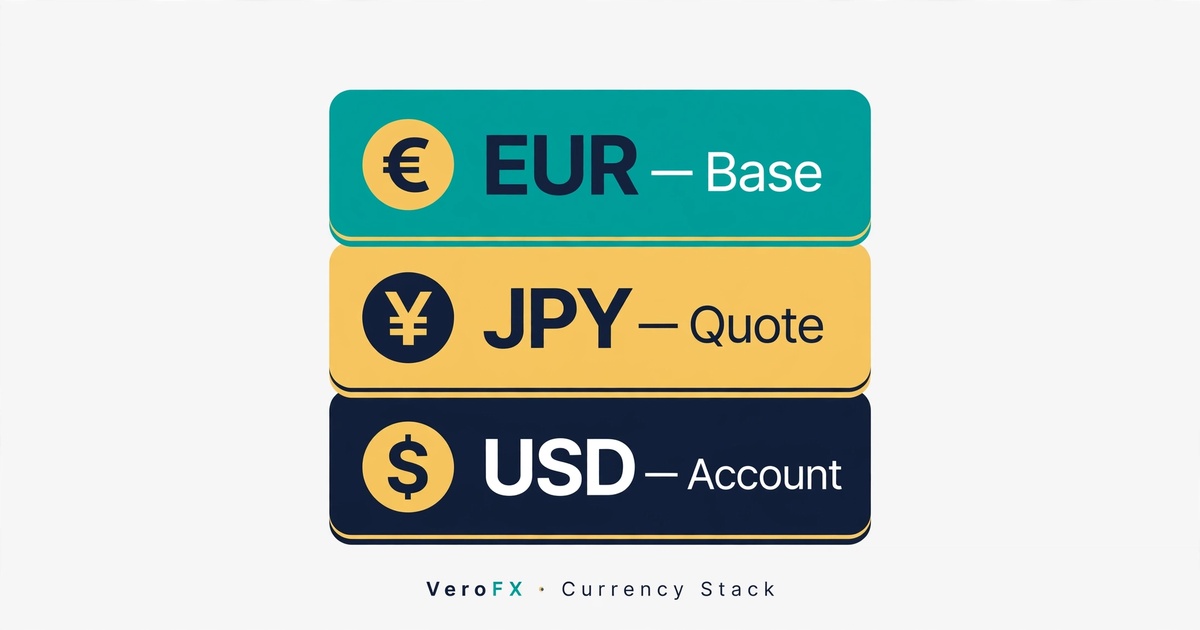
In forex, you trade currencies against each other. Every trade involves a pair, such as EUR/USD, where you buy one currency and sell the other at the same moment. If the base and quote idea is new, see how base and quote currencies in a currency pair work before reading on.
The market exists mainly because the world needs to exchange money. Companies pay overseas suppliers, investors buy foreign assets, and governments and central banks manage reserves. Speculators, including retail traders, join in to try to profit from price changes. That mix of needs is what keeps the market active.
A Decentralized Market, Not an Exchange
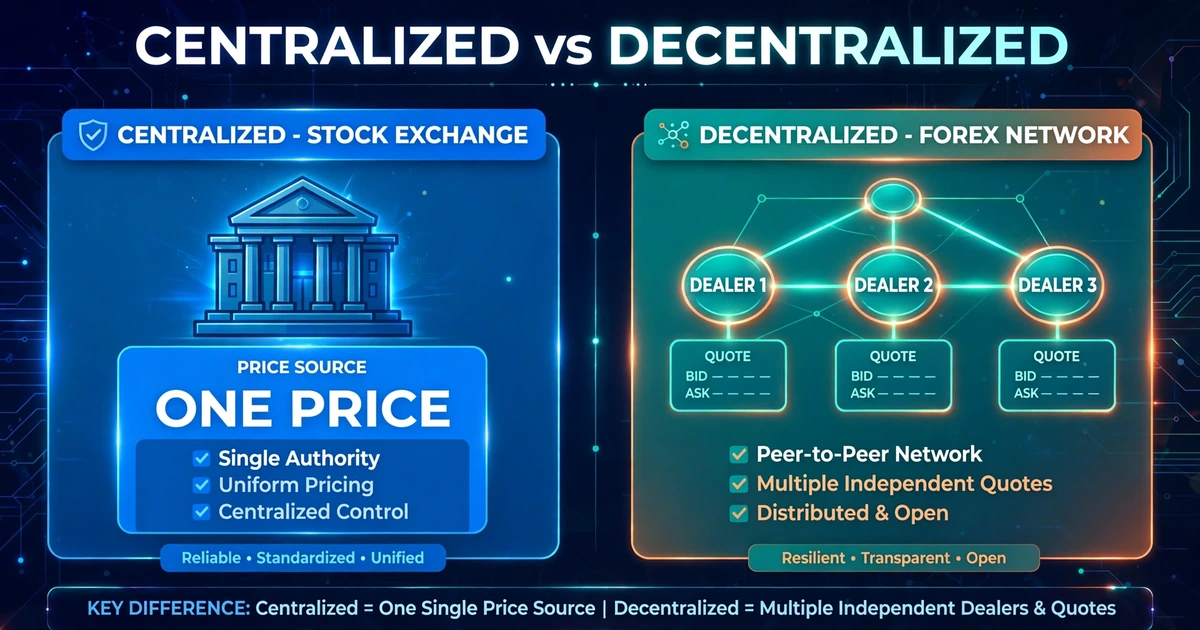
Stocks trade on an exchange with one official price. Forex doesn’t. It’s an over-the-counter market, which means trades happen directly between two parties through electronic networks and dealers.
Two things follow from that:
- There’s no single “true” price. Different dealers quote slightly different prices at any moment, so two brokers can show slightly different rates for the same pair.
- There’s no central opening or closing bell. Trading rolls from one financial center to the next across the day.
According to the BIS Triennial Survey, which tracks the market every three years, turnover runs to trillions of dollars a day. Spot trades, where currencies are exchanged at the current rate, are only one part of that. Instruments such as FX swaps and forwards typically make up a large share too.
The Layers of the Forex Market
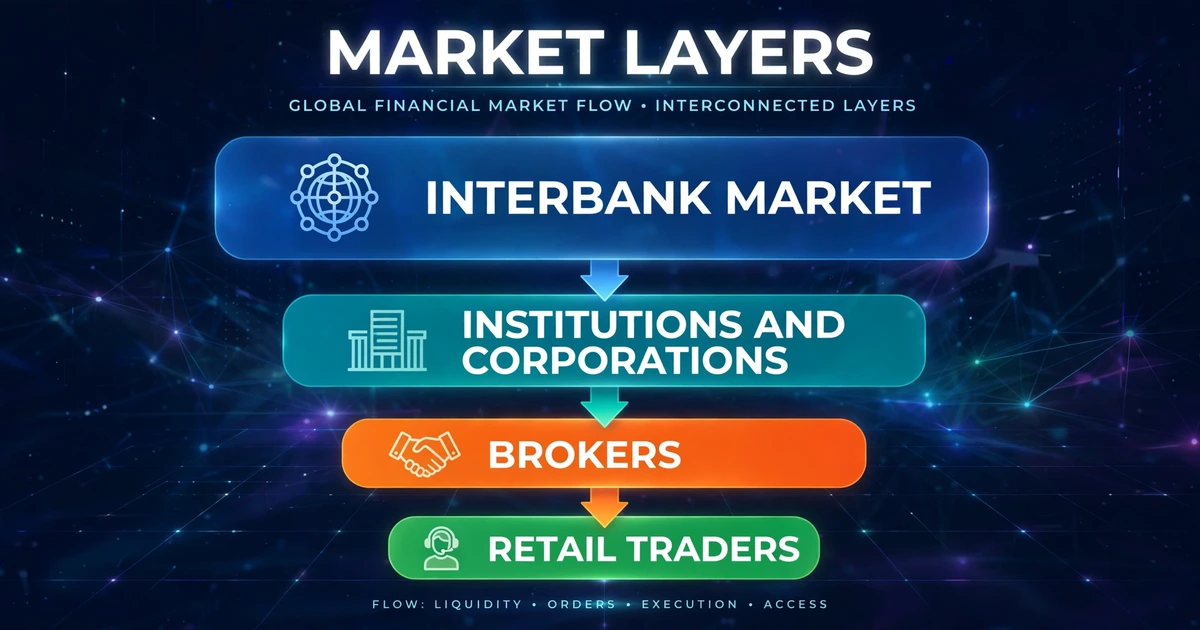
The market works like a pyramid of access.
- The interbank market. Large banks trade with each other and quote prices to clients. This is where much of the liquidity (the ease of buying or selling without moving the price) comes from.
- Institutions and corporations. Hedge funds, asset managers, multinational companies, and central banks trade through banks and other large providers.
- Brokers and retail traders. Brokers connect individuals to the market through trading platforms. Retail traders make up only a small share of total volume.
Each layer gets prices from the one above it. If you want a closer look at the participants, read about who trades forex.
How Forex Prices Are Set
No single body sets exchange rates. They move with supply and demand. If more participants want to buy euros than sell them, the euro’s price rises against other currencies. If more want to sell, it falls.
Many things can shift that balance, and traders often watch the following:
- Interest rate decisions and central bank signals
- Economic data, such as inflation and employment reports
- Risk sentiment, meaning how willing investors are to take risk
- Geopolitical events
Nobody can reliably predict how these will play out, and price reactions can surprise even experienced traders.
Bid, Ask, and the Spread
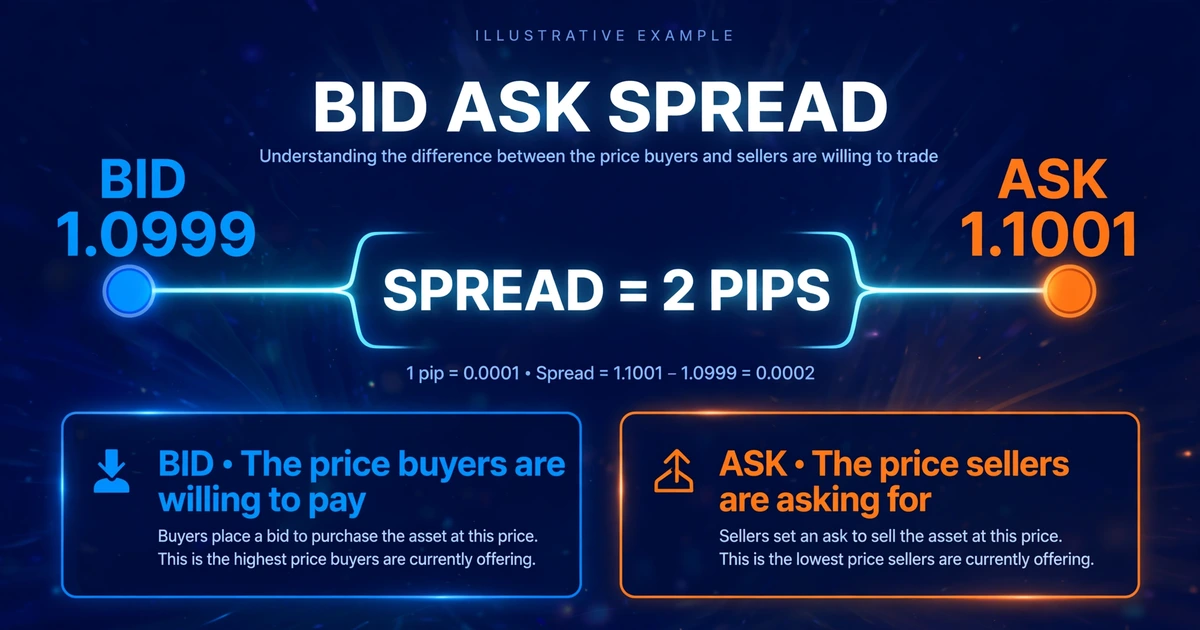
Dealers quote two prices for every pair:
- The bid is what they’ll pay to buy the base currency from you.
- The ask is what they’ll charge to sell it to you.
- The spread is the difference, and it’s a cost of trading.
For example, a hypothetical quote might be bid 1.0999, ask 1.1001. That’s a 2-pip spread. You buy at the ask and sell at the bid, so a trade starts slightly in the red by the amount of the spread. Spreads vary by pair, broker, and market conditions.
How Retail Traders Access the Market
As an individual, you usually can’t trade directly with the large banks. You connect through a broker.
In many regions, retail forex is offered as contracts for difference (CFDs). That means you’re trading a contract with the broker that tracks currency prices, not exchanging actual currency. How the broker handles your order varies:
- Some brokers act as the counterparty to your trade, quoting their own prices.
- Others route orders to outside liquidity providers and pass quotes on to you.
Neither model is automatically good or bad, but the differences affect spreads, execution speed, and potential conflicts of interest. Before you open an account, check which regulator oversees the broker and read its order execution policy. Rules vary by country, so check your local regulator.
A Trade From Start to Finish
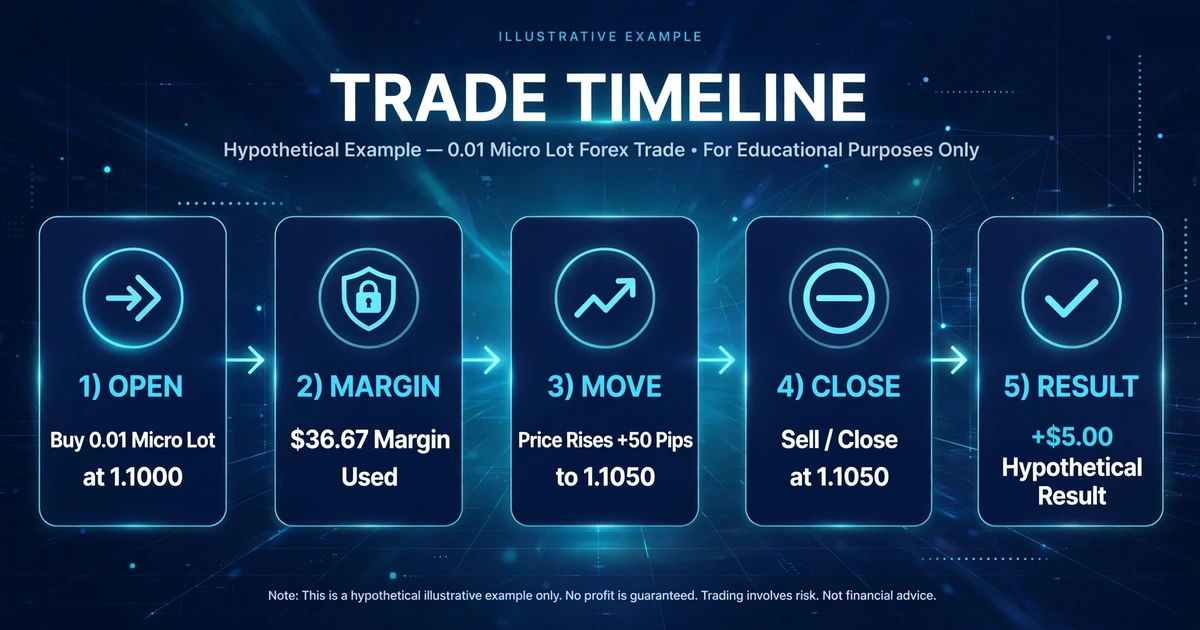
Here’s a hypothetical example for illustration only.
You have a $1,000 account and believe EUR/USD may rise. The quote is bid 1.0999, ask 1.1001.
- Open: You buy 1 micro lot (1,000 units of the base currency) at the ask, 1.1001.
- Margin: With 1:30 leverage, the broker sets aside about $1,100 ÷ 30 ≈ $36.67 of your balance as margin. Margin is a deposit held while the trade is open, not a fee.
- Move: The market rises. Later the bid is 1.1051.
- Close: You sell at the bid, 1.1051.
- Result: 1.1051 − 1.1001 = 0.0050, or 50 pips. At $0.10 per pip on a micro lot, that’s $5.
If the price had fallen by the same amount, you’d have lost $5. Leverage lets you control a larger position than your deposit alone, but it magnifies losses as well as gains, so small adverse moves can add up quickly.
When the Forex Market Is Open
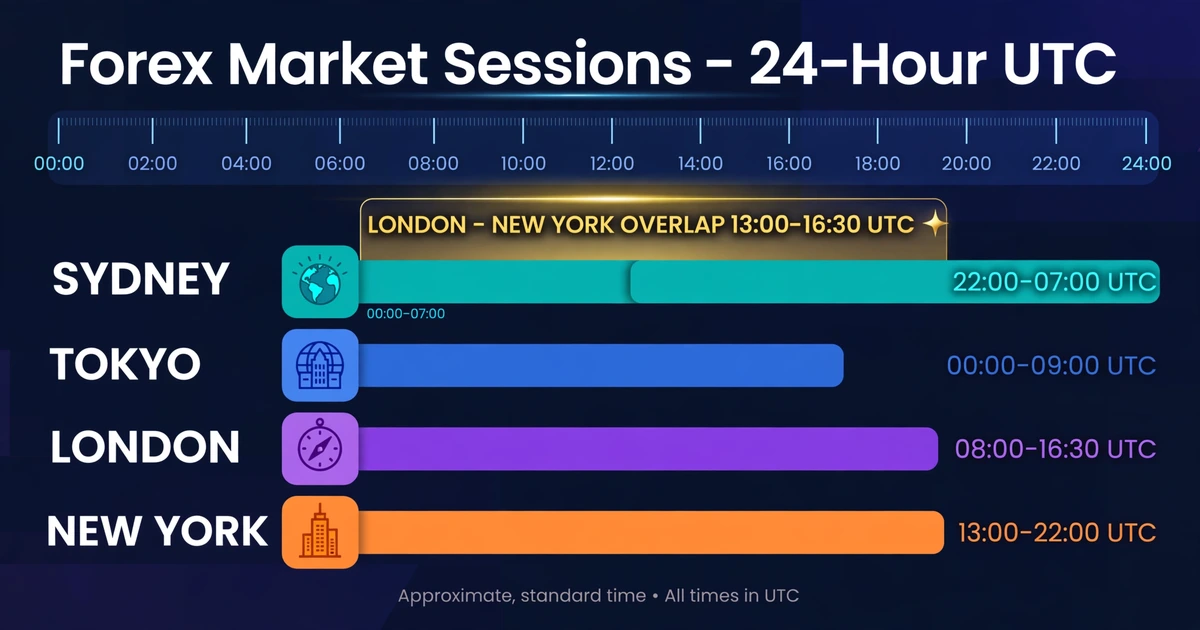
The market runs 24 hours a day from Sunday evening to Friday evening (New York time), because trading rolls between financial centers. Activity tends to rise when sessions overlap. Here are approximate hours in UTC during standard time:
| Session | Approximate hours (UTC) |
|---|---|
| Sydney | 22:00–07:00 |
| Tokyo | 00:00–09:00 |
| London | 08:00–17:00 |
| New York | 13:00–22:00 |
These shift by about an hour when daylight saving time starts or ends in each region. For a full breakdown, see forex trading sessions.
Common Beginner Mistakes
- Assuming there’s one official price. Quotes differ slightly between brokers, so compare the cost, not just the headline spread.
- Ignoring spread and swap costs. They apply whether or not a trade wins.
- Using too much leverage. It’s the fastest way to lose a small account.
- Trading through major news without a plan. Spreads can widen and prices can jump around data releases.
- Not checking how the broker works. Regulation, execution, and fees all matter.
- Treating the market as predictable. No one can reliably forecast where prices go next.
Risks and Limitations
The market’s structure creates some specific risks.
- Leverage can wipe out your deposit. Losses are magnified along with gains.
- Slippage and gaps. Orders can fill at a worse price than expected in fast markets, and prices can gap when the market reopens after the weekend.
- Counterparty risk. Your broker may be your trading counterparty, so its regulation and reliability matter.
- Widening spreads. Costs can rise sharply in thin or volatile conditions.
- Unregulated providers. Some firms operate with little oversight, and scams exist.
- Rules vary by country. Leverage limits and trading regulations differ by region.
Results vary, and there is no guarantee of profit.
Frequently Asked Questions
Is the forex market centralized?
No. The forex market is decentralized, so there’s no central exchange. Trades take place over the counter between banks, brokers, and other participants through electronic networks. That’s why quotes can differ slightly from one provider to another.
Who sets exchange rates?
No single entity does. Rates move with supply and demand across all participants. Central banks influence currencies through interest rate policy and, in some cases, direct intervention, but they don’t fix market prices day to day.
Why is the forex market open 24 hours?
Because trading shifts across time zones. As Sydney closes, Tokyo opens, then London, then New York. This continuous cycle keeps the market active from Sunday evening to Friday evening New York time, with some hours busier than others.
How do retail traders access the forex market?
Mostly through brokers, who provide trading platforms and connect you to prices. In many regions, retail forex is offered as CFDs. Check that your broker is regulated where you live, and understand how it executes orders.
Can you trade forex on weekends?
Generally not. The spot forex market closes from Friday evening to Sunday evening New York time. Prices can gap when it reopens if major news broke over the weekend, which can affect open positions and stop-losses.
Key Takeaway and Next Step
The forex market works as a decentralized network where prices come from supply and demand and a broker connects you to it. Knowing this helps explain quirks like different quotes at different brokers and wider spreads in quiet hours. A sensible next step is to open a demo account and watch how bid, ask, and spreads change over the day. If the fundamentals still feel unclear, revisit what forex trading is.
Disclaimer
This article is for educational purposes only and is not financial advice. Forex and CFD trading involves a high level of risk, and you can lose some or all of your capital. Leverage can magnify both gains and losses. Never trade with money you can’t afford to lose.
Any percentages or figures shown are historical averages or hypothetical examples, not guarantees. Past performance does not predict future results.
Join now
Comments (0)
Be the first to comment.