
Forex Trading Sessions Explained: A Complete Guide
Two traders take the same setup on the same pair. One enters at 3 a.m. UTC and watches price drift sideways for hours. The other enters in the middle of the London morning and sees it move within minutes. Same pattern, different clock.
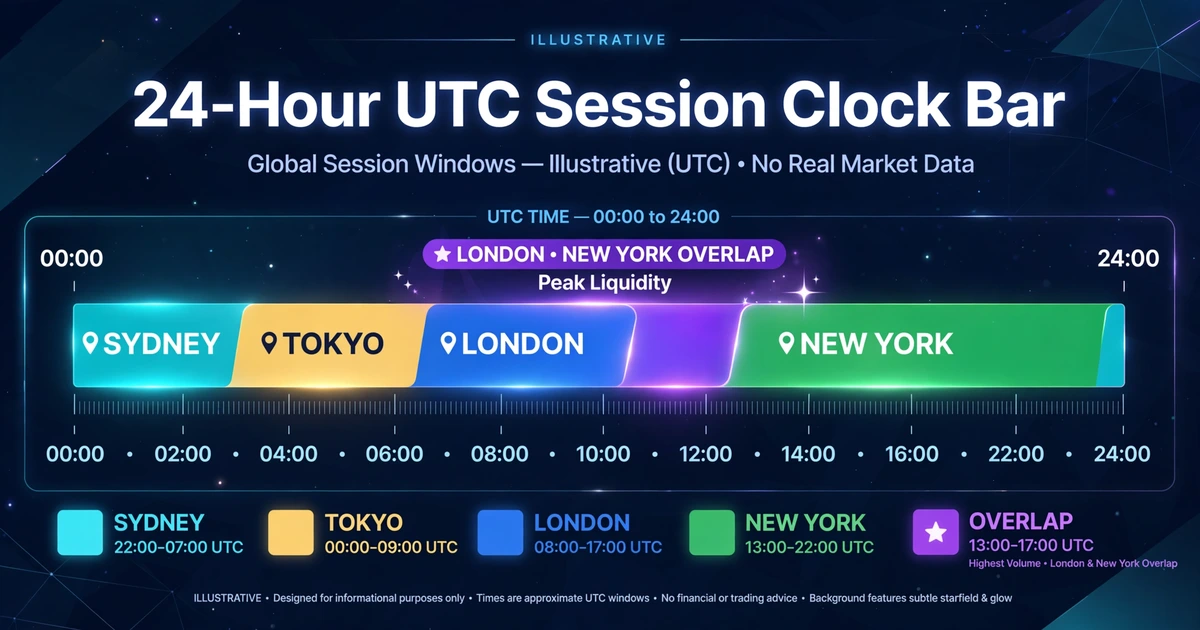
Forex trading sessions explain the gap. The market runs around the clock on weekdays, but activity rotates between financial centers as their business days start and finish. Below you’ll find the four sessions in UTC, how daylight saving shifts them, and which hours tend to suit which pairs and trading styles.
Four Sessions, One Rotating Market
- Forex trades continuously from the Sunday evening open to the Friday evening close, in four overlapping sessions: Sydney, Tokyo, London, and New York.
- Session hours follow local business days, so they shift by an hour when a region changes its clocks. Always check times in UTC.
- Activity usually builds when two sessions overlap, especially London and New York.
- Busy doesn’t mean easy. Faster markets can hit stops more often, so session timing should fit your pair, style, and schedule.
Why the Market Follows the Sun Around the Globe
Forex has no central exchange. It’s a network of banks, brokers, and institutions, and each one trades mostly during its own business day. As Sydney’s day ends, Tokyo’s begins, then London’s, then New York’s. The longer story of why the forex market has trading sessions comes down to this handoff: the market doesn’t need to close because someone, somewhere, is always at work.
That handoff also explains why liquidity (how easily you can trade without moving the price) rises and falls through the day.
The Four Sessions in UTC, With Daylight Saving Built In
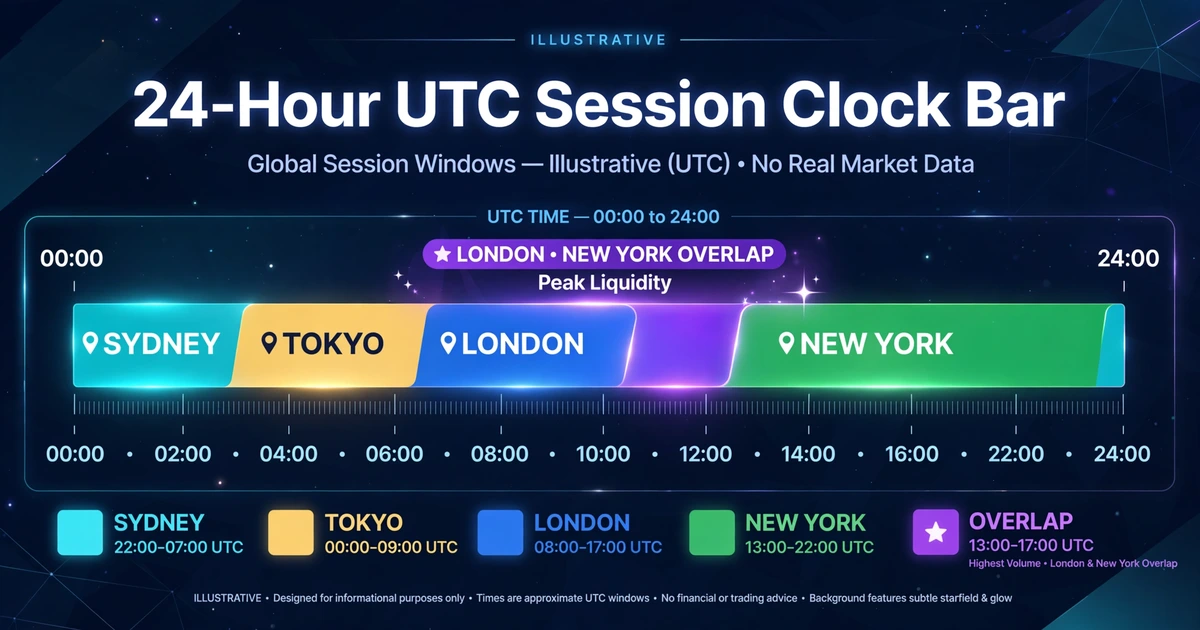
UTC (Coordinated Universal Time) is the neutral reference clock that doesn’t change with the seasons. The hours below are widely used conventions, not official exchange hours, and your broker’s server clock may differ.
| Session | Typical hours (UTC) | Shift during local summer time | Currencies most in focus |
|---|---|---|---|
| Sydney | 22:00–07:00 | Starts and ends an hour earlier (21:00–06:00) while Australia is on daylight saving, roughly October to April | AUD, NZD |
| Tokyo | 00:00–09:00 | None; Japan doesn’t use daylight saving | JPY, AUD, NZD |
| London | 08:00–17:00 | 07:00–16:00 during UK summer time | EUR, GBP, CHF |
| New York | 13:00–22:00 | 12:00–21:00 during US daylight saving | USD, CAD |
The Sydney row uses Sydney’s winter hours (roughly April to October) as its baseline. The London and New York rows use northern-hemisphere winter hours.
For the exact weekly start and finish, see the forex market open and close times. The short version is that the week begins when Sydney opens on Sunday evening UTC and ends when New York closes on Friday evening UTC.
What Each Session Tends to Feel Like
These are tendencies, not rules. Any session can produce a surprise.
Sydney: A Quiet Handoff
Sydney opens the week and the trading day with thin liquidity. Spreads (the gap between buy and sell prices) can be wider than usual in the first hours. Activity centers on AUD and NZD pairs, and on any news from Australia or New Zealand.
Tokyo: Asia’s Hours, With Yen in Focus
Tokyo is the main Asian session. Many EUR and GBP pairs tend to move less during it, while yen pairs and AUD and NZD crosses react to regional data and central bank news. Some traders watch for ranges that form here and get tested later, but a range isn’t a promise of a breakout.
London: The Volume Engine
London has historically ranked as the largest forex trading center, according to BIS Triennial Survey data. Liquidity for EUR, GBP, and CHF pairs is generally deep, spreads on majors are typically tighter, and many trends and reversals begin as European banks come online. European data releases often land in the first hours.
New York: Dollar News and Afternoon Fade
The US dollar sits on one side of most major trades, so New York matters for nearly every major pair. Key US data, such as employment and inflation reports, often comes out at 8:30 a.m. New York time. After London closes, activity usually fades, and late New York hours can feel thin.
For individual session breakdowns, the guide to the four major forex sessions goes deeper on each one.
Overlaps: When Two Financial Centers Trade at Once
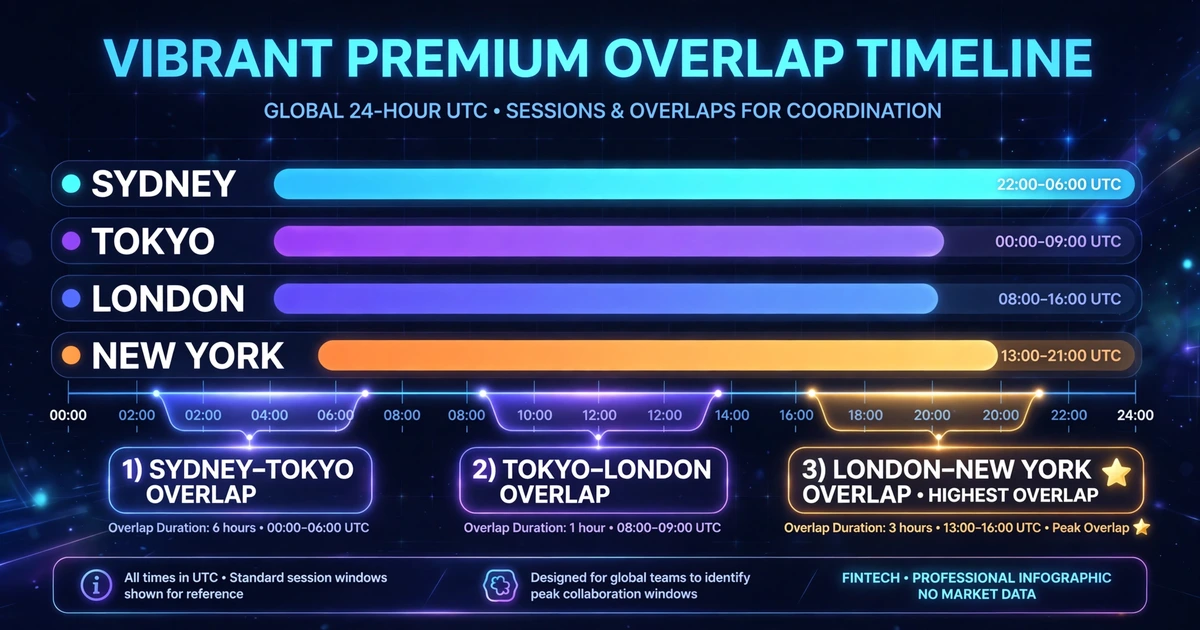
- Sydney–Tokyo (roughly 00:00–07:00 UTC): the longest overlap, though not the most active. Traders in both regions share the clock.
- Tokyo–London (about one hour, around 08:00–09:00 UTC in winter): short, and sometimes marked by quick moves as Europe takes over.
- London–New York (13:00–17:00 UTC in winter, 12:00–16:00 UTC in summer): four hours when the two deepest centers are both open. This tends to be the busiest part of the day for EUR/USD, GBP/USD, and USD/CAD.
Higher activity cuts both ways. Spreads may narrow, but price can also move quickly through your stop, and fills can be worse than planned during news.
Near the end of the New York session, around 5 p.m. New York time, brokers go through their daily rollover. Spreads often widen briefly at that point, so many traders avoid placing or adjusting orders in that window.
Pairs That Often Fit Each Session
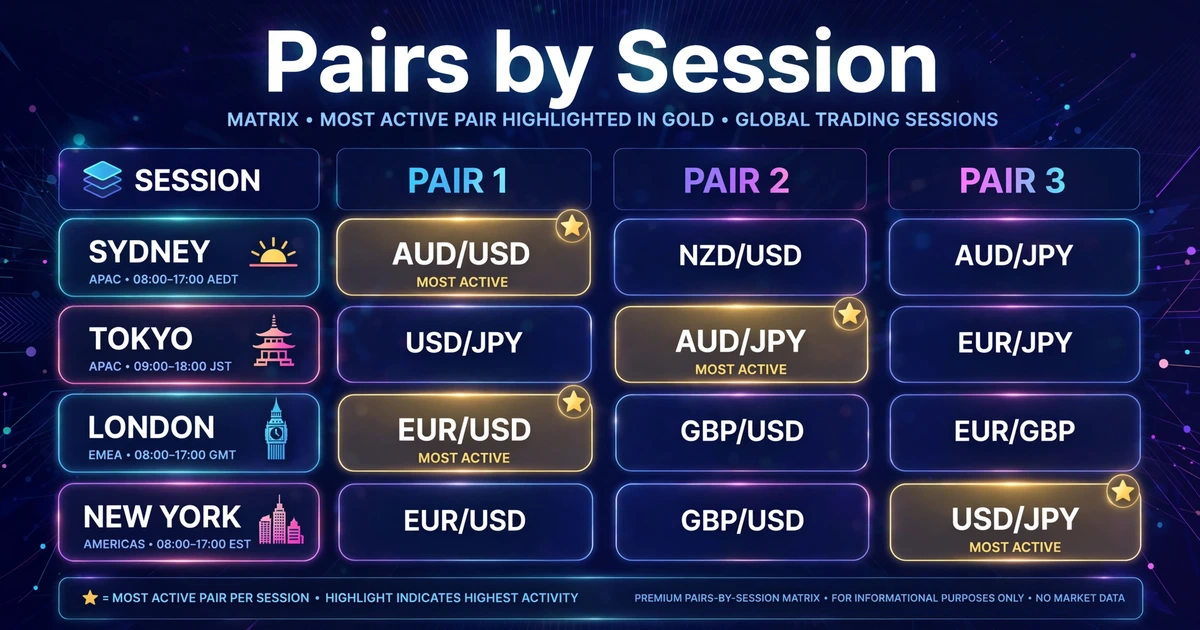
| Session | Pairs traders often watch | Why |
|---|---|---|
| Tokyo / Sydney | USD/JPY, AUD/JPY, AUD/USD, NZD/USD | Local currencies are active, plus regional data |
| London | EUR/USD, GBP/USD, EUR/GBP, USD/CHF | European currencies trade at peak depth |
| New York | EUR/USD, USD/CAD, USD/JPY | US data and dollar flows drive moves |
| London–New York overlap | EUR/USD, GBP/USD | Highest combined activity for the dollar and European currencies |
A pair can trade at any hour. The table shows where its home currencies are most active.
Converting Session Times Into Your Own Clock: A Singapore Example
Suppose a trader lives in Singapore, which is UTC+8 and has no daylight saving. During northern-hemisphere winter, the conversions are:
| Session (UTC) | Singapore time |
|---|---|
| Tokyo, 00:00–09:00 | 08:00–17:00 |
| London, 08:00–17:00 | 16:00–01:00 (next day) |
| New York, 13:00–22:00 | 21:00–06:00 (next day) |
| London–New York overlap, 13:00–17:00 | 21:00–01:00 |
Once the UK and US move to summer time, the London and New York sessions start an hour earlier in UTC. The overlap becomes 12:00–16:00 UTC, which is 20:00–00:00 in Singapore.
The Singapore clock never changes, but the market’s does. That’s why a trader who relies on local time alone can end up an hour off without noticing.
There’s one more wrinkle. The US and UK change clocks on different weekends. For a few weeks in spring and again around late October to early November, the London–New York overlap stretches to about five hours instead of four.
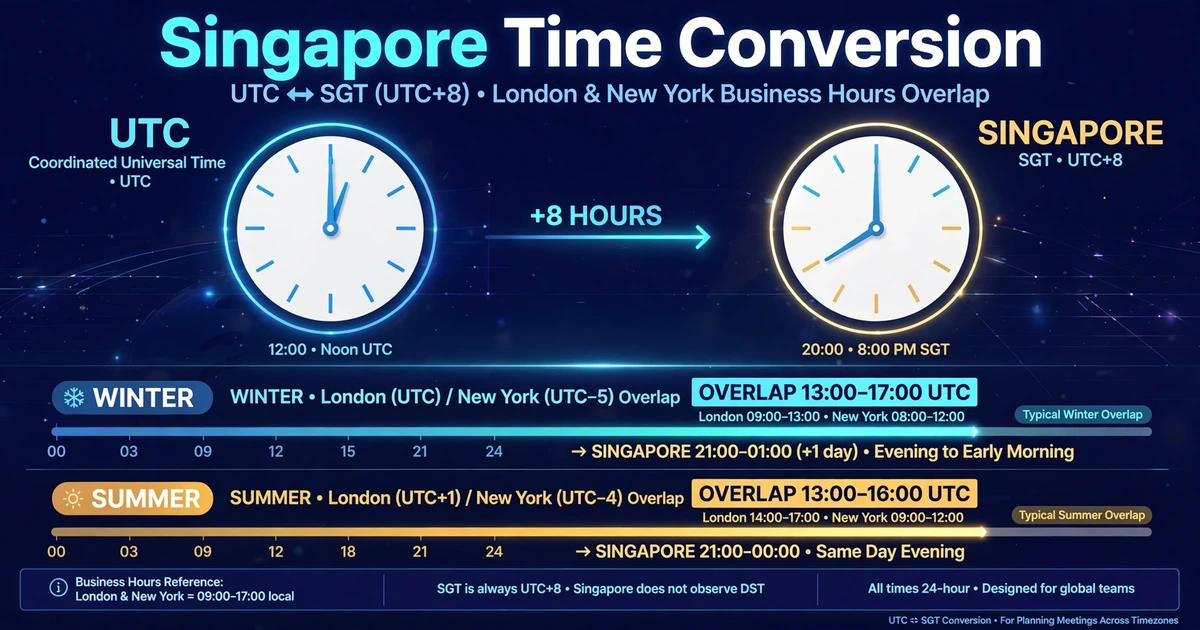
This is a hypothetical example for illustration only.
Matching a Trading Style to a Session Window
Your style and your schedule should drive which session you use, not the other way around.
- Short-term traders (scalpers and day traders) often focus on London and the London–New York overlap, where activity is highest and spreads on majors are usually tighter.
- Swing traders who hold for days care less about the exact hour, though they still avoid entering around thin hours or major news.
- Traders with day jobs in Asia or Oceania may find the Tokyo session fits their evenings and mornings, even if its moves are smaller.
If you’re unsure where you fit, choosing a trading style is a good place to settle your time commitment first.
Five Session Habits That Trip Up Newer Traders
- Ignoring clock changes. Treating “London opens at 8” as permanent when it moves with daylight saving.
- Mixing time zones. Using broker server time, local time, and UTC without knowing which one a chart displays.
- Assuming overlap means easy. Fast moves help some setups and wreck others.
- Trading through scheduled news without checking. A data release can move price in seconds, and session patterns say nothing about its direction.
- Using one session’s rules for another. A range logic that works during Tokyo can fail when London opens.
When Session Timing Works Against You
- Session patterns aren’t guaranteed. A move that “usually” appears when London opens simply may not show up, and trading it as if it must is a common way to lose money.
- Thin liquidity. In late New York, early Sydney, and around bank holidays, spreads can widen and prices can jump on small orders.
- Weekend gaps. Price at the Sunday open can differ from Friday’s close, and a stop-loss may fill beyond your set price.
- Overlap volatility. More activity can mean more slippage (the difference between the price you expected and the one you got).
- Leverage. It magnifies gains and losses alike, so a fast overlap move can hurt more than expected, and some traders can lose their entire deposit.
Session Timing Doubts, Settled in a Few Lines
What are the four main forex trading sessions?
Sydney, Tokyo, London, and New York. Each follows its local business day, and they overlap so that the market is active around the clock from the Sunday evening open to the Friday evening close in UTC.
Which session has the most trading activity?
London generally does, and the London–New York overlap is often the busiest stretch of the day. Activity varies by pair, so check the one you trade rather than relying on a general rule.
Does the forex market close during the day?
No. It closes only for the weekend, from roughly Friday evening to Sunday evening UTC. The exact times can vary slightly by broker, and holidays can thin trading even when the market stays open.
How does daylight saving time change forex sessions?
It shifts London and New York an hour earlier in UTC during their summer months and Sydney an hour earlier during Australia’s summer. Tokyo doesn’t change. The UTC hours move, but the local business hours stay the same.
Do I need to trade every session?
No. Many traders focus on one window that fits their schedule and pair, then review how it behaves over several weeks. Trading fewer hours with a clear plan is easier to manage than being at the screen constantly.
Pick One Window and Watch It for a Month
The forex trading sessions tell you where the activity is, not where the profit is. The most useful habit is choosing one window that fits your life, then learning how your pair behaves in it. For the next month, pick a single two-hour window in UTC, note in your journal what price did each day, and record the spread and any news. By the end you’ll have your own evidence instead of a rule of thumb.
Disclaimer
This article is for educational purposes only and is not financial advice. Forex and CFD trading involves a high level of risk, and you can lose some or all of your capital. Leverage can magnify both gains and losses. Never trade with money you can’t afford to lose.
Join now
Comments (0)
Be the first to comment.