

Why Does the Forex Market Have Trading Sessions?
A forex chart keeps printing candles at 2 a.m., which makes the idea of a “trading session” feel strange. If the market never shuts, why does the forex market have trading sessions at all?
The short answer is that no single place or clock runs it. Banks and dealers in different time zones do most of the trading, and each group works during its own business day. Sessions are what that rotation looks like on a chart. They’re a pattern in activity, not an official schedule.
No Exchange, No Closing Bell: The Short Reason
- Forex has no central exchange. It’s a network of banks, brokers, and institutions, so no one sets an official opening or closing time.
- Most large participants work during their local business hours, and those hours move around the globe as the Earth rotates.
- Sessions (Sydney, Tokyo, London, New York) are informal labels for where activity is concentrated at a given hour.
- The market is open continuously from Sunday evening to Friday evening in UTC. Sessions change how busy it is, not whether it’s open.
A Market Built From Direct Deals, Not a Trading Floor
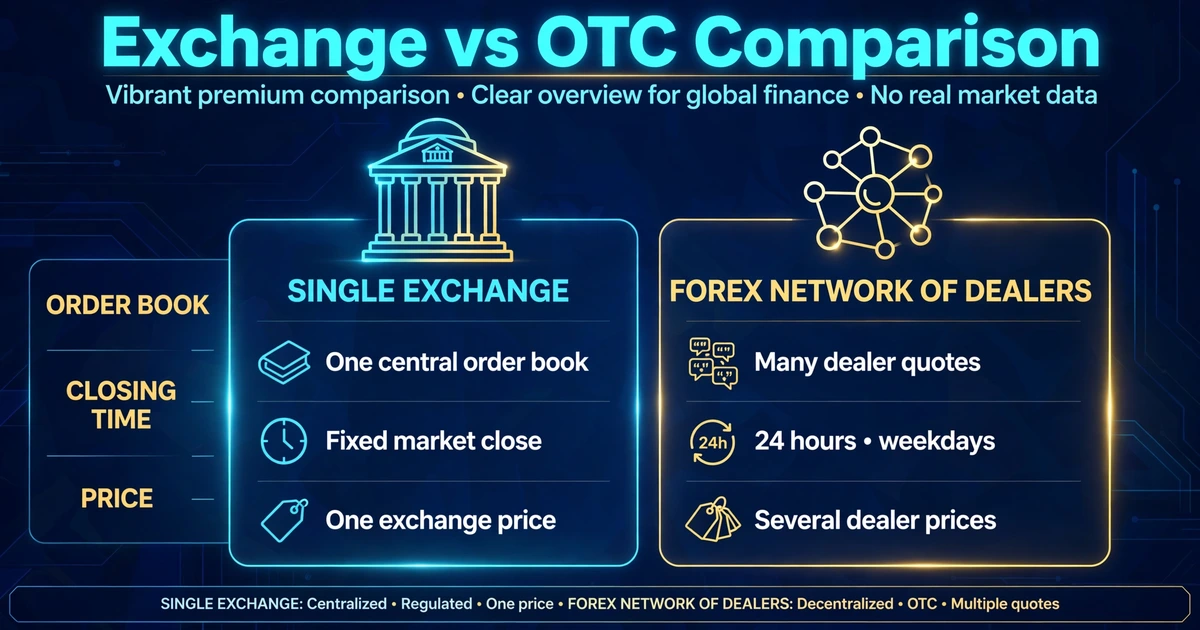
A stock exchange is a single venue with one order book, fixed opening and closing times, and a single price at any moment. Forex works differently. It’s an over-the-counter (OTC) market, meaning trades are agreed directly between parties instead of being matched on one exchange.
Dealers, usually large banks, quote buy and sell prices to clients and to each other. Different providers can show slightly different prices at the same instant. For a closer look at the mechanics, see how the forex market works.
Without one venue, there’s no one to ring a bell. When no single place sets the schedule, activity follows the people doing the trading.
Banks Work Business Hours, and Business Hours Follow the Sun
The bulk of trading volume comes from banks, funds, corporations, and other institutions. The article on who trades forex covers each group, and nearly all of them have staff, risk limits, and approval processes tied to a working day.
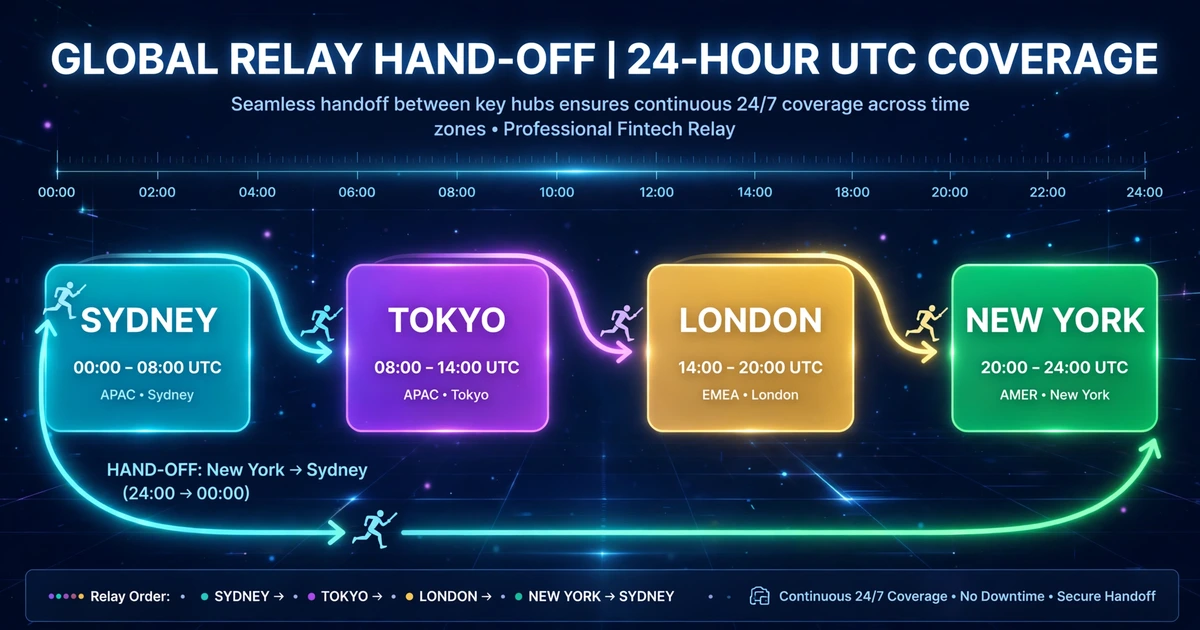
A treasurer at a company that pays suppliers abroad converts currency when the desk is open. A bank’s dealers are at their screens during local office hours. When those people go home, the activity they generate drops, and a team in the next time zone starts its day.
Some large dealers hand risk from one region to the next so that someone is always responsible for their positions. That relay is the “follow the sun” rhythm that traders describe as sessions.
| Driver | How it creates a daily rhythm |
|---|---|
| No central exchange | Nothing forces the whole market to open or close at one time |
| Local business hours | Dealers, treasurers, and fund managers trade mostly while at work |
| Time zones | The working day moves from Asia-Pacific to Europe to North America |
| Scheduled data and central bank decisions | Releases follow local clocks, so they cluster activity at set hours |
| Banking and settlement systems | Each currency settles through banks in its home region, so their hours and holidays matter |
Why Stock Exchanges Close and Forex Doesn’t
An exchange closes because it’s a physical or legal venue with set trading hours. Orders pile up overnight and match at the next open, which is why stocks can gap at the opening bell.
Forex has no single venue to close. As one center’s day ends, another’s has begun or is about to. The market stays open because there’s always a bank, a broker, or a corporate desk somewhere that’s still working.
That continuity applies to every currency but not to every hour. A currency often trades most actively when its home financial center is awake. An Australian dollar pair tends to be busier in Sydney hours than in the middle of the New York afternoon, for example.
Data Releases and Central Banks Keep Local Time
Many scheduled events that move currencies are timed to the local day of the country that issues them. An employment report from the United States comes out in the New York morning. A decision from a European central bank comes out during European hours. These clocks don’t adjust for traders in other time zones.
That matters in two ways. First, activity bunches around those local times. Second, when clocks change for daylight saving, the same local release lands at a different UTC time.
One Release, Two Clock Times: A Dubai Trader’s View
Suppose a major US employment report is scheduled for 8:30 a.m. New York time. A trader in Dubai (UTC+4, with no daylight saving) sees it at different times during the year:
| Season in the US | New York offset | Release in UTC | Dubai clock |
|---|---|---|---|
| Winter (standard time) | UTC−5 | 13:30 | 17:30 |
| Summer (daylight time) | UTC−4 | 12:30 | 16:30 |
The release didn’t move for the people who produce it. It stayed at 8:30 in the morning in New York. What changed is the distance between New York and Dubai, which shifts by an hour while the US is on summer time.
That’s the session idea in one scene: events stay tied to local business hours, so the market’s busy moments slide against UTC when clocks change. Your broker’s chart may use its own server clock, so check which time zone it follows.
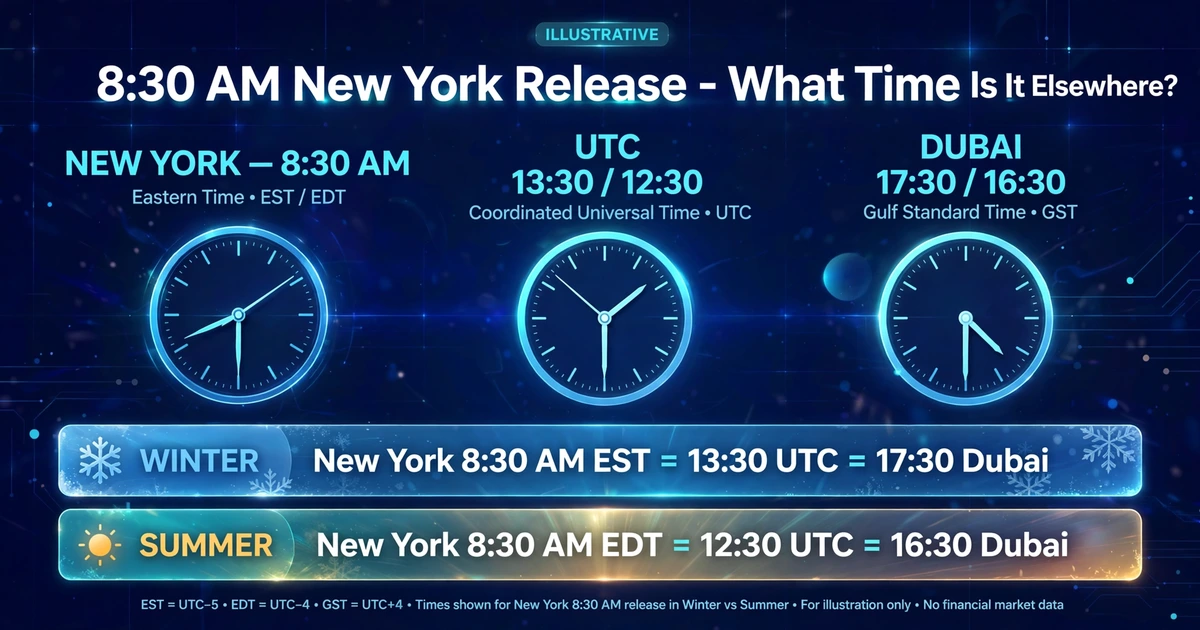
This is a hypothetical example for illustration only.
Why the Weekend Is the Only Real Closing Bell
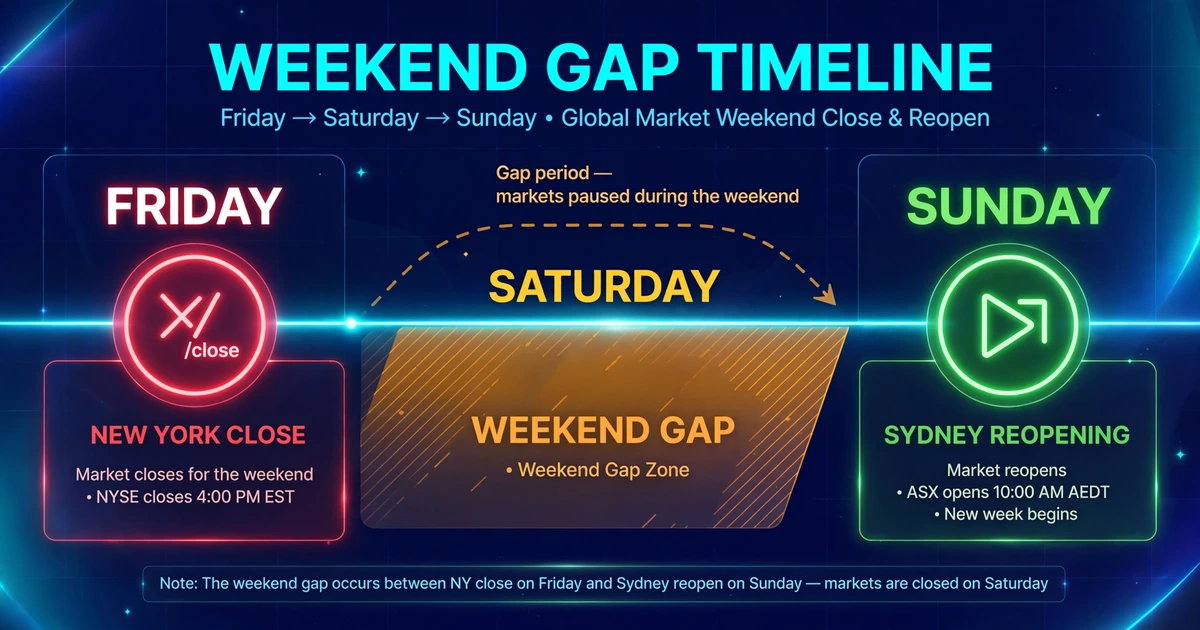
The market does pause, though only for the weekend. Trading winds down on Friday evening when New York closes, and it restarts on Sunday evening in UTC terms as Sydney’s week begins on Monday morning local time.
The pause happens because the major financial centers are closed for the weekend. Without participants at their desks, there’s little to trade. The exact start and finish vary by broker, and the page on when the forex market opens and closes has the details.
Do Sessions Still Matter With Electronic and Automated Trading?
Electronic platforms and automated systems have connected the centers more closely, and some systems run around the clock. That has made the lines between sessions blurrier than they once were.
But the people and institutions behind the orders still work human schedules, and scheduled events still follow local clocks. London and New York, for example, have long been among the largest trading centers, according to the BIS Triennial Survey, with Asian hubs such as Singapore, Hong Kong, and Tokyo also ranking high.
How strongly patterns hold varies by pair and changes over time, so treat sessions as tendencies you check against your own charts. For the actual hours, the guide to forex trading sessions lists them in UTC.
What the Session Structure Means for Your Orders
You don’t need to trade every hour to benefit from understanding why sessions exist. The structure shapes three things you’ll notice:
- Liquidity (how easily you can trade without moving the price). More participants usually means deeper liquidity.
- Spreads (the gap between the buy and sell price). They’re often narrower when many dealers are quoting and wider when the market is quiet.
- Volatility (how much price moves). Scheduled news and busy hours can raise it, but quiet hours can also spike on unexpected headlines.
A pair’s home currencies tell you when to expect activity. Aligning your trading window with that is a practical starting point.
Four Misreadings That Make Sessions Sound Like Rules
- “Sessions are official market hours.” They’re informal labels, and no regulator or exchange defines them.
- “The market is closed during the Tokyo session.” It’s open. Some pairs are simply quieter at that time.
- “Overlaps are always the best time to trade.” More activity helps some approaches and hurts others.
- “A session opening guarantees a big move.” Activity can rise without price going anywhere useful.
Thin Hours, Rollover, and Weekend Gaps: The Real Downsides
Understanding sessions doesn’t remove the risks they create:
- Thin liquidity. In quiet hours and around bank holidays, spreads can widen, and a modest order can move price more than you expect.
- Daily rollover. Around 5 p.m. New York time, brokers close one trading day and open the next. Spreads can widen briefly, so many traders avoid placing or adjusting orders then.
- Weekend gaps. Price at the Sunday open can differ from Friday’s close, and a stop-loss may fill at a worse price than you set.
- Slippage during news. Busy moments can fill your order away from the price you expected.
- Pattern risk. A habit that held for a few weeks can stop working, and trading it as if it were a rule can lose money.
- Leverage. It magnifies gains and losses alike, so a quick move in a thin or fast market can hurt more than planned. Some traders can lose the entire deposit.
Before You Ask Google Again: Sessions, Closings, and Overlaps
Why does the forex market trade 24 hours a day?
There’s no central exchange with fixed hours. Banks and dealers in different time zones trade during their own business days, and as one region finishes, the next begins. That relay keeps the market open from Sunday evening to Friday evening in UTC.
Who decides when forex sessions start and end?
Nobody does. Sessions are informal labels traders use to describe when major financial centers are active. The common hours are conventions based on local business days, and they shift when daylight saving changes.
Why is the forex market closed on weekends?
Because the major financial centers are closed. With no banks or institutions at their desks, there’s little to trade. Trading resumes on Sunday evening UTC as the new week begins in Asia-Pacific.
Do forex sessions change in summer?
The local hours stay the same, but the UTC hours move when a region changes its clocks. London and New York shift when the UK and US switch to summer time, and Sydney shifts with Australian daylight saving. Tokyo doesn’t change.
Is the market more active in some sessions than others?
Typically, yes. London and the London–New York overlap tend to be busiest for major pairs. Activity varies by currency pair and over time, so check the pair you trade.
The Sun Sets, the Market Doesn’t
Forex has sessions because it has no single owner, exchange, or closing bell. Activity follows the working day around the planet, and scheduled news follows local clocks. This week, mark the UTC boundaries of the four sessions on a one-hour chart of one pair and compare candle sizes by eye in each stretch. A few days of notes will show you how your pair behaves, which is more useful than any rule of thumb.
Disclaimer
This article is for educational purposes only and is not financial advice. Forex and CFD trading involves a high level of risk, and you can lose some or all of your capital. Leverage can magnify both gains and losses. Never trade with money you can’t afford to lose.
Join now
Comments (0)
Be the first to comment.