
When Does the Forex Market Open and Close?
Late on a Friday, your chart stops moving. Your broker’s server clock says midnight, and a friend in another country swears the market has another hour to run. Nobody’s wrong; you’re all reading different clocks.
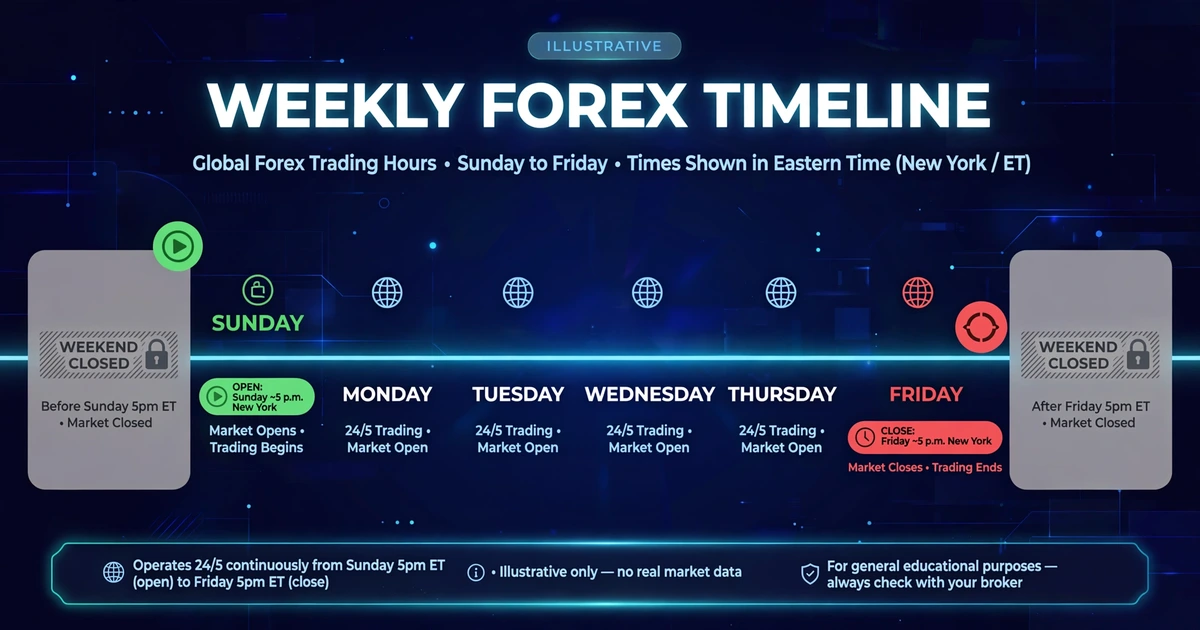
If you’ve wondered when the forex market opens and closes, the dependable anchor is 5 p.m. New York time. The market closes there on Friday and reopens there on Sunday. This article turns that one rule into UTC times, shows how daylight saving shifts it, and covers what the weekend gap, the daily reset, and holidays mean for your orders.
Sunday Evening to Friday Evening: The Week’s Boundaries
- Spot forex trades continuously from Sunday around 5 p.m. New York time until Friday around 5 p.m. New York time.
- In UTC, that’s 22:00 during US standard time and 21:00 during US daylight saving time.
- The market is closed on Saturday and for most of Sunday. Brokers can differ by a few minutes, so check your own platform.
- Individual currency centers and some brokers have extra closures on holidays, and liquidity thins before the market itself shuts.
The 5 p.m. New York Convention Behind the Weekly Clock
No exchange or regulator rings a bell for forex, as the explanation of why the forex market has trading sessions shows. The weekly boundary is a convention that grew up around the US dealer day: the “forex day” ends at 5 p.m. in New York, and the next one begins.
On Friday at that time, the last major center finishes its week. On Sunday at the same hour, dealers in Asia-Pacific start theirs. By the time Monday morning arrives in Sydney, the market is already underway.
Weekly Open and Close Times as Daylight Saving Moves Them
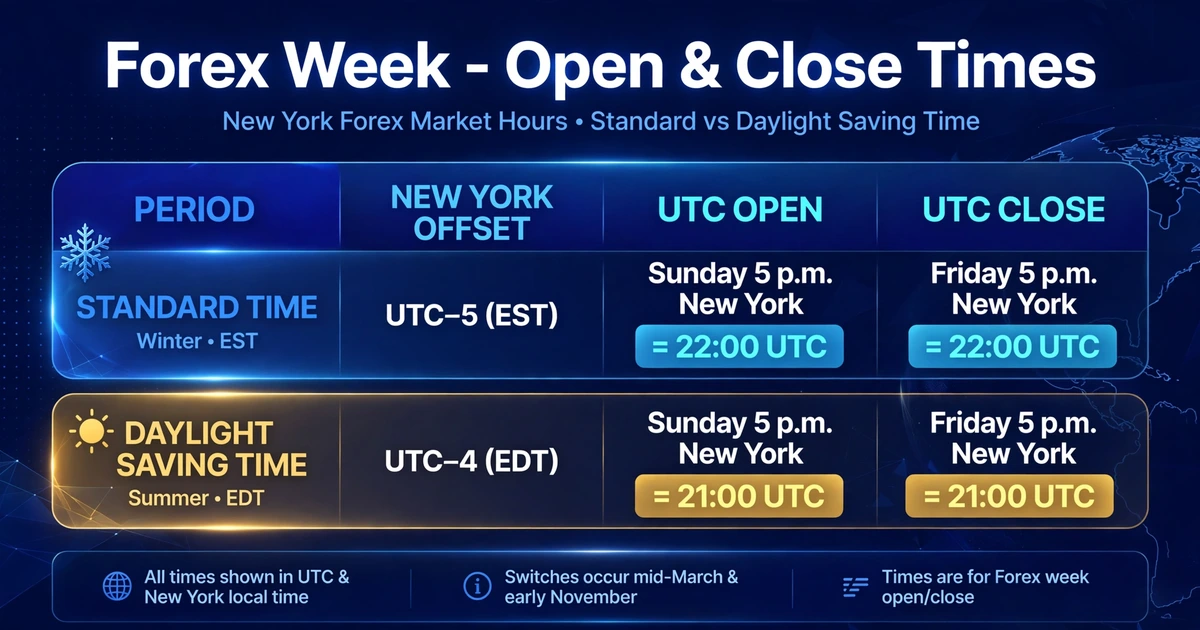
The 5 p.m. rule follows New York’s clock, so the UTC time moves when the US changes clocks. The US is on daylight saving time from roughly the second Sunday in March to the first Sunday in November.
| Period | New York offset | Weekly open (Sunday, UTC) | Weekly close (Friday, UTC) |
|---|---|---|---|
| US standard time (early November to mid-March) | UTC−5 | 22:00 | 22:00 |
| US daylight saving time (mid-March to early November) | UTC−4 | 21:00 | 21:00 |
Other regions change their clocks on different dates. The UK, Europe, and Australia all follow their own calendars. For a few weeks each year, the gap between New York and London, or between New York and Sydney, is an hour different from the rest of the year. The weekly open and close still follow New York, but the sessions around them shift. If you want the full 24-hour layout, the forex market hours schedule maps it out hour by hour.
Why Your Broker’s Chart May Disagree With the Clock
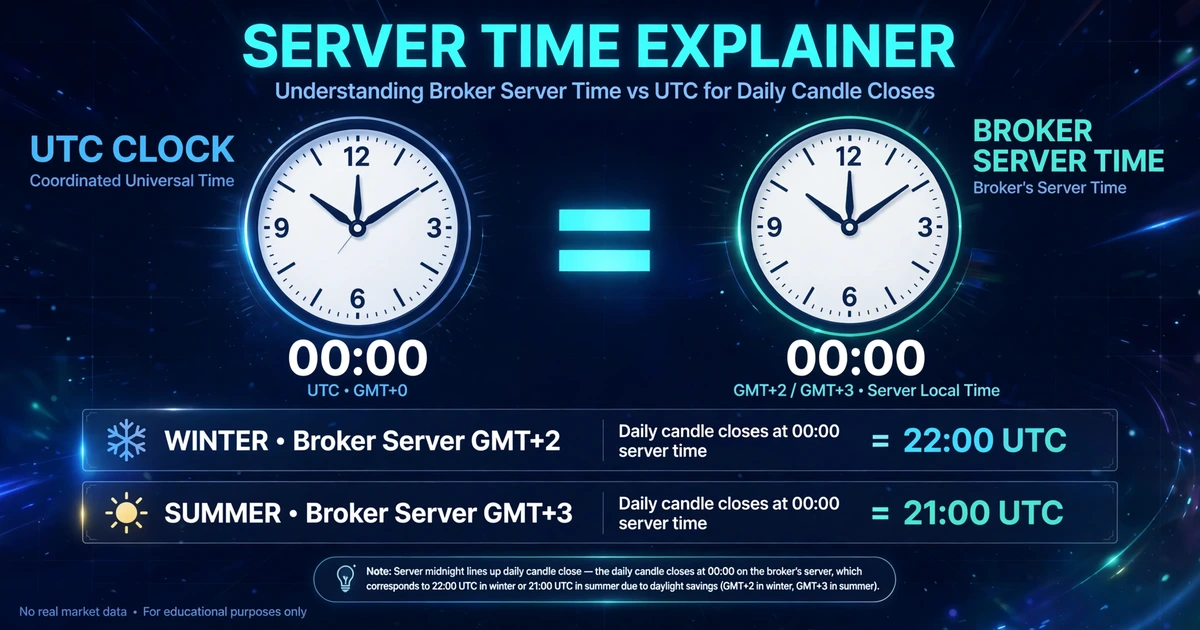
Many trading platforms display broker server time, not UTC or your local time. A common setup is GMT+2 in winter and GMT+3 in summer, chosen so that the New York close lines up with midnight on the chart. That way a “day” candle covers a full trading day.
Under that setup:
- 22:00 UTC (winter close) shows as 00:00 server time.
- 21:00 UTC (summer close) also shows as 00:00 server time.
Brokers vary, though, and some use other offsets. The server time setting is usually listed in your platform’s market watch or in your broker’s help pages. Find it before you plan around the weekly open or close.
Reading the Week’s Boundaries From Mumbai
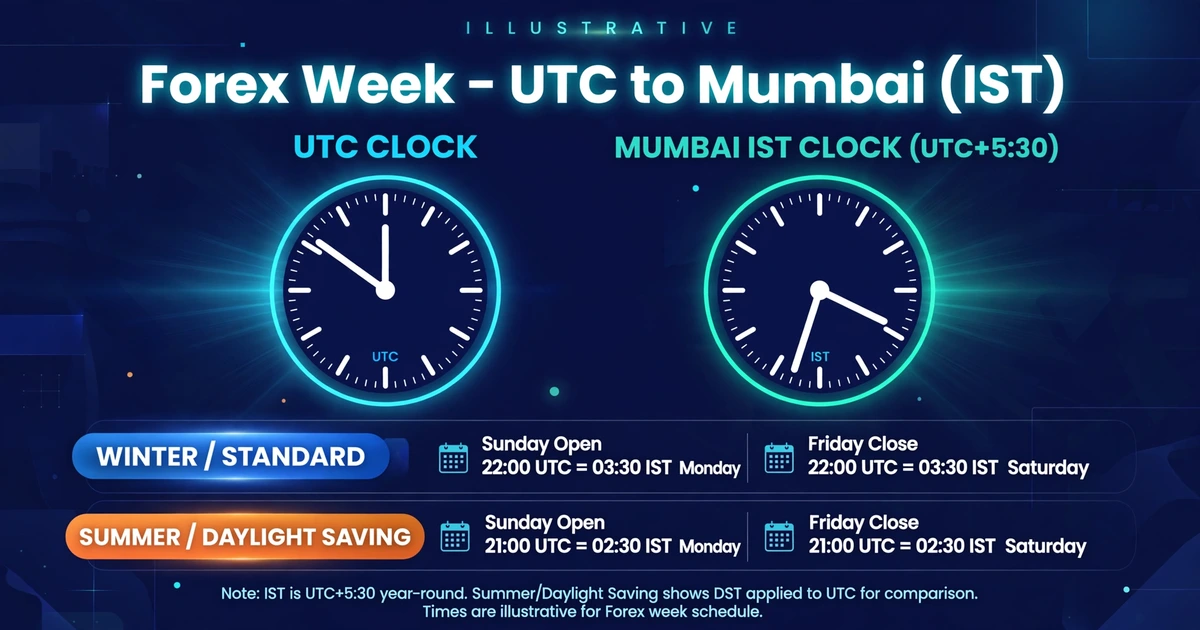
Suppose a trader lives in Mumbai, which is UTC+5:30 and doesn’t observe daylight saving. The weekly boundaries land like this:
| US period | Open (UTC) | Open in Mumbai | Close (UTC) | Close in Mumbai |
|---|---|---|---|---|
| Standard time | Sunday 22:00 | Monday 03:30 | Friday 22:00 | Saturday 03:30 |
| Daylight saving time | Sunday 21:00 | Monday 02:30 | Friday 21:00 | Saturday 02:30 |
The working week in Mumbai begins in the small hours of Monday and ends in the small hours of Saturday. The Mumbai clock never changes, but the weekly open and close slide by an hour twice a year.
This is a hypothetical example for illustration only.
Friday’s Last Hour and Sunday’s First Tick
Before the weekly close, activity usually fades. European traders have gone home, and New York has thinned out. Spreads (the gap between the buy and sell price) can widen as liquidity drops.
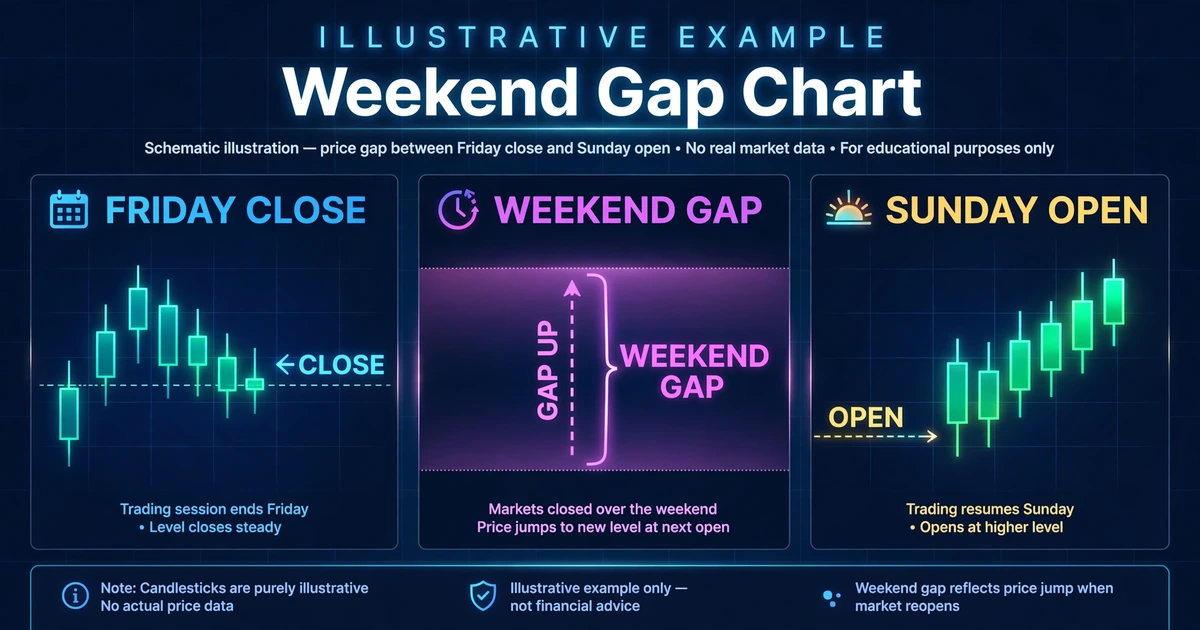
The Sunday open is often thin too. Dealers are returning, few participants are active, and quotes can be wider than usual for the first stretch. A gap is when the opening price differs from the previous close, with nothing traded in between. Weekend news can cause one, and a stop-loss order doesn’t prevent it. If the market opens beyond your stop, the order may fill at the first available price, which can be worse than the level you set.
The Daily Reset at 5 p.m. New York
The market doesn’t close at 5 p.m. New York time on weekdays, but a smaller reset happens then. This is the daily rollover: the moment brokers end one trading day and start the next.
Two things are worth knowing:
- Spreads can widen briefly. Many traders avoid placing, moving, or closing orders in the minutes around it.
- Swaps are applied. A swap is a small financing charge or credit for holding a position overnight. Many brokers apply three days’ worth on the Wednesday rollover to cover the weekend settlement, but practices differ, so check your broker’s terms.
Holidays and Half-Days: When the Market Stays Open but Thins Out
National holidays don’t close the entire forex market. They thin it. When a country is on holiday, banks there are closed, so trading in its currency can be quieter, and spreads can widen.
Some dates are known for lighter trading, including late December and the start of January. Some brokers also adjust their own hours or margin rules around holidays. Fees and hours vary by provider, so check your broker’s holiday notice before relying on a normal day.
Brokers That Quote on Weekends: Read the Fine Print
A few brokers offer weekend access to certain instruments, such as some crypto products or specific indices. That doesn’t mean the main forex market is open. Major currency pairs usually don’t have a normal liquid market while the large banks are closed.
If a broker offers weekend quotes, find out what the product is, who sets the price, what the spreads look like, and what the terms say about gaps. Those prices can behave differently from the weekday market.
Holding Through Friday’s Close: Checks Before You Log Off
Before you leave positions open over the weekend, run through a short list:
- Is your stop-loss in place? Remember that it can fill beyond your set price at a gap.
- How much margin do you have free? A gap against you can reduce it quickly.
- Is any major news due on Monday? Sometimes events scheduled just before the weekend can move prices at the open.
- What time does your broker close on Friday? Don’t assume.
- Do you need to hold at all? Many traders close before the weekend as a rule, and that’s a legitimate choice.
For a wider framework on position sizing and exposure, the forex risk management complete guide covers it.
Gaps, Weekend News, and Stops That Don’t Fill Where You Set Them
- Gap risk. Price at the Sunday open can differ sharply from Friday’s close, and your stop can fill at a worse price. Weekend events such as elections or political developments can contribute.
- Thin liquidity at both ends of the week. Late Friday and early Sunday often have wider spreads and larger slippage (the difference between the price you expected and the price you got).
- Rollover and holiday spreads. Widening spreads can trigger stops or distort fills for short-term traders.
- Broker differences. Closing times, holiday hours, and weekend rules vary by provider, and a mismatch between your plan and your broker’s actual schedule can cost money.
- Leverage. It magnifies gains and losses alike, so a gap against a leveraged position can cost more than the stop distance suggests. Some traders can lose all of their deposit.
Weekend Hours, Rollover, and Holidays: Short Replies
What time does the forex market open on Sunday?
Around 5 p.m. New York time, which is 22:00 UTC during US standard time and 21:00 UTC during US daylight saving time. In Sydney, it’s already Monday morning. Your broker’s platform may show a slightly different time, so check it before planning.
What time does the forex market close on Friday?
Around 5 p.m. New York time, or 22:00 UTC in US standard time and 21:00 UTC in daylight saving time. Liquidity often fades earlier in the day, and some brokers stop accepting certain orders shortly before the close.
Is the forex market open on Christmas and New Year’s Day?
The wider market doesn’t formally close for these holidays, but liquidity is usually much thinner, and some brokers adjust their hours. Spreads can widen, so check your provider’s holiday schedule in advance.
Why does the forex market close on weekends?
Because the banks and institutions that make up most of the market are closed. With no dealers at their desks in the major centers, there’s little to trade. It reopens when the next week begins in Asia-Pacific.
Does forex close every day?
Not on weekdays. A short reset around 5 p.m. New York time, called the daily rollover, can briefly widen spreads and apply swaps. Trading continues through it, though many traders avoid placing orders at that moment.
Set Two Alarms Before the Weekend
The week’s boundaries are simple once you anchor them to 5 p.m. New York: Friday close, Sunday open, and an hour of difference when the US changes its clocks. This week, put two calendar alerts in UTC, one an hour before the Friday close and one just after the Sunday open. Next to them, note your broker’s server time and its holiday hours, then compare what you see on the platform. A few minutes of setup prevents most surprises.
For the sessions that follow the open, forex trading sessions explained walks through each one in UTC.
Disclaimer
This article is for educational purposes only and is not financial advice. Forex and CFD trading involves a high level of risk, and you can lose some or all of your capital. Leverage can magnify both gains and losses. Never trade with money you can’t afford to lose.
Join now
Comments (0)
Be the first to comment.