

Forex Market Hours: The Full 24-Hour Schedule
A common beginner assumption is that “open 24 hours” means “equally active for 24 hours.” It doesn’t. Forex market hours are continuous on weekdays, but activity swings from near-silent to very busy depending on which financial centers are awake.
This schedule walks through the day in UTC, flags the scheduled moments that sit on the clock, shows how summer and winter time shift the edges, and ends with a way to build a trading window around a normal working day.
Where the Clock Is Busy, Quiet, and Closed
- Closed: from Friday evening to Sunday evening (around 5 p.m. New York time at each end).
- Busiest: the hours when London and New York are both open, typically early to mid-afternoon UTC.
- Quieter: late New York hours and the stretch before London opens, though yen, Australian, and New Zealand pairs often have their own activity then.
- Moving target: London and New York shift an hour in UTC when their clocks change, so memorize the logic, not just the numbers.
Read Every Time Below as UTC, and as a Convention
UTC (Coordinated Universal Time) doesn’t change with the seasons, which makes it the safest reference. The session hours below are the round-number conventions most traders use, not official exchange hours. Brokers, charts, and local clocks may differ, and each region’s edges move at different times of year.
For the exact weekly start and finish, the guide to when the forex market opens and closes pins down the Sunday and Friday boundaries.
Hour by Hour: One Day in Seven Blocks (UTC)
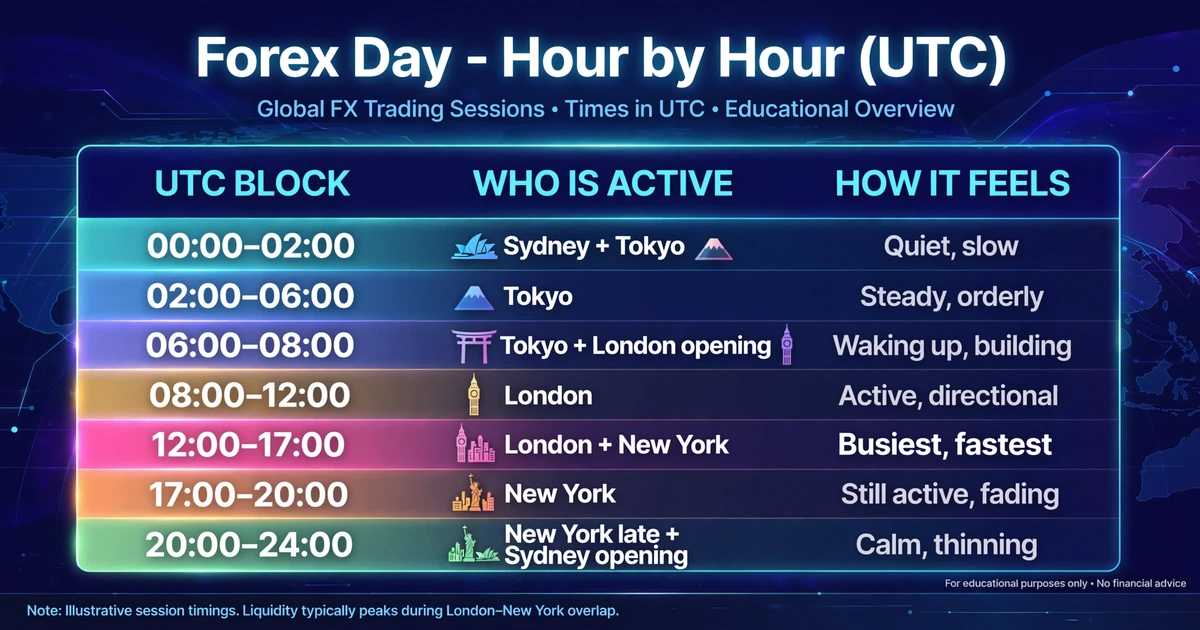
| UTC hours | Who’s active | What the stretch tends to feel like |
|---|---|---|
| 22:00–00:00 | Sydney opening; New York just finished | Thin, with wider spreads; the daily reset has just passed |
| 00:00–07:00 | Tokyo and Sydney | Asia-Pacific flow; yen, Aussie, and Kiwi pairs in focus; many European pairs quiet |
| 07:00–08:00 | Tokyo winding down; early European desks | Activity starts to build |
| 08:00–09:00 | London opens; Tokyo still open | A short overlap, sometimes with quick moves as Europe takes over |
| 09:00–13:00 | London on its own | Deep liquidity for euro, sterling, and Swiss franc pairs |
| 13:00–17:00 | London and New York | Often the busiest window of the day |
| 17:00–22:00 | New York on its own | Activity fades after London closes |
Those hours are a winter baseline, and the table is a rhythm, not a promise. Any block can produce a surprise.
The Hours Many Traders Circle
The London morning and the London–New York overlap draw the most attention because liquidity (how easily you can trade without moving the price) is typically deepest then, and spreads on major pairs are often tighter. Traders who want a per-session breakdown can read the guide to the four major forex sessions.
The Hours Many Traders Avoid
Late New York and the first hours after the weekly open tend to be thin. Spreads (the gap between the buy and sell price) can widen, and a modest order can push price further than expected. Some traders also stay out of the minutes around the 5 p.m. New York rollover, when spreads often widen briefly.
Scheduled Moments That Sit on the Clock
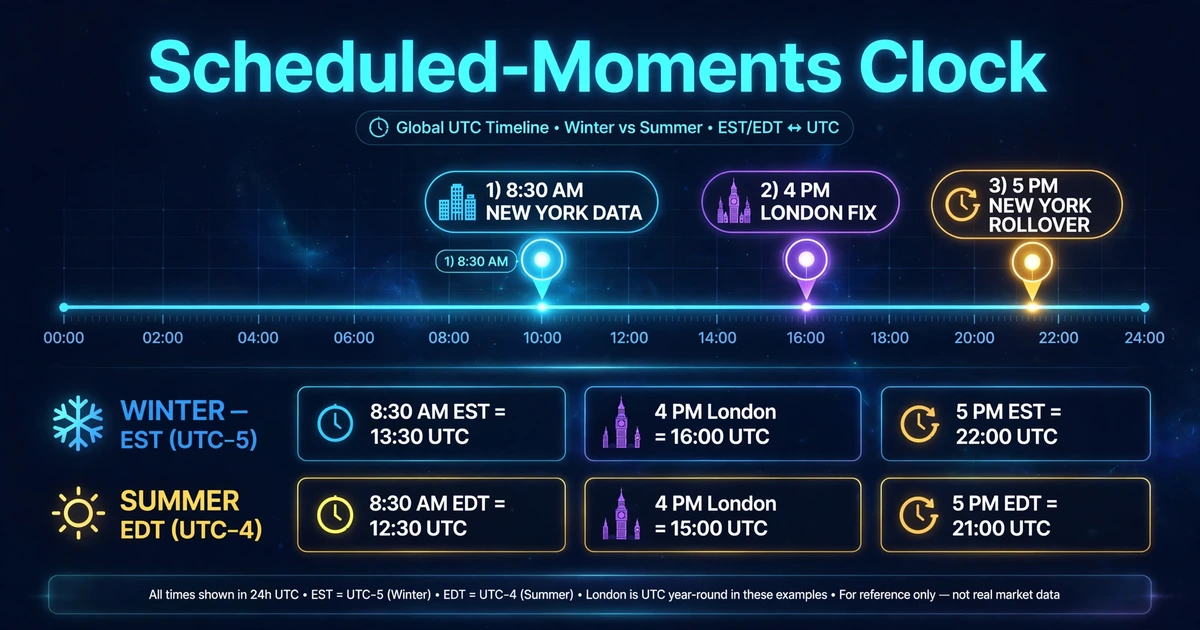
Some events follow local time, so their UTC hour moves with daylight saving:
| Moment | Local time | UTC in winter | UTC in summer |
|---|---|---|---|
| Major US data (such as employment) | 8:30 a.m. New York | 13:30 | 12:30 |
| London afternoon benchmark fix, often cited by traders | 4:00 p.m. London | 16:00 | 15:00 |
| Daily rollover and weekly boundary | 5:00 p.m. New York | 22:00 | 21:00 |
“Winter” and “summer” here mean UK and US standard and daylight time. Not every market-moving release has a fixed time, so check an economic calendar for the week. Central bank decisions, in particular, are posted by their own schedules.
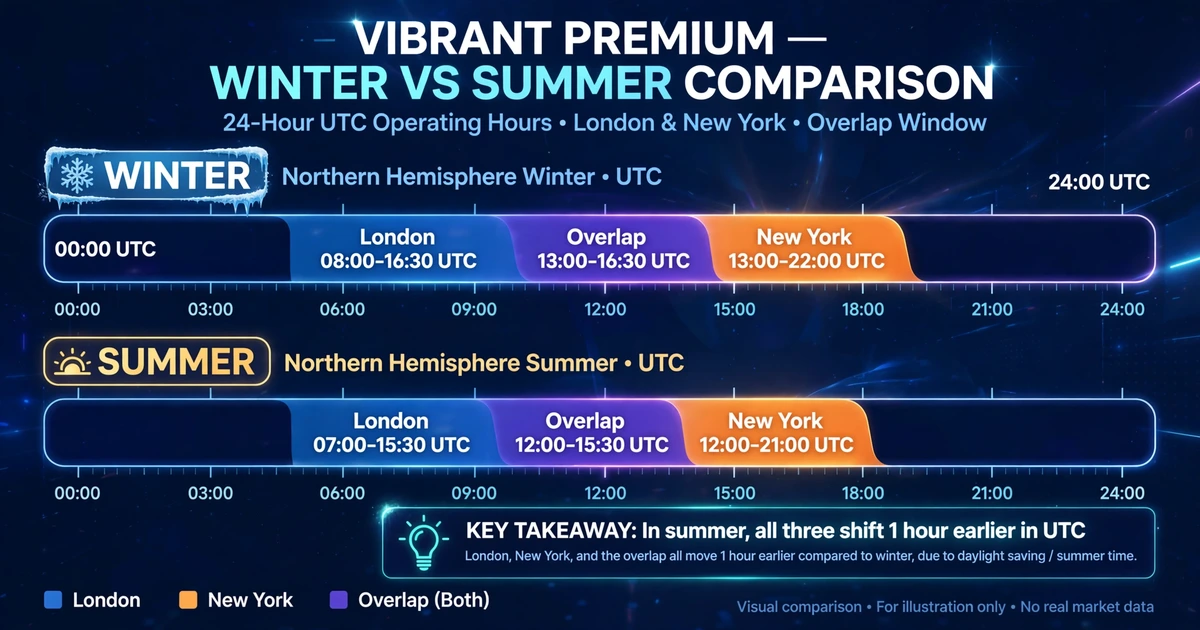
Summer Hours and Winter Hours: The Edges That Move
The numbers shift because regions change their clocks on different dates. Tokyo and most of Asia don’t change at all.
| Session | Winter (UK/US standard time) | Summer (UK/US daylight time) |
|---|---|---|
| Tokyo | 00:00–09:00 | 00:00–09:00 |
| London | 08:00–17:00 | 07:00–16:00 |
| New York | 13:00–22:00 | 12:00–21:00 |
| London–New York overlap | 13:00–17:00 | 12:00–16:00 |
Sydney moves too, but on the opposite season because Australia’s summer is the northern winter.
There’s one more wrinkle. The UK and US switch clocks on different weekends. For a few weeks in spring and again in the autumn, the London–New York overlap stretches to about five hours instead of four. If you trade the overlap, check the calendar around those weeks.
Finding Your Two Hours When Work Owns the Day
Here’s a hypothetical case. A trader in Lagos (UTC+1, no daylight saving) works 9 a.m. to 5 p.m. and wants a one- or two-hour window on weekdays. Here’s how three candidate windows land:
| Window | Lagos time | UTC | In winter | In summer |
|---|---|---|---|---|
| Early morning | 06:00–08:00 | 05:00–07:00 | Late Tokyo hours; Europe not open yet | Late Tokyo hours; London opens at 07:00 |
| Lunch break | 13:00–14:00 | 12:00–13:00 | London midday; New York not yet open | Inside the London–New York overlap |
| After work | 17:30–19:30 | 16:30–18:30 | Last 30 minutes of the overlap, then New York alone | New York alone, after London has closed |
The Lagos clock stays the same all year, but the same hour means something different depending on the season. The lunch hour is a pre-overlap period in winter and a busy overlap hour in summer. The after-work window is quieter in summer.
The takeaway isn’t that one window is right. It’s that a fixed local schedule will drift against the market twice a year, and your plan should expect that.
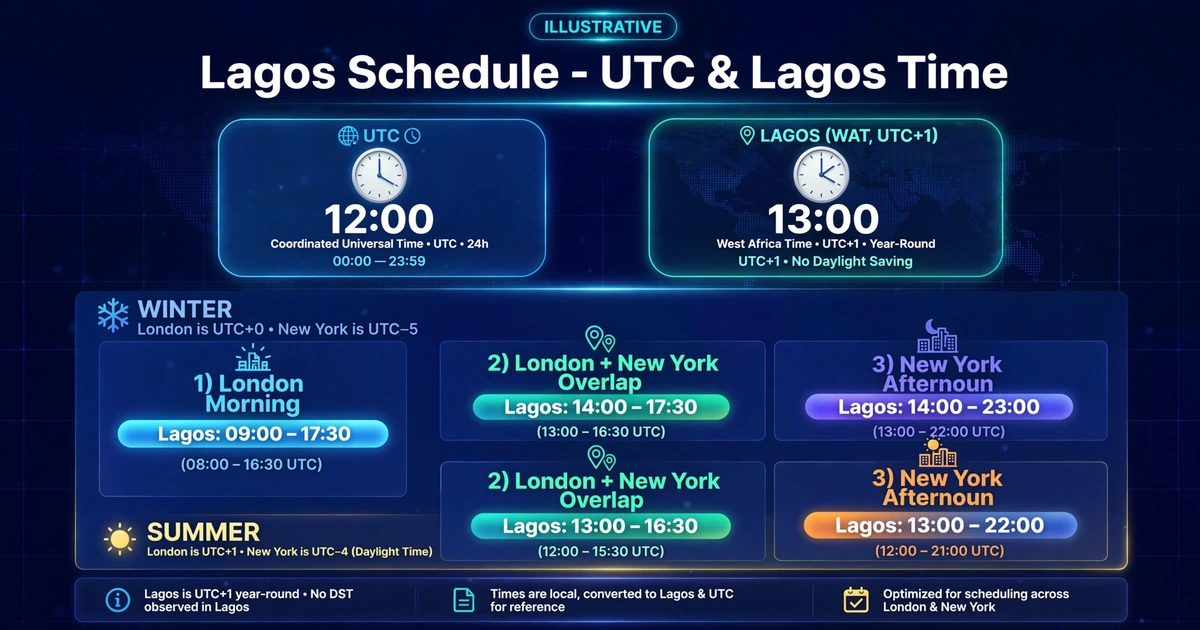
This is a hypothetical example for illustration only.
Pairs Follow Their Home Clocks, Not Yours
A pair’s activity follows the business hours of the countries behind its currencies. Yen and Australian dollar pairs tend to be more active in Asia-Pacific hours. Euro and sterling pairs tend to peak during the London morning, and dollar pairs are most active when New York is open. The guide to major, minor, and exotic currency pairs shows which currencies sit on each side.
Picking a window that matches your pair matters more than picking a window that matches a headline “best time.”
Time-Zone Slips Behind Wrong Entries
- Reading a chart in broker server time and thinking it’s UTC. Many platforms use a server offset such as GMT+2 or GMT+3. Check yours.
- Forgetting that US and UK clock changes happen on different dates. For a few weeks, your usual overlap hours are off by an hour.
- Assuming local news times stay fixed in UTC. An 8:30 a.m. New York release moves from 13:30 to 12:30 UTC in summer.
- Planning around Tokyo or Sydney without checking the season. Sydney’s edges move on the opposite schedule from London and New York.
- Treating a schedule as permanent. Review your windows after each clock change and write the new UTC times down.
If you’re still deciding how much time you can give trading, how to choose your trading style starts from your available hours.
What Hour-Based Thinking Can’t Protect You From
Knowing the clock doesn’t remove the risks tied to it:
- Busy doesn’t mean safe. Overlap hours can deliver fast moves that hit stops, and slippage (the difference between the price you expected and the price you got) can be larger around news.
- Thin hours widen spreads. A tight stop in a quiet window can get triggered by the spread alone.
- Rollover and gaps. Spreads can widen around 5 p.m. New York, and price at the Sunday open can differ from Friday’s close. A stop-loss can fill beyond your set price.
- Pattern drift. A tendency that held for a few weeks may stop holding. Treat any “this hour usually does X” idea as something to test, not a rule.
- Leverage. It magnifies gains and losses alike, and a fast move in a leveraged position can cost more than planned. Some traders can lose their entire deposit.
What Traders Ask When the Clock Confuses Them
What are the forex market hours in UTC?
The market opens Sunday around 22:00 UTC during US standard time (21:00 in US daylight time) and closes Friday at the same hour. Between those times it trades continuously, with activity shifting from Sydney to Tokyo to London to New York.
Is forex really open 24 hours a day?
On weekdays, yes. It runs continuously from the Sunday evening open to the Friday evening close in UTC, though activity varies a lot by hour. It’s closed on weekends.
Which hours are the busiest?
The London–New York overlap, roughly 13:00–17:00 UTC in winter and 12:00–16:00 in summer, is typically the busiest window for major pairs. Activity varies by pair and changes over time.
How does daylight saving change forex market hours?
It moves the UTC hours of London, New York, and Sydney by an hour in their summer periods. Tokyo doesn’t change. The local business hours stay the same, so the UTC schedule slides.
Can I trade forex on the weekend?
The main market is closed. Some brokers quote certain instruments at weekends, but those prices can behave differently, so read the terms and check what’s being quoted.
Print the Clock, Then Trim It to Your Hours
The 24-hour schedule is useful as a map, but nobody trades all of it. Write down your own two-hour window in UTC, then check it against the winter and summer tables above. For the next two weeks, note in a journal what the spread and typical candle size looked like during that window. That record will tell you more about your pair than any list of “good hours.”
Disclaimer
This article is for educational purposes only and is not financial advice. Forex and CFD trading involves a high level of risk, and you can lose some or all of your capital. Leverage can magnify both gains and losses. Never trade with money you can’t afford to lose.
Join now

Comments (0)
Be the first to comment.