

Why Gold Is Considered a Safe-Haven Asset
In many families, gold is what you hold when you don’t trust anything else: coins in a drawer, bangles passed down, a bar bought after a bank scare. Traders inherit that instinct, which is why “safe haven” appears in nearly every gold headline. Understanding why gold is considered a safe-haven asset means looking at a few specific properties: what it is, who owes you nothing, and who keeps buying it. It also means reading the label carefully. A haven describes a role gold has played in some crises, not a promise that its price will hold up.
Four Reasons Investors Reach for Gold in Stress
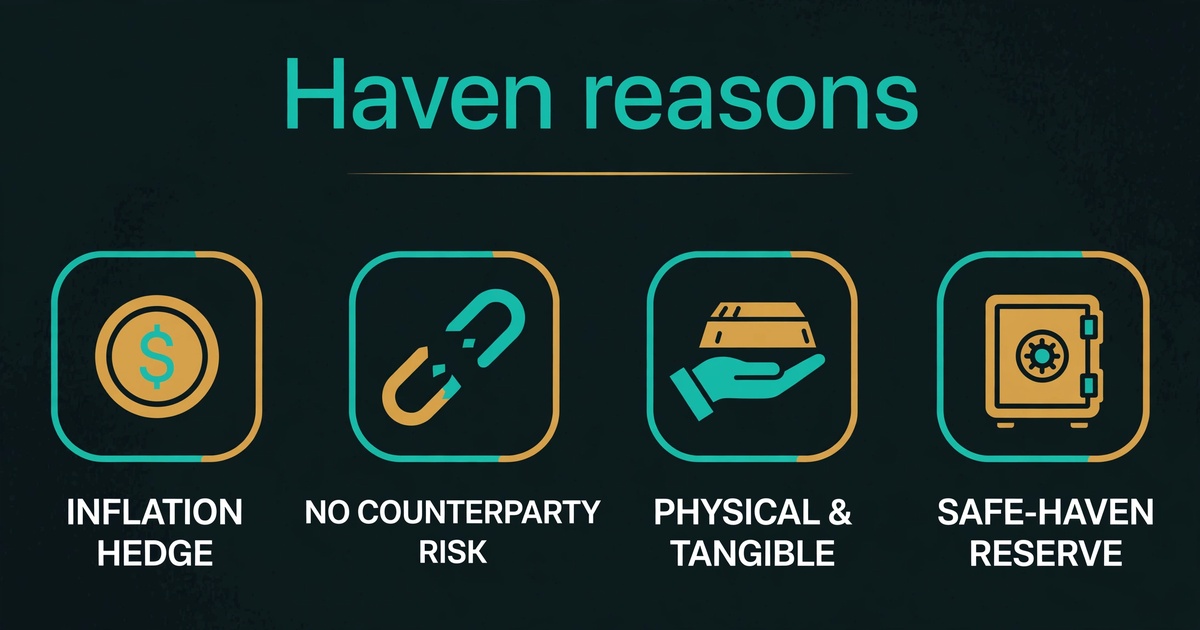
- It’s an old form of money. Gold has been trusted as a store of value across centuries and cultures.
- It isn’t anyone’s debt. Physical gold doesn’t depend on a company’s solvency or a government’s promise.
- Its supply is hard to expand. No central bank can create more of it by policy.
- Large holders keep it. Central banks hold it in reserves, which reinforces its standing.
None of this guarantees a rising price. It explains why people consider gold when other assets look shaky.
Metal Money: A Store of Value Older Than Any Currency
Gold was used as money long before paper currency existed, and for a long stretch of modern history, currencies were tied to it. The last formal link between the US dollar and gold ended in 1971. Today no major currency is backed by gold, but the habit of treating it as money of last resort stayed.
That history matters because markets are partly psychology. When enough people believe something will be accepted anywhere, in any currency, and by anyone, that belief keeps demand alive. Gold benefits from centuries of it.
No One Owes You Payment: Gold Without Counterparty Risk
A stock depends on a company continuing to earn. A bond depends on its issuer repaying. A bank deposit depends on the bank. These are all claims on someone else, and in a crisis the “someone” can fail.
A gold bar in your possession is nobody’s liability, so its value doesn’t depend on a promise being kept. That’s the core of the haven argument.
The catch is that most traders don’t hold bars. They hold other things:
- Gold funds and certificates: These carry structure, custody, and issuer risks.
- Gold CFDs: You’re trading a contract with your broker, which adds counterparty risk. This is why broker regulation and client money protection matter, and rules vary by country.
- Physical gold: It has storage, insurance, and wide buying and selling spreads.
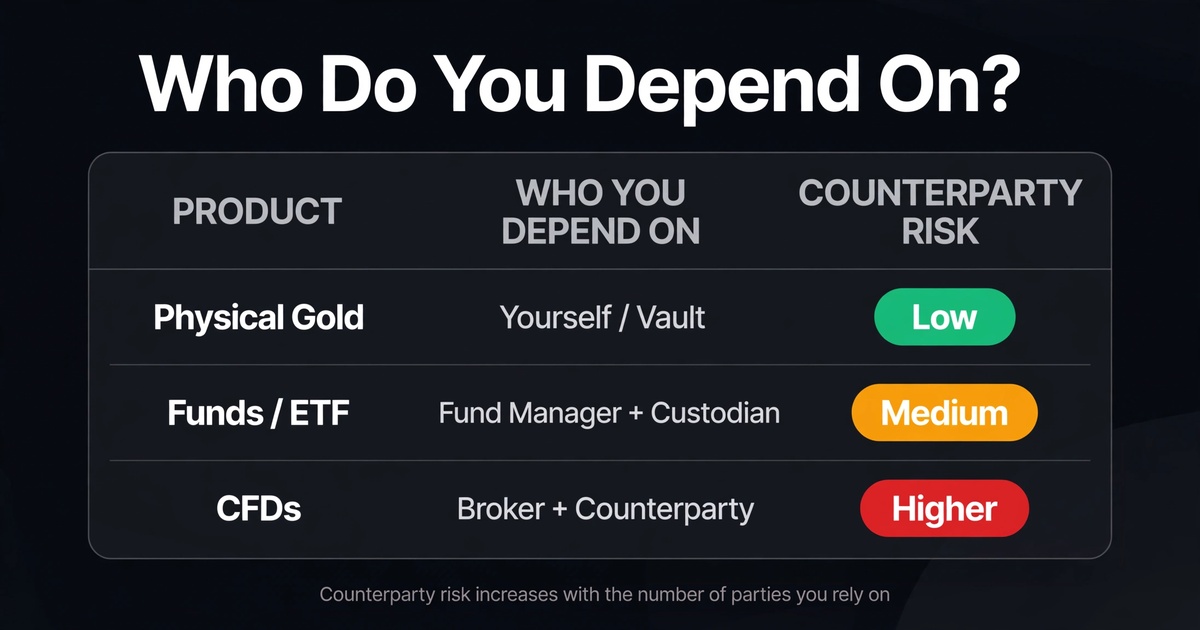
So gold’s no-issuer feature applies cleanly only to the metal itself.
A Supply Curve No Central Bank Can Expand
Governments can expand the supply of their currencies. They can’t print gold. New mining adds only a small amount compared with the metal already above ground, and mines take years to open.
When people worry that money is being created faster than the economy grows, scarcity becomes appealing. That’s the logic behind the idea that gold protects purchasing power over long periods.
Scarcity alone doesn’t set the price, though. Plenty of scarce things have no buyers. Gold’s price comes from demand meeting limited supply, and demand moves with fear, interest rates, and other forces. Those drivers are laid out in what moves the price of gold.
Haven, Hedge, Diversifier: Three Jobs People Blur Together
“Safe haven” gets used loosely. It can mean three different things:
| Role | The claim | The reality |
|---|---|---|
| Crisis haven | Gold rises when markets panic | True in some episodes, not all |
| Inflation hedge | Gold keeps purchasing power over long periods | Works unevenly, and can lag for years |
| Diversifier | Gold often doesn’t move with stocks | Correlations change and can turn positive |
Gold doesn’t do all three reliably. A trader expecting a crisis hedge may buy it for an inflation story that hasn’t started, or the reverse.
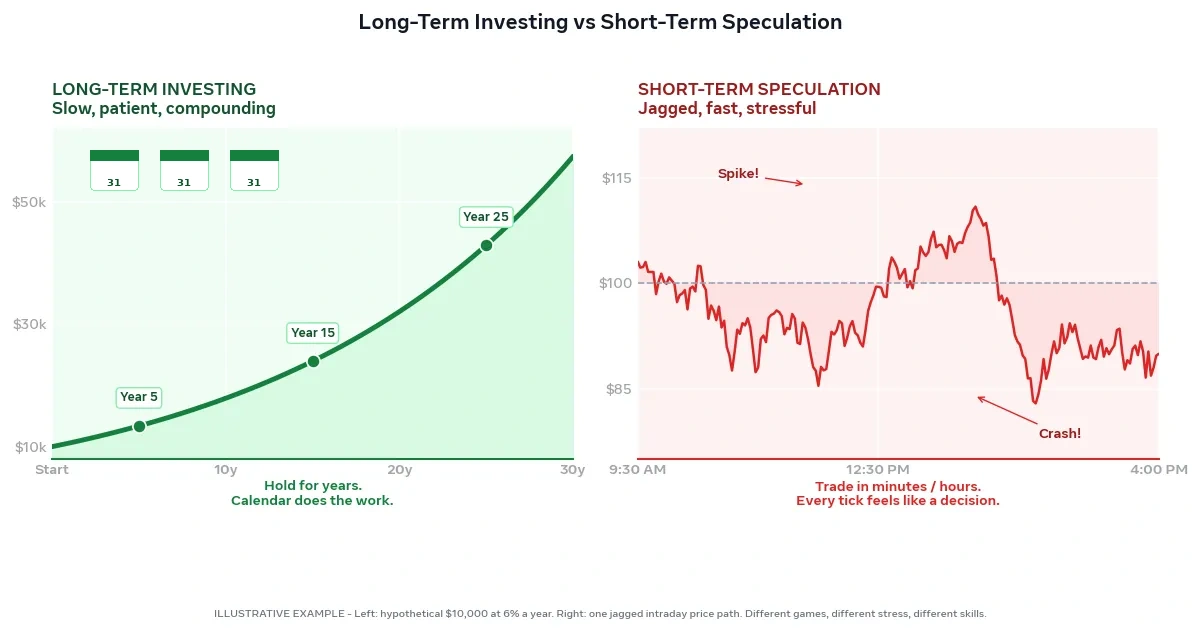
It also helps to separate gold’s role as a long-term holding from its role as a short-term trading instrument. The first is about preservation. The second is about volatility, and gold is volatile.
A $50,000 Portfolio in a Bad Year: Gold’s Cushion in Numbers
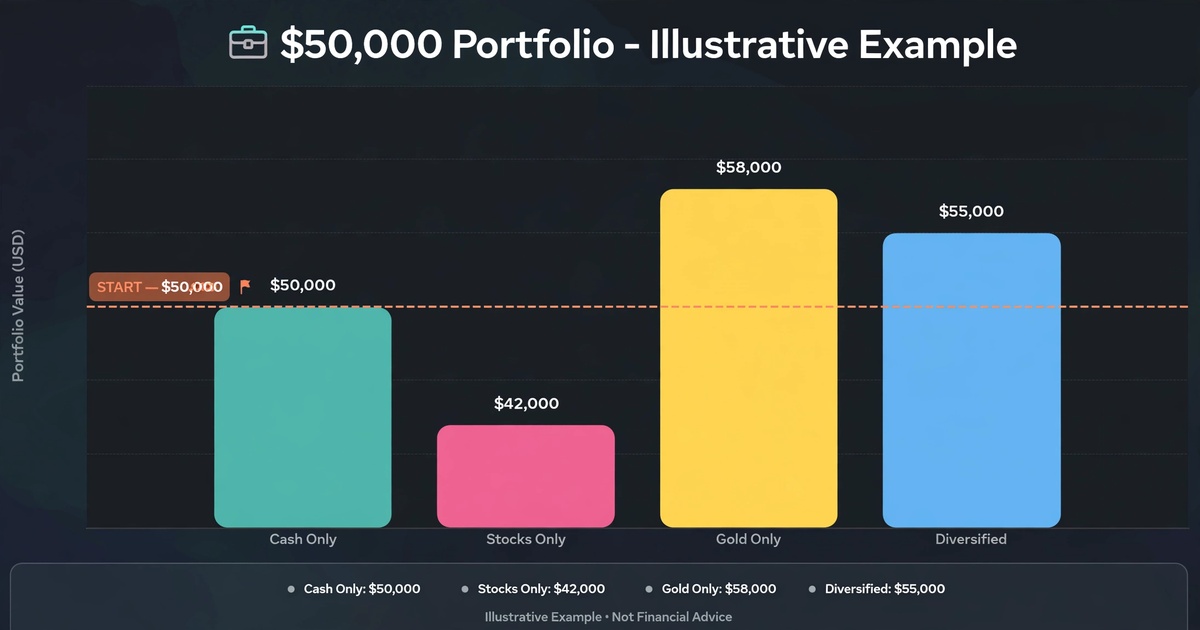
Here’s what a haven can and can’t do. All numbers are invented.
Imagine a $50,000 portfolio: 90% in stocks ($45,000) and 10% in gold ($5,000). In a bad year, stocks fall 20%, so the stock slice drops by $9,000 to $36,000. Compare it with holding only stocks, under three outcomes for gold:
| Scenario | Gold slice | Stock slice | Total | Change |
|---|---|---|---|---|
| No gold, all stocks | n/a | $40,000 | $40,000 | −20.0% |
| Gold rises 10% | $5,500 | $36,000 | $41,500 | −17.0% |
| Gold flat | $5,000 | $36,000 | $41,000 | −18.0% |
| Gold falls 25% | $3,750 | $36,000 | $39,750 | −20.5% |
When gold rises, it softens the damage. When it’s flat, it dilutes the stock loss a little. When it falls hard, the “haven” makes the year worse than holding stocks alone.
This is a hypothetical example for illustration only. It isn’t a recommended allocation, and the right mix depends entirely on your own situation.
When the Haven Leaks: Long Droughts and Sudden Sell-Offs
Gold’s record has gaps:
- Decades-long stretches without gains. After peaking in early 1980, gold’s price didn’t recover that level in nominal terms for well over two decades.
- Initial-panic selling. In some episodes, including the 2008 and 2020 shocks, gold sold off alongside other assets as investors raised cash, and recovered afterward.
- Interest rate pressure. Gold pays no income, so rising real yields can drain demand even in a crisis. How interest rates affect gold covers why the opportunity cost matters so much.
- Crowded fear. If everyone already owns the haven, the news that was supposed to lift it may not.
The pattern is that gold tends to perform best when fear is paired with falling real yields or a weakening currency, and worst when fear arrives with rising yields.
How Currency Traders Read Haven Demand
For forex traders, haven demand shows up across several charts at once. XAU/USD is the obvious one, but traders also watch the Japanese yen and Swiss franc, which have often been treated as havens too, along with the US dollar itself. These haven reputations also shift over time.
Because gold is priced in dollars, a dollar surge in a panic can offset gold’s haven bid. That’s why the pair can look odd when fear is high. The interaction is covered in the guide on the gold and US dollar relationship.
A useful habit is to compare gold with stock index futures and bond yields during stress, rather than treating the haven story as settled. Gold may be rising because of fear, or because the dollar fell, or because yields dropped. The cause changes what to expect next.
Misconceptions That Make Gold Look Safer Than It Is
- “Safe haven means safe price.” Gold can fall 10% in a few weeks, and CFD leverage makes that worse.
- “It always rises when stocks fall.” The table above shows a case where it doesn’t.
- “It’s immune to central banks.” Rate policy is one of its biggest drivers.
- “Holding the metal removes all risk.” Storage, theft, and wide dealer spreads remain.
- “A haven rally is a buy signal.” By the time headlines call gold a haven, much of the move may be done.
The Ways a Gold Haven Position Can Lose Money
- Price risk: Gold’s long droughts mean that holding it for safety can still mean years of flat or negative returns.
- Leverage: Trading gold through CFDs amplifies both gains and losses, and you can lose some or all of your capital.
- Spread and slippage: Spreads widen sharply during crises, exactly when haven demand is strongest. Stops can fill well away from your price.
- Wrong driver: Buying gold for fear while real yields rise can leave you holding the wrong thesis.
- Counterparty risk: Funds, certificates, and CFDs add layers that the metal itself doesn’t have.
- Opportunity cost: Gold pays no income, so what you give up while waiting can be large.
- Timing: The haven bid can fade within days even if the original worry remains.
What Beginners Ask About Gold as a Safe Haven
Is gold safe to hold during a crisis?
It’s relatively resilient in some crises, but “safe” overstates it. Gold’s price can fall sharply, including during initial market panics, and it can underperform for years. It’s better described as an asset with haven characteristics than as a place where capital is protected.
Does gold always go up when stocks crash?
No. In some downturns gold has risen. In others it fell with stocks, usually when investors needed cash or when interest rates were climbing. Its relationship with stocks changes across periods, so no single pattern can be assumed.
Is gold a good inflation hedge?
Partly, and over long periods. Over shorter windows, gold and inflation often move out of step, because interest rates and the dollar can outweigh inflation. Many traders describe gold as an imperfect, slow-acting inflation hedge, not a precise one.
What other assets are called safe havens?
Traders often cite high-quality government bonds, the Swiss franc, the Japanese yen, and at times the US dollar. The label shifts with conditions. An asset that acted as a haven in one episode may not in the next.
Can I trade gold as a haven through a forex broker?
Many brokers offer gold as XAU/USD CFDs, but that’s a leveraged trading contract, not ownership of the metal. Losses can exceed what you expect. Product availability and rules differ by country, so check your local regulator.
A Haven Is a Role, Not a Guarantee
Gold earns its reputation from scarcity, history, and the fact that it isn’t anyone’s debt, but its price still answers to yields, the dollar, and positioning. Over the next month, pick the day the stock market falls the most and note in your journal what gold, the dollar, and Treasury yields did that same day. A handful of those entries will tell you more about gold’s haven behavior than any headline. When you’re ready to look at the chart itself, gold trading for beginners (XAU/USD) is the natural next read.
Disclaimer
This article is for educational purposes only and is not financial advice. Forex and CFD trading involves a high level of risk, and you can lose some or all of your capital. Leverage can magnify both gains and losses. Never trade with money you can’t afford to lose.
Any percentages or figures shown are historical averages or hypothetical examples, not guarantees. Past performance does not predict future results.
Join now
Comments (0)
Be the first to comment.