
How Interest Rates Affect Gold Prices
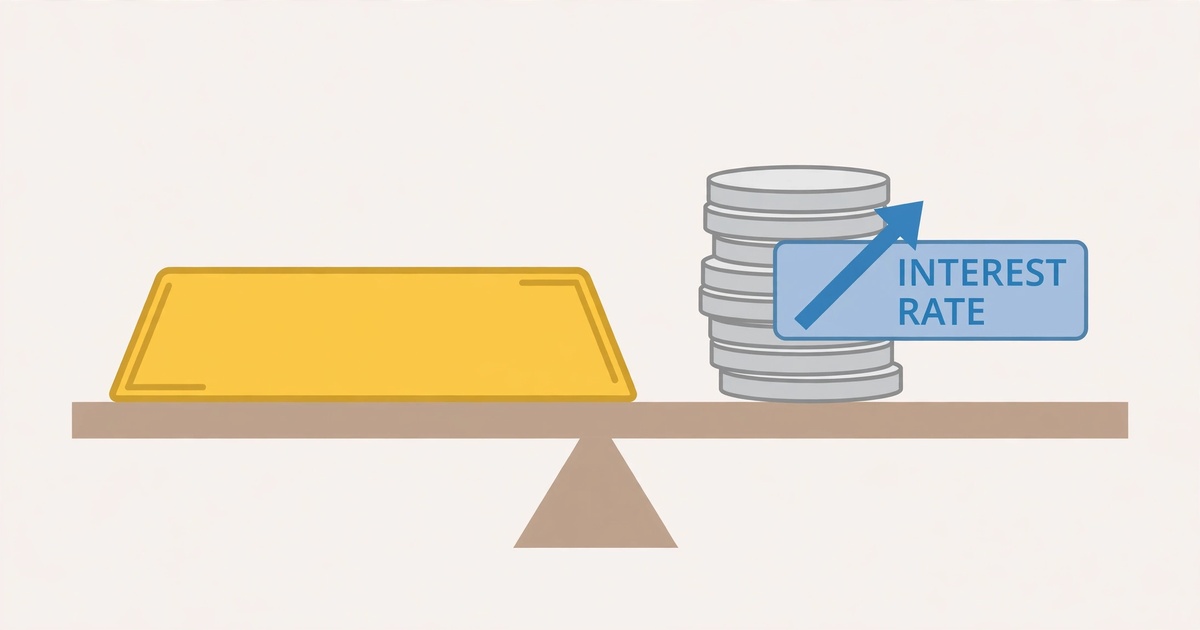
A central bank raises rates and gold falls, exactly as the textbook says. Two months later it raises again and gold rallies. Neither result is a puzzle once you separate the rate itself from what traders expected and what inflation is doing. How interest rates affect gold prices comes down to opportunity cost: gold pays no interest, so the more cash and bonds pay, the more it costs to wait in gold. But the link runs through expectations, inflation, and the dollar, and it fails often enough that trading it as a one-line rule gets expensive.
Higher Rates, Lower Gold: The Rule and Its Fine Print
- The core idea: Higher rates make interest-paying assets more attractive and gold relatively less so, which has historically tended to weigh on its price.
- The better measure: Gold responds more to real yields (yield minus inflation) than to the headline rate.
- The timing trap: Markets move on expectations, so the rate decision often matters less than the surprise around it.
- The exception: Rates, inflation, fear, and the dollar can pull in different directions, and gold has sometimes held firm during hiking cycles.
Forgone Interest: The Hidden Cost of Owning Gold
Imagine holding one ounce of gold worth $2,000. If a safe short-term government bill pays 5% a year, then keeping that $2,000 in bills would earn about $100. At a 2% yield, the same money would earn $40. Gold pays nothing in either case.
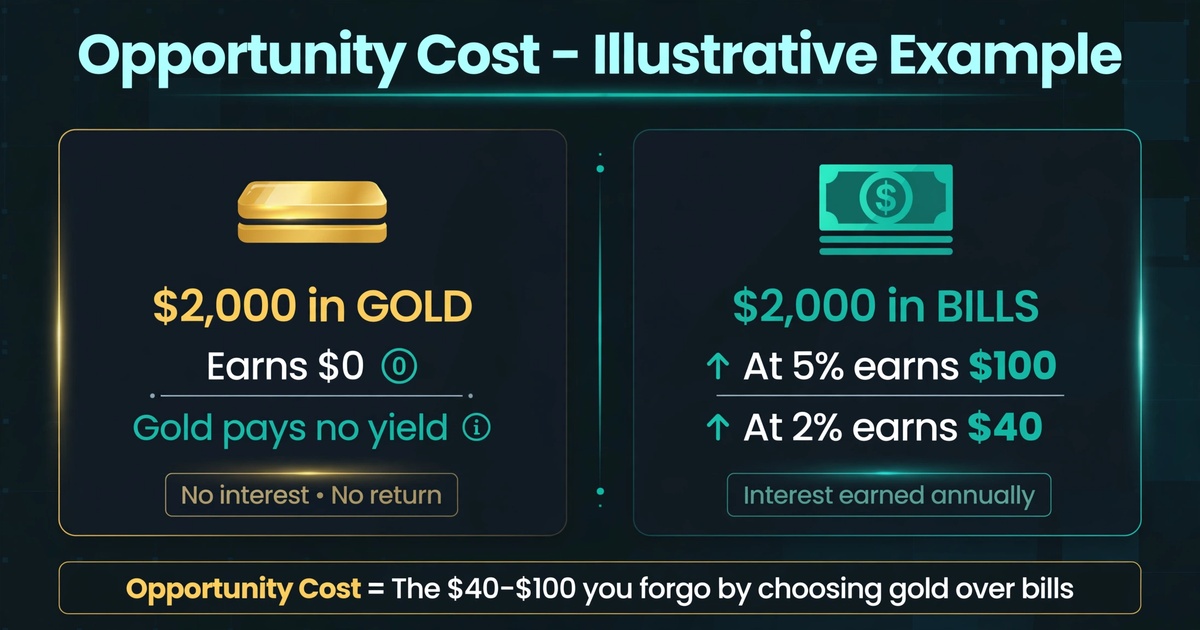
That $60 difference per year (3% of the gold’s value) is the extra cost of waiting in gold when rates are higher. It’s called opportunity cost: the income you give up by choosing one asset over another.
Large investors compare these figures constantly. When bonds pay little, giving up that income is cheap. When they pay a lot, gold has to offer something else, such as inflation protection or crisis cover, to justify holding it.
Take these figures as a hypothetical illustration only, since actual yields and prices change daily.
Nominal Rate, Inflation, Real Yield: Three Cases Side by Side
A 5% rate sounds high until inflation is 6%. That’s why traders look at real yields, calculated as the nominal yield minus expected inflation. Here are three invented cases:
| Case | 10-year nominal yield | Expected inflation | Real yield | Typical read for gold |
|---|---|---|---|---|
| A | 4.5% | 2.0% | 2.5% | Headwind: bonds pay well after inflation |
| B | 4.5% | 3.5% | 1.0% | Milder headwind |
| C | 3.0% | 3.5% | −0.5% | Tailwind: bonds lose to inflation |
Case B shows the usual trap. The nominal rate is the same as in A, yet the pressure on gold is far less, because inflation expectations absorbed most of the yield.
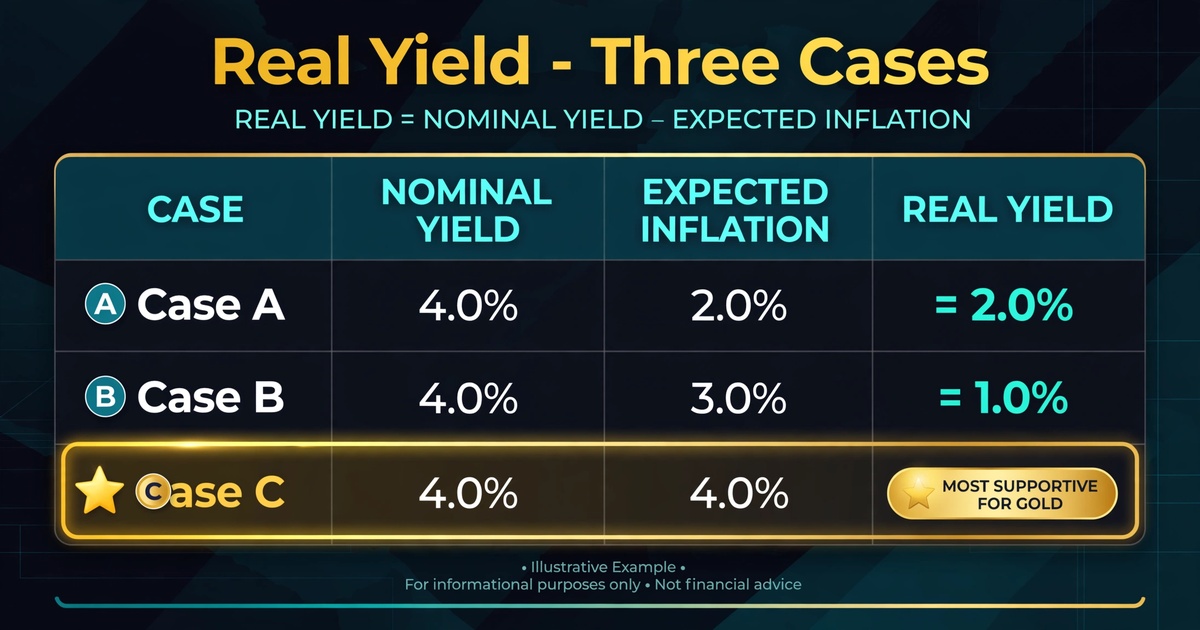
This is a hypothetical example for illustration only.
In the broader set of forces behind gold, covered in what moves the price of gold, real yields sit near the top for this reason. Real yields also aren’t directly observable. They’re estimates that depend on how inflation expectations are measured.
Rate Hikes Versus Rate Expectations: What Gold Reacts To
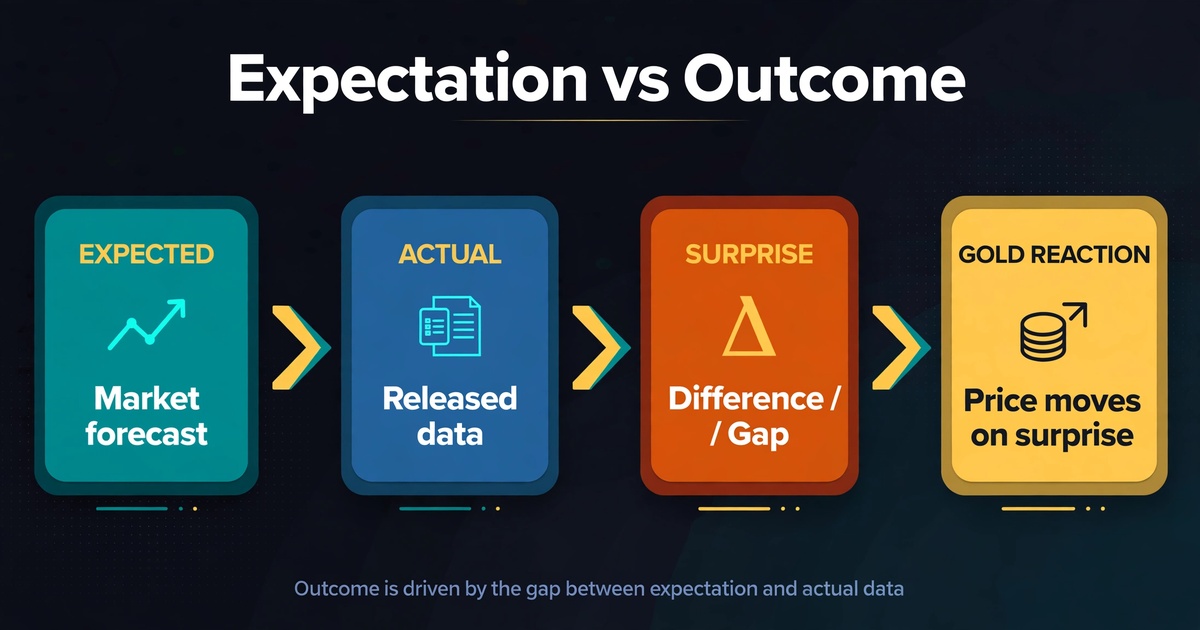
Markets look ahead. If a central bank is widely expected to raise rates by 0.25 percentage points and does exactly that, gold may barely react, because the move was already built into prices.
What moves gold is the gap between expectation and outcome:
- A bigger hike than expected, or a more hawkish tone: Rate expectations rise, and gold often drops.
- A smaller move, or a softer tone: Expectations fall, and gold often rises.
- An as-expected decision with new guidance: The guidance often matters more than the decision.
This is why gold can fall on a rate cut. If traders expected a bigger cut, the smaller one reads as hawkish in context.
Many traders follow rate-futures pricing from major exchanges, which shows what the market expects, and compare the actual decision against it.
Currency Route: How Rate Gaps Reach XAU/USD
Interest rates affect gold a second way, through the dollar. When US rates rise relative to other countries, dollar assets pay more, which can attract capital and strengthen the dollar. A stronger dollar tends to press on gold because gold is priced in dollars.
On the XAU/USD chart, you see both effects at once: the opportunity cost story and the currency story. They usually point the same direction, which can make rate moves look more dramatic than either force alone. When they split, such as rising yields with a falling dollar, price can chop.
The currency side of the story is covered in more depth in the guide on the gold and US dollar relationship.
When a Rate Cut Fails to Lift Gold
It’s tempting to say “cuts are good for gold,” but the reason for the cut matters:
- Cuts because inflation is cooling: Real yields may stay high, so gold’s benefit can be small.
- Cuts because the economy is weakening: Gold may gain if the cut reduces real yields or revives fear, though weak growth can also drag risk assets and trigger cash raising.
- Cuts in a crisis: Gold may get a haven bid, but it isn’t guaranteed. The reasons behind that are discussed in why gold is considered a safe-haven asset.
- Cuts already priced in: There may be little left to push gold higher.
Hiking works the same way in reverse. History offers a stark case: gold peaked in early 1980 and then fell for years as the US Federal Reserve pushed real rates sharply higher. Yet in some more recent periods, gold held up or rose during rate increases, with strong central bank buying among the reasons commonly cited. The relationship is real but not mechanical.
Reading the Rate Path: Meetings, Guidance, and Timing
Traders focus on a few things around central bank decisions:
- The statement: Changes in wording from the previous meeting often move price first.
- The press conference: It typically follows shortly after and can reverse the first reaction.
- Forward guidance: Hints about the future path of rates.
- Inflation data between meetings: These set the expectations the next decision is judged against.
US Federal Reserve statements are typically released at 2:00 p.m. New York time, which is 19:00 UTC in winter and 18:00 UTC in summer. Clock changes in the US and elsewhere happen on different dates, so offsets shift briefly each year. Check a current schedule rather than relying on a fixed conversion.
A Hypothetical Long Position Through a Rate Decision
All figures here are invented. Suppose a trader with an $8,000 account holds 0.05 lot of XAU/USD, which is 5 ounces if the contract is 100 ounces per lot (contract sizes vary by broker). Gold is near $2,000. The trader’s stop is $15 below entry, a planned risk of $15 × 5 = $75, or about 0.9% of the account.
A central bank holds rates, as expected. But the statement hints at fewer future cuts. Rate expectations rise, and gold drops sharply within minutes. Spreads widen, and the stop fills $21 below entry instead of $15.
- Actual loss: $21 × 5 = $105
- That’s about 1.3% of the account, versus the planned 0.9%
- The difference is slippage
This is a hypothetical example for illustration only.
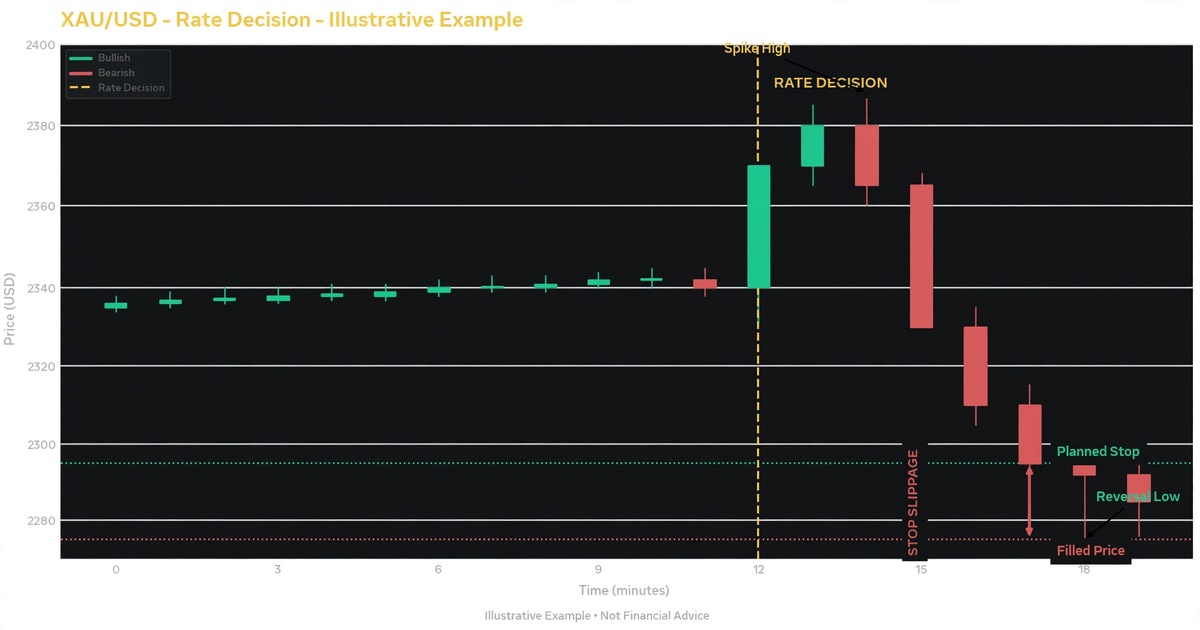
The lesson isn’t that the trader misjudged the decision, because the decision matched expectations. It’s that the guidance changed the picture, and the stop didn’t protect the planned amount. Many traders choose to avoid holding positions through major decisions for exactly this reason.
Overnight Costs on a Gold CFD
If you trade gold through a CFD, interest rates reach you directly as well. Holding a position overnight usually incurs a financing charge or credit called a swap, which is linked to benchmark rates plus the broker’s markup. When rates are higher, holding a long gold CFD tends to cost more.
Swap rates vary by broker and change over time, and they’re often tripled on one weekday to cover the weekend. For a position held a few days, this is usually minor next to price moves. For positions held for weeks, it adds up, so check your platform’s published rates before assuming holding costs are negligible.
Shortcuts That Misread the Rate Story
- “Rates up, gold down” as a fixed rule. It’s a tendency, and it has failed for months at a time.
- Trading the decision instead of the surprise. An as-expected outcome often moves little.
- Using nominal yields without inflation. Case B showed how that misleads.
- Treating every cut as bullish. The reason for the cut changes the outcome.
- Ignoring the dollar. A rate-driven move may be mostly a currency move.
- Reacting to the first two minutes. The press conference can reverse the initial move.
Costs and Hazards of Trading Gold Around Rate Decisions
- Slippage and spreads: Both can widen sharply at decision time, and stops may not fill where you set them.
- Volatility whipsaws: Price can spike one way, then reverse within the same hour.
- Leverage: CFD leverage multiplies both gains and losses, and you can lose some or all of your deposit.
- Unstable relationships: Gold’s link to yields can break for long stretches, as recent years have shown.
- Estimated inputs: Real yields depend on inflation expectations that can’t be measured exactly.
- Financing drag: Swap costs rise with rates and compound on longer holds.
- Overconfidence from a clean story: The tidy “rates explain gold” narrative is often built after the move.
Interest Rate and Gold Questions Traders Search For
Do rising interest rates always push gold down?
No. Higher rates raise the opportunity cost of holding gold, which tends to weigh on it, but other forces can offset that. Strong central bank buying, fear, or rising inflation expectations have at times kept gold firm or lifted it during hiking cycles. Treat rates as one major driver among several.
Why does gold sometimes rise when rates are cut?
A cut can reduce real yields and weaken the dollar, both of which tend to help gold. It can also signal economic worry that boosts haven demand. But if the cut was expected or the economy looks fine, the effect may be small.
What is the real interest rate and why does it matter for gold?
It’s the nominal yield minus expected inflation. It matters because gold pays no income, so what bonds pay after inflation is the true comparison. Negative real yields have historically favored gold, while high positive ones have tended to weigh on it.
Does gold react to the Fed only?
No, though US policy gets the most attention because gold trades in dollars and the Fed influences global yields. Decisions from other major central banks can also move gold, mainly through the dollar and global yield levels.
Should I trade gold during interest rate announcements?
That depends on your risk tolerance, and many traders choose to stay out. Spreads widen, slippage is common, and the first reaction can reverse quickly. If you test it, do it on a demo account first to see how your platform behaves.
Watch the Expectation, Not the Headline
The takeaway is that gold responds less to the rate itself than to what the rate means for real yields, the dollar, and the path ahead. At the next central bank decision, write three lines in your journal before the release: what the market expects, what actually happened, and how gold moved in the first 30 minutes. A few of those entries will teach you more than any rule of thumb. When you’re ready to apply this to the chart, gold trading for beginners (XAU/USD) is the logical next read.
Disclaimer
This article is for educational purposes only and is not financial advice. Forex and CFD trading involves a high level of risk, and you can lose some or all of your capital. Leverage can magnify both gains and losses. Never trade with money you can’t afford to lose.
Any percentages or figures shown are historical averages or hypothetical examples, not guarantees. Past performance does not predict future results.
Join now
Comments (0)
Be the first to comment.