
Why Most Traders Fail: The Psychology Behind Losses
Many regulated brokers are required to publish a warning that a large share of retail clients lose money trading CFDs. The exact percentage varies by provider and period, and it usually sits in small print that few people read. If you came here to learn why most traders fail, the answer isn’t one fatal flaw. It’s a stack of small, predictable decisions: risking too much, expecting too much too soon, and abandoning rules at the exact moment they matter. This guide separates the psychological causes from the structural ones, so you can tell what’s fixable and what’s simply the cost of a difficult activity.
Failure Is a Stack, and Psychology Sits in the Middle
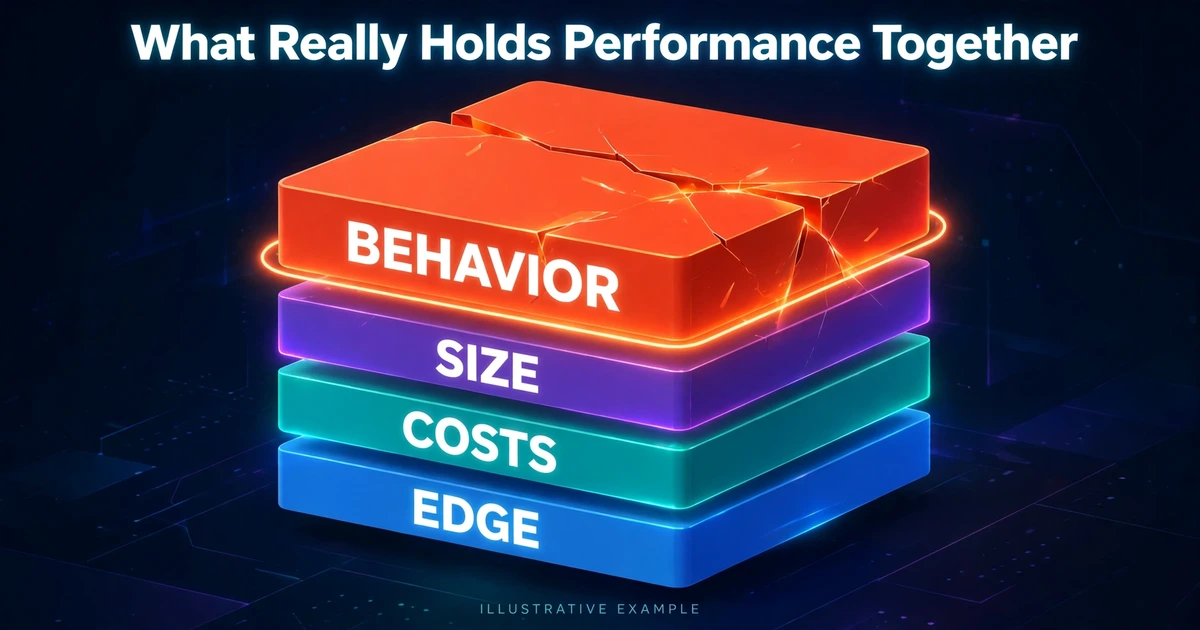
- Most retail losses come from several problems layered together: no tested edge, trading costs, oversized positions, and behavior under stress.
- Psychology rarely causes a loss by itself. It’s the layer that turns an ordinary losing streak into an account-ending one.
- The common thread is breaking rules you wrote while calm.
- The most dependable defenses are structural: small fixed risk, written rules, loss limits, and honest review.
What the Risk Warnings Are Telling You
A risk warning isn’t a verdict on your intelligence. It’s a base-rate reminder: leveraged trading is a zero-sum-minus-costs activity, meaning every trade also pays spread and sometimes commission, so the average participant is working against a small, constant headwind.
Two further things distort what you see online:
- Survivorship bias. Traders who blew up their accounts rarely post about it. The visible sample skews toward winners, which makes success look more common and more replicable than it is.
- Short samples. A handful of winning weeks looks like skill. Over small samples, luck and skill are almost impossible to separate.
No honest source can give you a precise “failure rate” that applies to you. What you can control is how many of the known failure points you leave open.
Four Layers Beneath a Blown Account
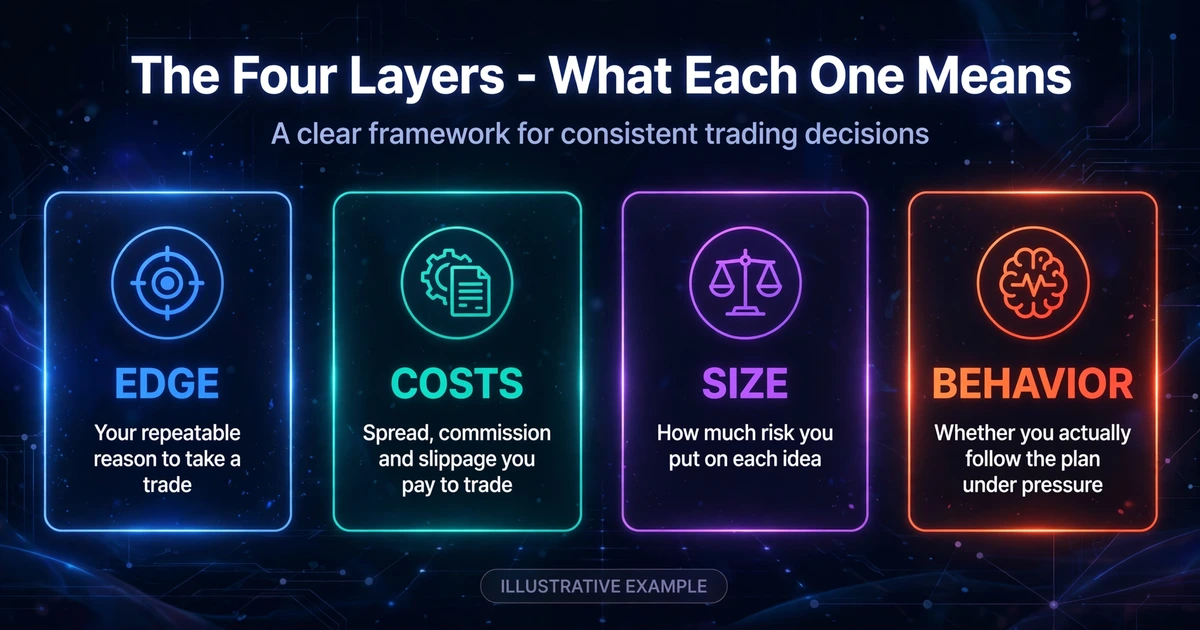
Layer one: no verified edge. An edge is a repeatable reason your trades should win more, or lose less, than they cost you. Many beginners trade indicators or patterns they’ve never tested, so there’s nothing to follow faithfully.
Layer two: costs. The spread is the gap between the buy and sell price, and it’s paid on every trade. Add commission and swap (an overnight financing charge) and a strategy with a thin edge can turn negative.
Layer three: size. Position size is how much you risk on a trade. It’s the single most common mechanical way to lose everything quickly, and the one most tied to emotion. The forex risk management guide covers sizing methods in detail.
Layer four: behavior. Fear, hope, and frustration decide whether you follow your plan on the trade that counts. If you want the foundations of how mindset and a plan interact, start with trading psychology explained.
Fixing only one layer rarely works. A calm trader with oversized positions still fails, and so does a well-sized trader with no edge.
Expecting Fast Results From a Slow Skill
Most people try trading with a small account and a big hope. The math is unforgiving: a $500 account earning a realistic return produces small dollar amounts, which feels unsatisfying, so beginners increase size or leverage to make the numbers feel worthwhile. Leverage is borrowed buying power, and it magnifies losses just as much as gains.
That mismatch of a skill that develops slowly and expectations that develop quickly drives some of the worst decisions: skipping a demo period, risking large amounts on early trades, and judging a strategy after ten outcomes.
A sturdier mindset treats the first stretch as tuition. Capital preservation matters more than growth at the start, a point explored in why risk management matters more than strategy.
Ten Straight Losses at 5% Risk: A Hypothetical Account
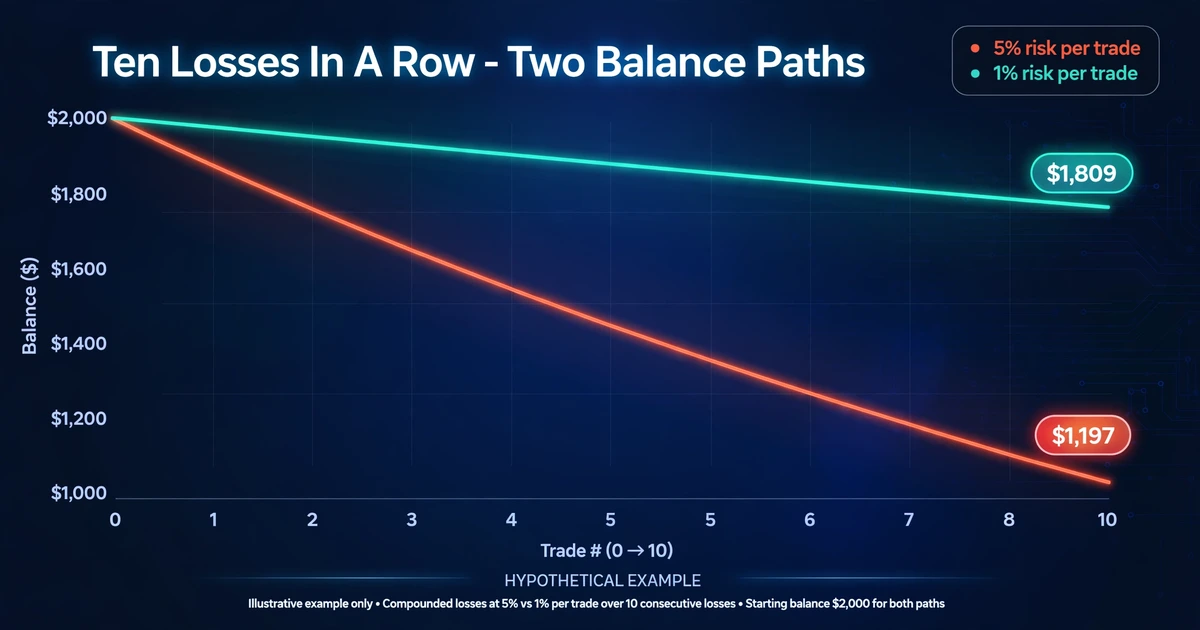
Assume a $2,000 account where every trade risks a fixed percentage of the current balance. Ten consecutive stop-outs is an unlucky run, but it can happen to any approach that doesn’t win every trade. This is a hypothetical example for illustration only.
| Risk per trade | Balance after 10 losses | Drop from start | Gain needed to recover |
|---|---|---|---|
| 5% | about $1,197 | about 40.1% | about 67.0% |
| 1% | about $1,809 | about 9.6% | about 10.6% |
The math: 0.95¹⁰ ≈ 0.5987 and 0.99¹⁰ ≈ 0.9044, so $2,000 becomes roughly $1,197 versus $1,809. Recovery is steeper than the loss because the gain is measured against a smaller balance.
The trader at 5% faces a long climb and a strong temptation to take bigger risks to shorten it. The trader at 1% faces a rough patch. Same strategy, same bad luck, very different psychological position.
Beliefs That Keep Beginners Stuck
The gambler’s fallacy. “I’ve lost four in a row, so a win is due.” Each trade’s outcome doesn’t owe you anything. A losing streak says nothing reliable about the next trade.
Overconfidence after a hot streak. A few wins can feel like mastery, so risk creeps up. Then ordinary variance returns while your position size is at its highest.
Confirmation bias. Once you hold a view, you notice the candles that support it and dismiss the ones that don’t. Charts have enough ambiguity to justify almost any story.
Sunk-cost thinking. “I’ve held this loser too long to close it now.” The market doesn’t care how long you’ve been in a trade; the only question is whether you’d enter it today.
The illusion of control. Staring at a chart longer or adding another indicator can feel like control without improving the decision. Often it just produces more reasons to deviate from the plan.
Anatomy of a Spiral: From One Loss to a Blown Account
Many blown accounts follow a recognizable arc rather than a single bad trade:
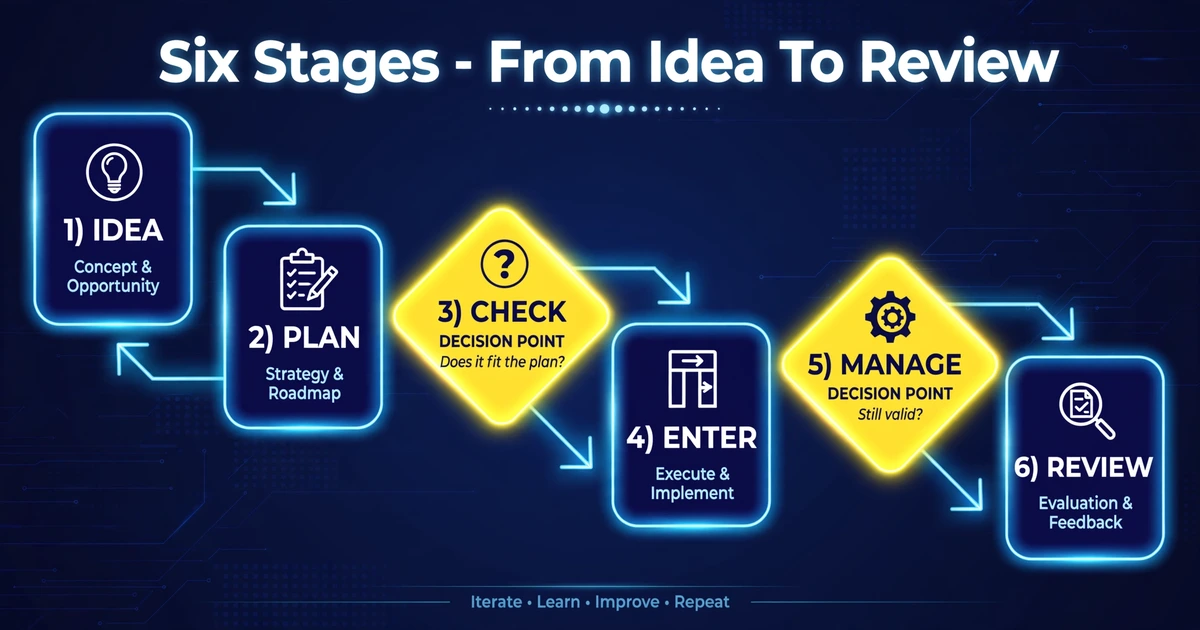
- A loss within the rules. Annoying but normal.
- Hope. The next trade is taken slightly larger or less carefully “to even things out.”
- A second loss, now outside the plan. The loss feels personal.
- Denial. A stop is moved or removed, because closing it would make the loss real. Stops can help limit losses, but only if they’re left in place, and even then a gap can fill you beyond your level.
- Chasing. Size jumps, setups loosen, and the original strategy is no longer being traded.
- Capitulation. A large loss ends the account or the trader’s confidence.
Looking back, steps 2 through 5 are decisions, not market events. That’s encouraging, because decisions can be constrained by rules written in advance.
Outside Voices That Pull You Off Your Plan
Signal groups, social media feeds, and polished “guru” marketing push in a consistent direction: faster, bigger, more certain. Screenshots show outcomes without showing risk, position size, or the losses that came before. A plan you trust is hard to follow when a stranger’s highlight reel makes it feel slow.
The same applies to automated systems marketed with strong performance claims. Past results, including backtests, don’t guarantee future performance, and what you see online is rarely verifiable.
What Traders Who Last Tend to Do Differently
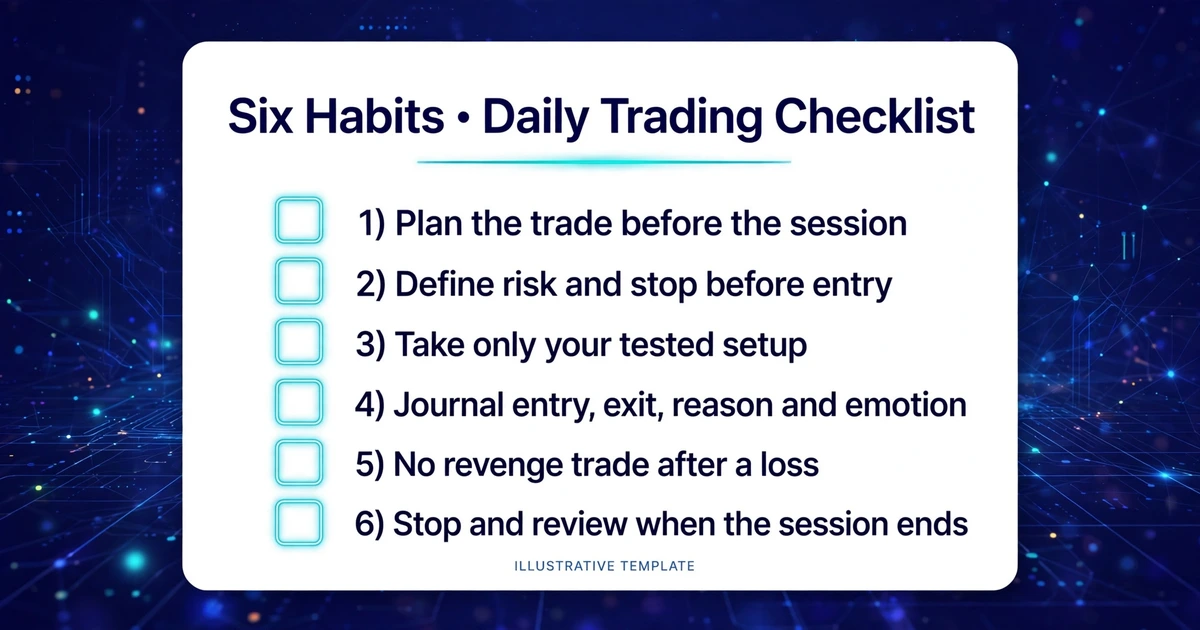
There’s no secret here, and no guarantee that any habit leads to profit, but widely taught practices have a recognizable theme: making failure survivable.
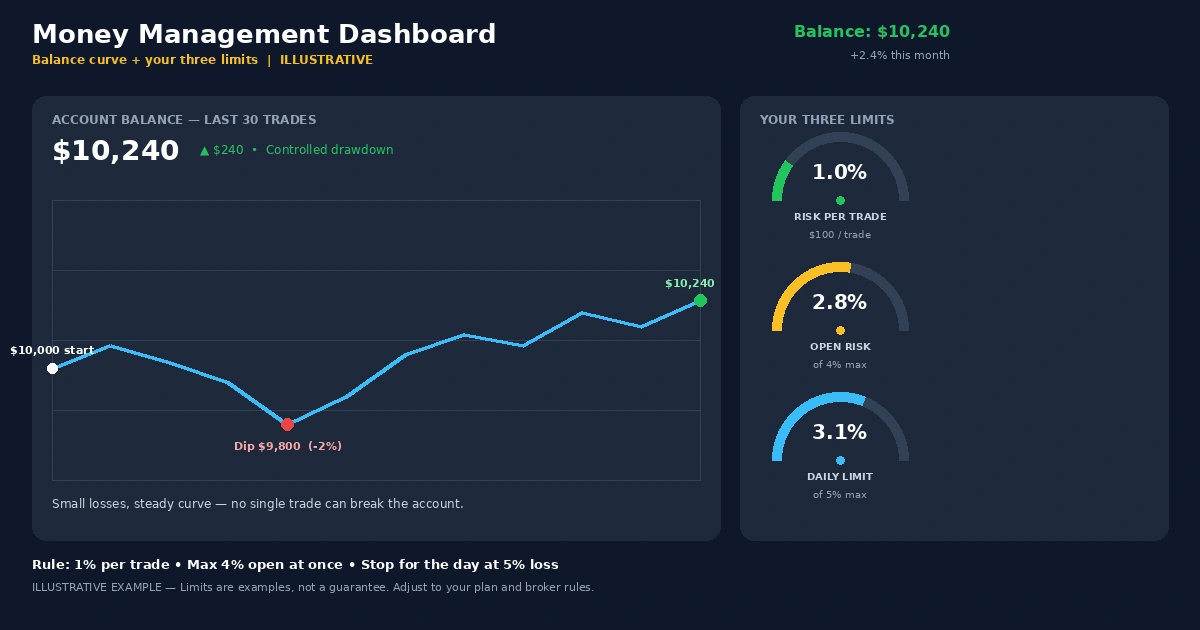
- Risk a small, fixed amount per trade so a streak is an inconvenience, not a crisis.
- Write rules down before the session and treat deviations as data to review.
- Keep a journal that records what you did and how you felt.
- Judge yourself by rule adherence across many trades, not by one result.
- Use money you can afford to lose, kept separate from bills and emergencies.
- Practice on a demo account until following your rules is routine, then start live with small size.
Honest Limits: Habits Reduce Damage, They Don’t Remove Loss
Good psychology improves your odds of staying in the game. It doesn’t convert trading into a reliable income source.
- Discipline can’t create an edge. A flawed plan followed perfectly still loses.
- Costs are constant. Spread, commission, and swap work against you whether you win or lose.
- Gaps and slippage. Price can jump past your stop, particularly around news, so your actual loss can exceed your planned one.
- Leverage cuts both ways. Traders can lose some or all of the money they deposit.
- Time and attention. Learning takes longer than most people expect, and results vary widely with market conditions, execution, and experience.
When Money You Can’t Spare Is on the Chart
Leveraged trading may not suit you if the capital is needed for rent, debts, or emergencies, if you’re trading to recover a loss from elsewhere, or if you feel you “must” win. Pressure like that guarantees poor decisions.
If losses are affecting your sleep, mood, relationships, or sense of self-worth, pause trading and consider talking with a qualified professional. This article is educational and isn’t a substitute for mental health support.
Reader Doubts About Losing Streaks and Staying in the Game
What percentage of traders lose money?
There isn’t one reliable number. Many regulated brokers publish a share of retail accounts that lose money on CFDs, and it varies by provider, region, and time period. Treat those figures as a reminder of the odds rather than a prediction about you. Check the current disclosure from any provider you consider.
Is trading failure mostly psychological?
Partly. Psychology often determines whether a flawed situation becomes a catastrophic one, but it’s rarely the only cause. Lack of a tested edge, trading costs, and oversized positions all contribute. Fixing behavior helps most when the underlying plan and risk size are already sound.
Can a beginner avoid losing money?
No one can promise that. Losses are a normal part of trading, even for experienced traders. What a beginner can influence is how large the losses get: small fixed risk, demo practice first, and rules written in advance can help limit damage while skills develop.
Why do traders blow up accounts so fast?
Usually through position size. Risking a large percentage per trade means a short losing streak removes a big part of the balance, and the pressure to recover pushes size even higher. Because losses compound against a shrinking balance, accounts can fall faster than traders expect.
Should I stop trading after a big loss?
A pause is often reasonable. Review the trade against your plan to see whether it was a rule-following loss or a rule-breaking one, and don’t resume until you can state the lesson. If the loss involved money you need, consider stepping away and getting support.
Survive First, Improve Second
Failure in trading is usually a pile-up, not a single event, and the psychological layer decides how badly the pile-up hurts. Your next step: pull your last twenty trades, from demo or live, and label each one “followed my rules” or “broke my rules.” The ratio tells you where to focus. When you’re ready for a contrasting view, the psychology of a profitable trader shows what consistent process looks like in practice.
Disclaimer
This article is for educational purposes only and is not financial advice. Forex and CFD trading involves a high level of risk, and you can lose some or all of your capital. Leverage can magnify both gains and losses. Never trade with money you can’t afford to lose.
Any percentages or figures shown are historical averages or hypothetical examples, not guarantees. Past performance does not predict future results.
Join now
Comments (0)
Be the first to comment.